 LearnSportsBetting
Where Do Sports Odds Come From?
How oddsmakers use data, power ratings, sharp bettors, AI, and the vig to set and adjust sports betting odds in real time.

Where Do Sports Odds Come From?
Sports odds are numbers that show how likely an event is to happen and how much money you could win if you bet on it. They’re created by oddsmakers who use data, algorithms, and market trends. These odds are not just about predicting outcomes - they’re designed to balance bets and ensure sportsbooks make a profit.
Here’s how it works:
- Oddsmakers set initial betting lines based on team strength, player stats, and factors like weather or injuries.
- Sharp bettors (professionals) help refine these lines by betting early, which adjusts odds to more accurate levels.
- Sportsbooks build in a fee (vig) to ensure they profit no matter the result.
Odds also change as bets come in, especially when large bets from sharp bettors or breaking news (like injuries) affect expectations. Advanced tools like AI and machine learning now play a big role in calculating odds quickly and adjusting them in real time.
To make smart bets, you need to:
- Understand odds formats (American, decimal, fractional).
- Calculate implied probabilities to find value in bets.
- Compare odds across sportsbooks to get better payouts.
Odds reflect both the game’s reality and public betting behavior, making them a mix of math, market strategy, and psychology.
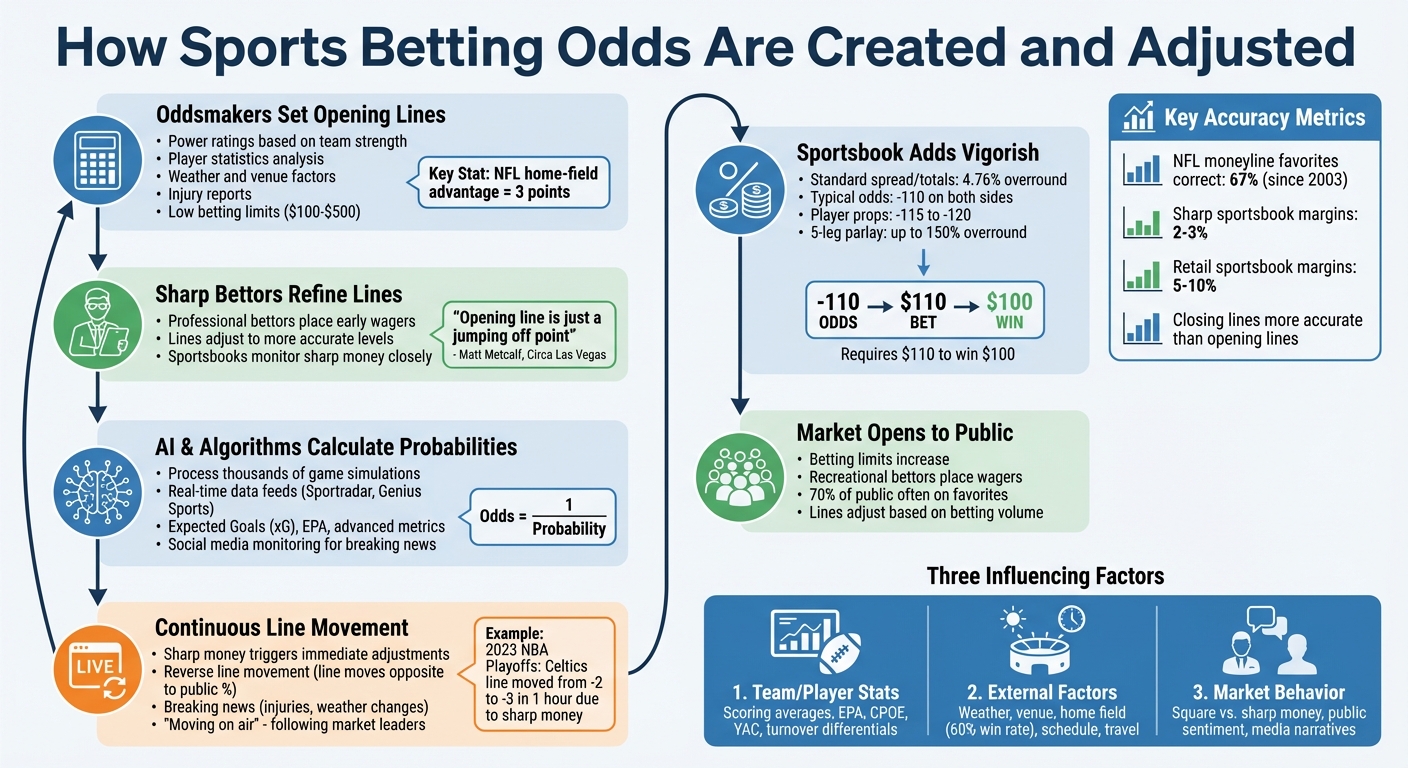
How Sports Betting Odds Are Created and Adjusted
How Betting Odds Work in 8 Minutes – Beginners Explanation 2026
sbb-itb-3ff9055
What Oddsmakers Do and How They Work
Oddsmakers are responsible for setting the initial betting lines, aiming to balance risk, attract wagers on both sides, and secure a profit through the vig. This initial setup provides a foundation that is adjusted by professional bettors and refined with the help of data-driven algorithms.
Top sportsbooks like Pinnacle and Circa Sports are known for creating these opening lines. To start, they set low betting limits - sometimes just a few hundred dollars - to test the waters. Sharp bettors then step in to challenge these lines, helping to adjust them to more accurate numbers. Once this process is complete, limits are raised for the general public. Matt Metcalf from Circa Las Vegas explains:
"The important thing to remember when discussing the opening line, is that it is just a jumping off point. It serves as a starting place for professional bettors to enter the marketplace and hammer the line out to where they believe it should be."
Many retail sportsbooks, such as FanDuel and DraftKings, don’t create their own lines. Instead, they rely on third-party consulting firms or tweak the numbers set by market leaders based on how their customers place bets.
Professional Expertise in Oddsmaking
Oddsmakers rely on both professional expertise and advanced data analysis to refine betting lines. A key part of this process involves creating "power ratings", which are numerical scores that reflect a team's relative strength. These ratings are based on factors like margin of victory, strength of schedule, and other key performance metrics. However, oddsmakers also account for less tangible factors, such as revenge games, coaching changes, or public biases toward popular teams like the Dallas Cowboys or Los Angeles Lakers.
In the NFL, home-field advantage is typically worth about 3 points on the betting line, reflecting the fact that home teams win around 60% of the time. A standout quarterback, on the other hand, can influence the line by as much as 6 or 7 points.
While technology, including AI and machine learning, has revolutionized oddsmaking by processing decades of historical data in minutes, human judgment remains crucial. Lamarr Mitchell, Director of Trading at MGM Resorts and BetMGM, emphasizes this balance:
"If you don't [set the right line], it just becomes gambling for the house."
Data Collection and Research Methods
Oddsmakers also rely heavily on thorough data collection to fine-tune their lines. They analyze team statistics such as scoring averages, defensive efficiency, yards gained, and historical matchups. This data is further refined with information about injuries, roster changes, travel schedules, and player fatigue. Real-time factors like weather conditions and venue specifics also play a major role in shaping betting lines.
Market behavior provides additional insights. Oddsmakers track public sentiment, media narratives, and the wagering patterns of professional bettors (often referred to as sharp money). Tools like odds screens allow them to monitor competitors’ lines and detect movements that could reveal valuable information. Simulation engines, such as AccuScore, can run thousands of game simulations to help predict outcomes.
The results speak for themselves: since 2003, sportsbooks have correctly identified the NFL moneyline favorite about 67% of the time. Sharp sportsbooks typically operate on slim profit margins of 2–3%, while retail books, which cater to casual bettors, maintain higher margins of 5–10%. This balance between data, expertise, and market awareness ensures oddsmakers stay ahead in the game.
Main Factors That Determine Sports Odds
Oddsmakers rely on several key factors when setting sports odds. These elements combine statistical analysis with market dynamics to ensure the lines reflect both the realities of the game and the behavior of bettors. The ultimate goal? To balance risk while attracting equal betting action on both sides.
Team and Player Statistics
Team and player stats are at the heart of odds-making. Oddsmakers start with traditional metrics like scoring averages, win-loss records, and defensive efficiency. But that's just the beginning. Advanced stats - such as expected points added (EPA), third-down conversion rates, red zone efficiency, and turnover differentials - offer a deeper layer of analysis to fine-tune the odds.
Player performance is equally essential. Oddsmakers monitor metrics like yards after catch (YAC), rushing success rates, and even fatigue levels. For quarterbacks, specific stats like completion percentage over expected (CPOE) and average depth of target help paint a more detailed picture of their effectiveness. As Andrew Edwards from Sports Betting Strategy & Information puts it:
"Data does not predict outcomes. It helps estimate probability more accurately than guesswork."
To further enhance accuracy, oddsmakers use processed data models like Elo ratings, expected goals (xG), and player impact models. These models require a significant amount of data - often at least 1,000 matches - to minimize randomness and identify reliable patterns.
Weather, Venue, and Schedule Considerations
Odds aren't just about stats; external factors like weather, venue, and scheduling also play a big role. Weather conditions - wind, rain, or extreme temperatures - can impact performance, especially in outdoor sports. For horse racing, track conditions are particularly influential. As noted by Delta Optimist:
"Weather is especially key for events played on a field, while the ground condition has a huge impact on horse racing. Bookies may also take into account the venue, including whether a team is playing at home."
Venue considerations often revolve around home-field advantage, while game schedules can influence team performance. For instance, teams traveling long distances or playing on short rest may face disadvantages that oddsmakers account for. Real-time updates also come into play; sportsbooks can adjust lines quickly if, say, a sunny forecast changes to heavy rain just before a game.
Public Betting Patterns and Market Sentiment
The behavior of bettors is another critical factor in shaping odds. Recreational bettors, often driven by emotion, tend to favor popular teams, bet on favorites, and lean toward "over" totals. This predictable behavior allows oddsmakers to "shade" lines, offering less favorable odds on heavily favored choices to balance the action.
The distinction between "square" (casual) and "sharp" (professional) money significantly impacts line movement. A few large bets from respected professionals can shift odds much more than numerous smaller wagers from casual bettors. For example, in May 2023, FanDuel adjusted its opening line for a Boston Celtics vs. Miami Heat playoff game from Celtics -2 to -3 within an hour due to sharp money influencing the market.
Ultimately, closing lines - reflecting all available data and betting activity - tend to be more accurate than opening lines. The market itself becomes a key tool in refining odds, blending statistical models with real-time betting patterns to create the most informed predictions.
How Algorithms and Predictive Models Create Odds
Every betting line you see is backed by a sophisticated network of algorithms working tirelessly behind the scenes. Forget relying on gut instincts - modern sportsbooks lean on AI-driven systems that process enormous amounts of data in real time. These systems pull information from a variety of sources, including live score feeds, injury updates, weather conditions, and even social media chatter, to fine-tune the odds.
The process kicks off with data ingestion pipelines that gather raw information from providers like Sportradar, Genius Sports, and Stats Perform. From there, algorithms simulate thousands of potential outcomes. As industry analyst Alyssa Waller explains:
"The goal? Balance the action on both sides so the house doesn't get caught paying out too much, no matter who wins".
These simulations not only identify likely winners but also calculate precise probabilities. Using the formula Odds = 1 / Probability, sportsbooks then add a margin - usually between 3% and 7% - to guarantee their edge (known as the overround). This blend of data collection and simulation forms the backbone of predictive modeling.
AI and Machine Learning Applications
Machine learning takes traditional algorithms to the next level by uncovering intricate betting patterns. These systems can differentiate between professional bettors (often called "sharp money") and more casual, public wagers. This distinction allows sportsbooks to adjust lines quickly and aggressively when seasoned bettors enter the fray. AI also monitors social media and beat writer reports, enabling sportsbooks to react instantly to breaking news, like injuries or last-minute lineup changes.
AI technology also powers microbetting - wagering on highly specific, in-game events like the outcome of the next pitch in baseball or the next free throw in basketball. These markets demand lightning-fast data processing to update odds every few seconds while managing risk across thousands of bets happening simultaneously. Looking ahead, the industry is moving toward deep learning models capable of predicting player-level events and preventing arbitrage opportunities across markets by 2026. These advancements feed directly into the predictive models that calculate odds with incredible accuracy.
Probability Calculation Through Predictive Models
Predictive models rely on machine learning insights to simulate game outcomes using detailed metrics. Take soccer, for example: algorithms assign Expected Goals (xG) values to every shot based on variables like distance, angle, and defensive pressure. A penalty kick might carry an xG of 0.78, while a long-range effort could be as low as 0.03. These nuanced calculations allow models to estimate probabilities with impressive accuracy.
For live betting, odds are recalculated in real time. In-play models use probabilistic simulators that adjust odds every few seconds based on live indicators like shots on target, possession stats, and player substitutions. Modern algorithms also factor in time decay, which determines how quickly older stats lose relevance - recent performances carry more weight than games played months ago. This dynamic approach ensures that odds reflect not just pre-game data but also the evolving action on the field.
How Odds Change: Vigorish and Betting Volume
Once sportsbooks establish their opening lines, the odds don't remain static. They shift due to two key factors: the built-in margins (known as the vig) and the flow of bets placed by both casual and professional bettors.
Understanding the Vigorish (Vig)
The vigorish - commonly called the "vig" or "juice" - is essentially the fee sportsbooks charge to take your bet. It's their way of ensuring profit regardless of the outcome. Instead of offering true 50/50 odds at +100 on both sides, sportsbooks typically set point spreads at –110 on each side. In practical terms, this means you need to bet $110 to win $100.
At –110 odds, the implied probability for both sides adds up to 104.76%, rather than the even 100% you'd expect from true odds. That extra 4.76% is the overround, which represents the bookmaker's edge.
The vig isn't uniform across all bet types. For standard spreads and totals, the overround is usually around 4.76%, but it can climb higher for other bets. For example, player props often come with odds of –115 or –120 on both sides, increasing the vig. Parlays, meanwhile, amplify the vig with each additional leg. A five-leg parlay, where each selection has a 10% overround, can result in a total overround of 150%, heavily favoring the sportsbook.
These built-in margins are only part of the story. Odds continue to shift as betting activity unfolds.
Line Movements and Risk Management
Sportsbooks don’t just set odds and leave them alone - they adjust them constantly to manage risk and balance their books. The goal is to attract roughly equal money on both sides of a bet. If one side starts drawing too much action, the sportsbook tweaks the line to make the less popular side more appealing.
When professional bettors, often referred to as "sharps", place bets, the impact can be immediate. For instance, during the 2023 NBA playoffs, FanDuel initially listed the Boston Celtics as –2 favorites against the Miami Heat. Within an hour, the line moved to –3 due to sharp money influencing the odds. Sportsbooks prioritize sharp money over the sheer volume of public bets. As Sloan Piva from Sporting News explains:
"Sportsbooks respect the sharps' opinions more than the sheer volume of public money, and traders will adjust accordingly".
A phenomenon called reverse line movement is worth noting. This occurs when the line shifts in the opposite direction of public betting trends. For example, if 70% of bets are on a favorite, but the line moves toward the underdog, it often signals significant sharp money on the less popular side. A real-world example comes from Week 13 of the 2022 NFL season: the Miami Dolphins opened as +170 moneyline underdogs against the San Francisco 49ers. Sharp bets drove the line down to +150, but news of injuries to two starting offensive tackles pushed it back to +170.
Lastly, some sportsbooks engage in a practice called "moving on air." Here, they adjust their lines simply because influential market-making books like Pinnacle or Circa have moved theirs, even if they haven’t taken substantial bets themselves.
How to Read and Apply Sports Odds
Grasping how to read and apply sports odds is a must for anyone aiming to make smart, strategic bets. Once you know how to interpret these numbers and switch between formats, you’ll be able to spot opportunities across different platforms.
Common Odds Formats and Conversions
Sportsbooks typically use three main formats to display odds, and while they look different, they all convey the same information.
- American odds: These are based on a $100 benchmark and use positive and negative numbers. For example, +200 means you’ll earn $200 profit on a $100 bet, while –150 means you need to bet $150 to make a $100 profit.
- Decimal odds: Common in Europe and Canada, these show your total return for every $1 wagered. A line of 3.00 means you’ll get $3 back in total - your $1 stake plus $2 profit.
- Fractional odds: Often used in horse racing, these reflect the profit compared to your stake. A 5/1 line means you’ll win $5 for every $1 you bet.
Here’s a real-world example: In the 2025 College Football Playoff Championship Game, Ohio State had odds of –400, while Notre Dame was at +310. Betting $400 on Ohio State would have returned $100 in profit, while a $100 bet on Notre Dame could have netted $310.
To make this clearer, here’s a quick reference table:
| American Odds | Decimal Odds | Fractional Odds | Implied Probability | Profit on $100 Bet |
|---|---|---|---|---|
| +100 (Evens) | 2.00 | 1/1 | 50% | $100 |
| +200 | 3.00 | 2/1 | 33.3% | $200 |
| –110 | 1.91 | 10/11 | 52.4% | $90.91 |
| –150 | 1.67 | 2/3 | 60% | $66.67 |
| –200 | 1.50 | 1/2 | 66.7% | $50 |
| +500 | 6.00 | 5/1 | 16.7% | $500 |
Odds also reveal the implied probability of an outcome, or the chance a sportsbook assigns to it. For instance, to break even on a –110 line, you’d need to win 52.4% of your wagers. As sportsbook expert Patrick Cwiklinski puts it:
"Understanding how to read betting odds is a crucial step to becoming a successful sports bettor".
These conversions are the foundation for using tools like those offered by LearnSportsBetting.
Tools for Odds Analysis and Comparison
Once you’ve nailed the basics of odds conversions, advanced tools can make betting analysis even easier. Manual calculations can be tricky, but LearnSportsBetting provides resources to streamline the process.
- The odds converter instantly switches between American, decimal, and fractional odds, making it simple to compare values across sportsbooks.
- The implied probability calculator translates odds into percentages, helping you spot value when your research suggests an outcome is more likely than the bookmaker’s estimate.
- For multi-leg bets, the parlay calculator does the heavy lifting by multiplying decimal odds for each selection, giving you the payout multiplier.
- Real-time odds updates let you shop for the best lines across platforms like FanDuel, DraftKings, and BetMGM. Even small differences, like –110 vs. –105, can significantly affect your profits.
Tracking your bets is just as important. Use a simple spreadsheet or LearnSportsBetting’s tracking tools to log odds, stakes, and results. This helps you spot trends in your strategy and optimize your returns. Combining these tools with thorough research ensures you’re making informed, data-backed decisions.
Conclusion
Sports odds are created through a detailed process that combines expert judgment, statistical modeling, and market adjustments. Oddsmakers start by using power ratings and data-driven models to set initial lines. These lines are then adjusted based on factors like betting activity, sharp money, and real-time developments such as injuries or weather updates. Todd Fuhrman, a seasoned oddsmaker, sums it up well:
"How odds are determined in sports betting '[isn't just] Xs and Os, it's data, numbers, and an understanding of the market.'"
For bettors, understanding this process is key to making smarter decisions. Odds represent market prices designed to balance wagers while ensuring the sportsbook remains profitable. By paying attention to things like reverse line movement or where sharp money is flowing, you can uncover valuable insights that others might overlook.
Your advantage comes from identifying value - when your research indicates an outcome is more likely than the odds suggest. This involves converting odds into probabilities, comparing lines across different sportsbooks, and maintaining a record of your bets over time. Even small differences in odds can add up to significant gains when spread across numerous wagers.
To make this process easier, tools like those offered by LearnSportsBetting can be a game-changer. These tools simplify odds analysis, help you spot inconsistencies, and provide a data-driven approach to betting. Combined with educational resources and expert guidance, they allow you to make more informed and calculated decisions.
As we've explored, setting odds is a blend of expertise, real-time data, and predictive modeling. By mastering how odds work and leveraging the right tools, you can transform into a disciplined and informed bettor, setting yourself up for long-term success.
FAQs
How are sports betting odds created?
Sports betting odds are crafted by oddsmakers who dive into a mix of data, statistics, and market insights. They begin by analyzing key metrics such as team and player performance, recent game results, injury reports, and head-to-head matchups. From there, advanced algorithms and predictive models come into play, incorporating factors like historical trends, weather forecasts, and lineup changes to estimate the likelihood of various outcomes.
But it’s not just about crunching numbers. Oddsmakers also take market trends and public opinion into account. They tweak the initial odds based on betting activity, media coverage, and other external factors to ensure wagers are evenly distributed on both sides. This balancing act allows sportsbooks to minimize risk while staying profitable, blending statistical analysis with real-world betting behavior.
How do sharp bettors influence sports odds?
Sharp bettors, known for their expertise and deep knowledge, play a major role in shaping sports odds. Their large wagers, often guided by meticulous analysis and data, grab the attention of sportsbooks. When this happens, sportsbooks adjust their odds to reflect the sharp action, keeping their betting lines balanced and aligned with actual probabilities.
These changes aren’t just about managing risk and avoiding losses for the sportsbooks - they also serve as a signal to other bettors. The activity of sharp bettors acts like a real-time indicator, showing how the market is evolving and where the most accurate odds might lie.
How does AI impact the way sports odds are created and adjusted?
AI has become a game-changer in the world of sports odds, thanks to its ability to process massive amounts of data with speed and precision. It takes into account a variety of factors - like past performance, player injuries, weather conditions, and even trends from social media - to calculate probabilities and adjust betting lines on the fly.
By leveraging advanced algorithms, AI enables oddsmakers to refine their predictions and react to market shifts faster than ever. This blend of cutting-edge technology and human expertise ensures that the odds remain competitive and reflect the latest available information.


