 LearnSportsBetting
Ultimate Guide to Betting Psychology
Betting success depends more on mastering emotions and biases than picking winners—use discipline, bankroll rules, and mindfulness.

Ultimate Guide to Betting Psychology
The biggest challenge in betting often isn't the sportsbook or the unpredictability of games - it's your own emotions and cognitive biases. Here's what you need to know:
- Cognitive Biases: Common traps like recency bias, gambler's fallacy, and confirmation bias can distort your decision-making.
- Emotional Triggers: Wins can lead to overconfidence, while losses often push bettors into risky behaviors like chasing losses.
- Stress and Anxiety: Pressure can cloud judgment, leading to impulsive bets.
Key stats:
- Losing feels about twice as painful as winning feels good.
- Gambling problems affect 2-4% of the U.S. population, with 32% of those seeking help reporting suicidal thoughts.
To succeed, you need discipline, a structured betting plan, and tools to manage emotions. This guide breaks down how to recognize psychological pitfalls, manage stress, and build systems for better decision-making.
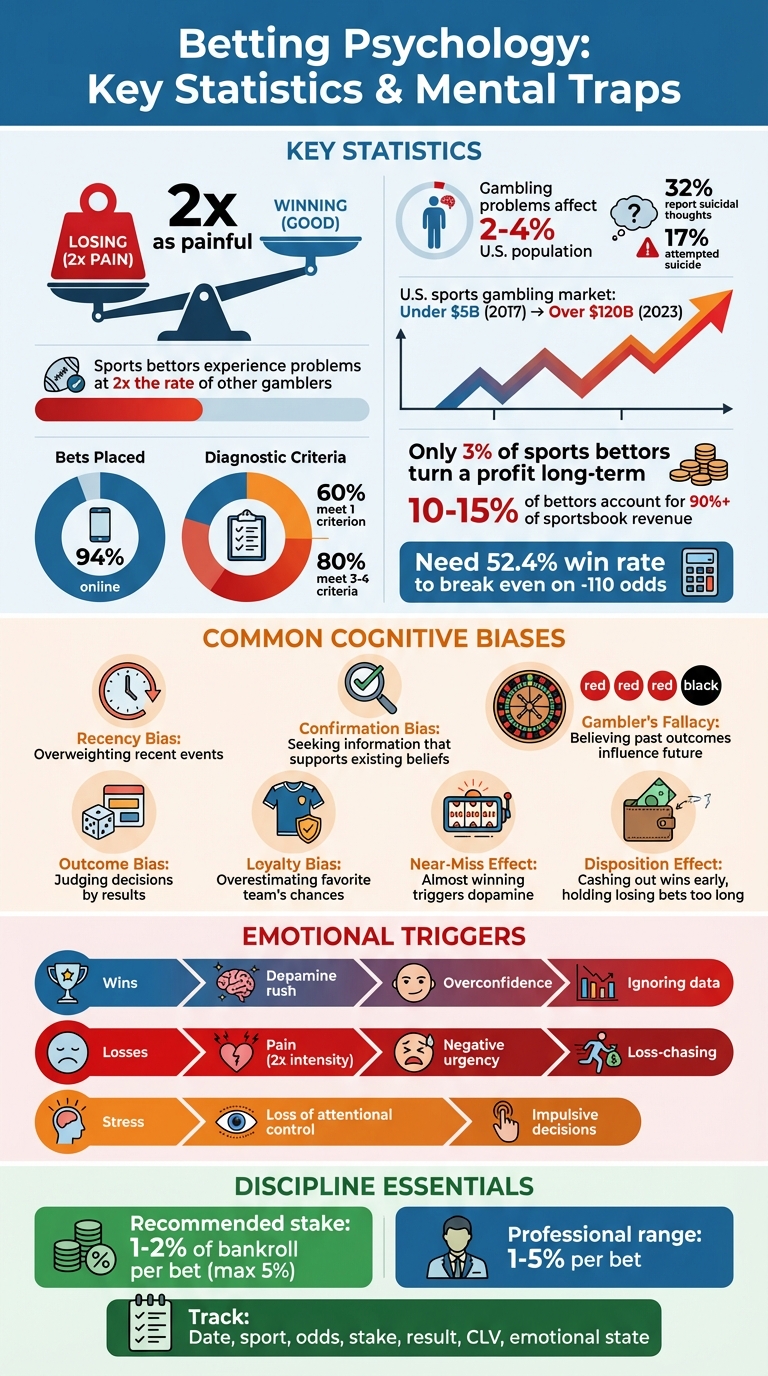
Betting Psychology Statistics and Key Mental Traps
The Psychology of Sports Betting | Biases, Flaws and More!
sbb-itb-3ff9055
Key Psychological Factors in Betting
When money's on the line, your brain can sometimes work against you. Stress, anxiety, and emotional highs and lows can quickly turn a well-thought-out strategy into impulsive mistakes. Understanding these psychological factors is crucial to making better decisions. Let’s break down how stress, anxiety, and emotions impact betting behavior.
How Stress and Anxiety Affect Betting Decisions
Stress and anxiety can cloud your judgment, making it harder to make rational choices. When you're under pressure, your brain can filter out important information, leaving you vulnerable to distractions, hype, and emotional reactions. This is what sports psychologists refer to as a loss of attentional control - a mental state where anxiety overrides your ability to focus on critical data.
On a physiological level, stress disrupts your brain's reward system. The prefrontal cortex, which handles logical thinking, takes a back seat to the ventral striatum, the part of the brain that drives reward-seeking behavior. This shift makes it harder to resist risky bets. Consider this: the U.S. sports gambling market exploded from under $5 billion in 2017 to over $120 billion in 2023, with 94% of bets now placed online. This fast-paced environment amplifies stress, leading to quick, high-stakes decisions.
The psychological concept of loss aversion adds another layer to the problem. Losing feels about twice as painful as winning feels good. This imbalance can lead to panic bets, premature cash-outs, or even chasing losses - a dangerous cycle where larger, riskier bets are made to recover previous losses. It's no surprise that sports bettors experience gambling problems at twice the rate of other gamblers. Among those seeking help for gambling disorders, 32% report suicidal thoughts, and 17% have attempted suicide.
These stress-driven reactions set the stage for emotional triggers that can further derail your betting strategy.
Emotional Triggers: Wins, Losses, and Chasing
Wins and losses can stir up powerful emotions that may throw your strategy off track. A win triggers a dopamine rush, which can lead to overconfidence and a tendency to ignore data while raising your bets. On the flip side, losses hit harder. According to Prospect Theory, the pain of losing is far more intense than the joy of winning an equivalent amount. This emotional imbalance often leads to negative urgency - a type of impulsivity where decisions are made quickly in an attempt to ease emotional distress.
One of the most common emotional traps is loss-chasing - the urge to recover losses by escalating bets. This behavior is a hallmark of disordered gambling, with 60% of gamblers meeting at least one diagnostic criterion for gambling problems and 80% meeting three or four. Frustration and anxiety fuel this cycle, making it harder to break free.
The near-miss effect adds yet another layer of complexity. Missing a win by a small margin can trigger a dopamine response similar to that of an actual win. Luke Clark, Director of the Centre for Gambling Research, explains:
"Near-misses appear to harness a reward system that evolved to learn skill-oriented behaviours, and by modulating activity in this system, these cognitive distortions may promote continued, and potentially excessive, gambling."
This phenomenon can make you feel like you're constantly "almost winning", encouraging you to keep betting despite repeated losses.
Another emotional pitfall is the disposition effect, where you might cash out winning bets too early to lock in a profit but hold on to losing bets, hoping for a turnaround. As Paul Costanzo notes:
"The tendency to devalue wins and overestimate losses is natural for all of us... selling at a loss often means having to admit that we were wrong."
Globally, between 0.1% and 5.8% of people are estimated to struggle with gambling problems. The best way to avoid these emotional traps is to recognize when your emotions are taking over and to establish systems that create a pause between your impulses and your actions.
Common Cognitive Biases That Affect Bettors
Cognitive biases can quietly undermine your betting decisions, even when you're calm and composed. While emotional reactions like stress can cloud judgment, biases in how your brain processes information can be just as disruptive. These mental shortcuts often distort reality, especially when money is on the line.
Recency bias is a prime example. This occurs when you place too much importance on recent events - like a team’s recent blowout win - while ignoring long-term data. For instance, after a short winning streak, public perception favored the Steelers as 4.5-point favorites, only for them to lose to the underdog Jets. This shows how recent performances can skew market perceptions.
Confirmation bias often works alongside recency bias. It leads you to seek out information that supports what you already believe while ignoring contradictory evidence. If you’re rooting for your favorite team, you might cherry-pick stats that back your optimism, even if the broader data tells a different story.
The gambler's fallacy is another common trap. This bias makes you believe that past outcomes influence future events, like thinking a team is "due" for a win after a losing streak. In reality, independent events - like a roulette wheel landing on red - have fixed probabilities, regardless of past results.
Outcome bias causes you to judge your decisions based solely on results rather than the logic behind them. For example, in October 2014, the San Francisco 49ers beat the St. Louis Rams 31–17, but the score was misleading. Two fluke plays - a long touchdown before halftime and a late interception return - skewed the outcome. This led to the Rams being undervalued as 10-point underdogs in a rematch, which they won 13–10. A good bet can lose, and a bad bet can win, but focusing on the reasoning behind your choices is what matters.
Team Loyalty Bias and Social Pressure
Personal loyalties and social dynamics can also cloud judgment. Loyalty bias can cause you to overestimate your team’s chances, while social pressure might push you into bets based on group hype instead of logic. Sportsbooks are well aware of these tendencies and often adjust odds based on fan enthusiasm rather than actual probabilities. A famous example is the 2014 FIFA World Cup. Brazil’s historical success and home-field advantage made them heavy favorites, but many overlooked the team’s weaknesses. The result? A stunning 7–1 loss to Germany in the semifinal.
In today’s online betting culture, social pressure is amplified. Betting has become a shared activity, especially among young men, with group chats and screenshots of bets creating a sense of peer validation. This environment can normalize risky behavior, leading you to follow the crowd rather than trust your own analysis.
Jeff Ma, the inspiration behind the movie 21, offers this advice:
"The best way to combat [biases] is to try to remove subjectivity from the decision-making process and understand how these biases can color your decisions."
Tracking your bets and the reasoning behind them can help you spot patterns where loyalty or peer influence outweighs data-driven decisions.
The Dopamine Effect: Why Winning Feels Addictive
Winning activates dopamine in your brain’s reward centers, reinforcing betting behavior and making it harder to stop. This is linked to variable ratio reinforcement, where unpredictable rewards - like a big win - make each loss feel like it brings you closer to the next victory. James Sauer, a Senior Lecturer at the University of Tasmania, explains:
"Loot boxes tap into the same psychological principles that draw people to slot machines... this type of variable ratio reinforcement... exploits a cognitive distortion that makes a player or gambler view each loss as one step closer to a win."
The near-miss effect is another factor. Narrow losses or almost winning can trigger dopamine responses similar to actual wins, encouraging you to keep betting even when you’re losing money. As Investopedia notes:
"The powerful lure of 'almost winning' primes your brain to lose money both at the sportsbook and in the stock market."
Over time, excessive dopamine activity can impair your brain’s ability to manage impulses, leading to riskier bets in an effort to recover losses. This cycle resembles substance addiction, where higher stakes are needed to achieve the same thrill. Research shows that 10% to 15% of bettors account for over 90% of sportsbook revenue, often driven by this dopamine feedback loop.
To counteract the dopamine effect, you can adopt strategies like the 1–2% rule, which limits any single bet to 1%–2% of your bankroll. This can help reduce emotional swings. Adding friction to your decision-making - such as a mandatory 24-hour waiting period before placing bets - can also help. Writing down clear exit rules, like stop-loss limits and profit targets, can keep you from making impulsive choices during a dopamine surge.
How to Manage Stress and Emotions While Betting
Understanding stress and avoiding cognitive traps is a good start, but it’s not enough to truly manage emotions while betting. You need systems in place to keep stress and emotions from clouding your judgment. As mental game coach Jared Tendler puts it, "When the emotional system becomes overactive, it has the power to shut down higher brain functions." In simpler terms, when emotions take over, your ability to think logically and process information is compromised.
The upside? Stress and emotional control are skills you can strengthen with the right strategies. These aren’t about suppressing emotions but about creating safeguards to keep your decisions steady. Here’s how you can manage emotions and improve decision-making while betting.
Creating a Structured Betting Plan
A well-thought-out betting plan takes the sting out of emotionally charged decisions. By setting clear rules - like how much to bet, how long to play, and when to stop - you reduce the chance of making impulsive choices. For instance, many professional bettors stick to risking just 1%–5% of their bankroll on any single bet. This approach helps you avoid rash decisions in the heat of the moment.
Adding a "cooling-off" period after each bet can also help. Keep a journal not just for wins and losses but also for your mood. Note emotional states like "tilted", "confident", or "bored." Over time, patterns might emerge, showing when you’re most prone to reactive betting.
To further slow down impulsive actions, try removing betting apps from your phone, unsubscribing from promotional emails, or using website blockers. These small hurdles make it harder to act on a whim and give you more time to assess whether a bet is worthwhile.
Using Mindfulness Techniques
Mindfulness is all about recognizing emotional triggers before they lead to action. Dr. Hedy Kober of Yale University explains, "Mindfulness involves observing your thoughts and urges with curiosity but without judgment."
One method to try is urge surfing. When you feel a strong impulse to bet, don’t act on it immediately. Instead, imagine the urge as a wave - it builds, peaks, and eventually fades. This gives you time to regain control. Pair this with the "ten-minute rule": when the urge strikes, wait ten minutes before placing any bets. Often, the intensity will pass.
Breathing exercises can also help calm you down. Deep, slow breaths lower your heart rate and blood pressure, which can help during stressful moments. For something more structured, progressive muscle relaxation (PMR) is effective. It involves tensing and relaxing muscle groups, starting from your toes and working up to your head. Additionally, setting aside 10–20 minutes a day for mindfulness meditation can build emotional resilience over time. This practice helps you tune out distractions like hype or irrelevant stats, making it easier to recognize emotional cues before they derail your judgment.
These techniques are even more effective when paired with a healthy lifestyle.
Maintaining a Balanced Lifestyle
Your ability to manage stress while betting is closely tied to your overall well-being. Regular exercise, proper sleep, and a balanced routine all contribute to better decision-making. After a tough loss or a big win, taking a short break can help reset your nervous system. Physical activity, in particular, stabilizes your mood and lowers stress levels, giving you the emotional stability to handle the ups and downs of betting.
Sleep is another critical factor. Without enough rest, your prefrontal cortex - the part of your brain responsible for logical thinking - doesn’t function at full capacity. This leaves you more vulnerable to impulsive decisions. Prioritizing quality sleep ensures your emotions stay in check.
Finally, it’s important to have interests outside of betting. When betting isn’t your sole focus, it’s easier to put wins and losses into perspective. Diversifying your activities helps keep the emotional stakes lower.
As Jared Tendler reminds us, "Emotions are the reason you can't stop these mistakes from happening. Fix your sights firmly on correcting fear, anger, overconfidence or a lack of confidence, because they are at the heart of what's costing you." By structuring your betting habits, practicing mindfulness, and maintaining a balanced lifestyle, you can build the emotional resilience needed to navigate the psychological challenges of betting successfully.
Tools and Strategies for Disciplined Betting
Managing your emotions is just one piece of the puzzle. The other is having a solid system to ensure your good intentions translate into consistent actions. Without reliable tools and strategies, even the most disciplined bettors can slip back into old habits. As veteran handicapper Jerald puts it:
"I feel that it is almost as important to implement good money management tactics as it is to pick winners."
Here’s how to create a framework that keeps discipline front and center, starting with effective bankroll management.
Bankroll Management and Fixed Staking Models
At the heart of disciplined betting lies bankroll management. This approach separates resilient bettors from those who crumble under pressure. The rule is straightforward: only bet money you can afford to lose - funds that aren’t meant for essentials like rent or groceries [40,41].
Once you’ve set aside your betting bankroll, the next step is determining a unit size. Most professionals recommend risking just 1%–2% of your bankroll per bet. This ensures you can endure losing streaks without significant damage [40,43]. For example, if your bankroll is $1,000, a single unit would be $10 to $20. Even with an impressive 60% win rate, you’ll still lose 4 out of every 10 bets. A conservative unit size helps you survive these ups and downs.
Flat betting - where you wager the same amount on every bet - prevents emotional decisions like chasing losses or betting too much after a win. For those with more experience, the Kelly Criterion offers a formula to calculate optimal stake sizes based on your perceived edge and the odds. However, it’s highly sensitive to estimation errors, so many professionals use a Half Kelly or Quarter Kelly approach for added safety.
To break even on standard -110 odds, you need to win at least 52.4% of your bets. Anything above that is profit, but betting more than 5% of your bankroll per wager can quickly lead to losses [40,41]. Think of your bankroll as a business expense.
Digital tools can make these strategies even more effective by removing emotional bias from your decisions.
Using LearnSportsBetting Tools for Better Decisions
Discipline isn’t just about keeping emotions in check - it’s also about relying on data to guide your choices. LearnSportsBetting offers a range of calculators designed to take the guesswork out of betting and help you stay level-headed.
The Kelly Calculator is particularly helpful for determining mathematically sound stake sizes. Instead of relying on gut instinct, you input your perceived edge and the odds, and the calculator provides the optimal bet size. This eliminates the temptation to overbet on "sure things" or underbet when feeling uncertain.
The Odds Converter allows you to compare odds across different formats - American, decimal, fractional - and understand the implied probability behind each line. For instance, -110 odds equate to a 52.4% chance of winning. If you believe the actual probability is higher, it’s a value bet; if not, it’s better to skip.
Other tools, like the EV Calculator, Hedge Calculator, and Hold Calculator, help you evaluate the expected value of a bet, manage risk across multiple wagers, and calculate how much the sportsbook is charging in "vig." These tools shift your focus from short-term wins to the long-term success of your strategy.
Tracking Your Bets and Learning From Mistakes
Just as self-awareness is key to managing stress, disciplined betting requires thorough tracking of every wager. Without proper bookkeeping, you’re essentially betting blind. As Brian DeFranco from The Hammer explains:
"Bookkeeping tells you what you're good at, what you're not good at, and everything in between. Most people who first jump into sports betting tend to believe they can easily beat the market, but tracking the data can take the emotion and irrational thinking out of it."
For every bet, log details like the date, sport, bet type, odds, stake, result, and net profit or loss [46,48]. Don’t cherry-pick - record everything, including small bets and losses, to avoid skewing your data and giving yourself a false sense of success [46,47].
For deeper insights, track your Closing Line Value (CLV) - the difference between the odds you took and the final odds before the game. Consistently beating the closing line is a strong indicator of long-term success [46,48]. If your CLV is consistently negative, it might signal issues with your strategy or timing.
Another helpful tactic is strategy tagging. Label each bet based on its reasoning - like "fading the public", "injury angle", or "home underdog." After a few months, you’ll have a clearer picture of which strategies are profitable and which are costing you money.
Before placing a bet, write a brief explanation of why you’re making it. This habit helps you differentiate between a good bet that loses due to variance and a bad bet based on flawed logic [48,49]. As professional bettor Rob Pizzola says:
"The hardest part of betting is being honest with yourself - and the data never lies."
Review your records monthly or quarterly to spot patterns and address consistent losses. Only about 3% of sports bettors turn a profit over the long term, and 90% of losses by recreational bettors stem from mistakes like chasing losses and failing to track results. Ultimately, success boils down to discipline, math, and having a clear plan before placing that first bet.
Conclusion
Professional bettors don’t succeed by simply picking more winners - they excel by mastering their emotions and sticking to disciplined mental strategies. They understand how common biases can disrupt even the most well-informed wagers. This awareness translates into actionable steps for maintaining control and focus in betting.
Sustained success hinges on managing stress, adhering to disciplined bankroll strategies, and evaluating performance with honesty. Using fixed staking models can safeguard your bankroll during inevitable losing streaks. Meanwhile, mindfulness techniques and intentional pauses can help curb impulsive reactions.
By tracking your wagers alongside your emotional state, you can uncover patterns that might otherwise remain hidden. Mental game coach Jared Tendler emphasizes this point:
"What is more likely to increase your POT by 1% – doing that testing/modeling work, or eliminating the mistakes that cost you money time and again and are driven by anger, fear, greed, or confidence problems?"
FAQs
How can I spot and avoid cognitive biases when betting?
Cognitive biases are mental shortcuts that often steer bettors toward flawed decisions. Take the gambler’s fallacy, for instance - this is when someone falsely believes that past outcomes will influence future ones, like assuming a coin is "due" to land heads after several tails. Then there’s confirmation bias, where people focus only on information that aligns with what they already believe, ignoring anything that contradicts it.
To steer clear of these traps, start with self-awareness. Rely on objective data instead of gut instincts, and don’t be afraid to challenge your own assumptions. Be mindful of emotional factors like overconfidence or the urge to chase losses - they can cloud your judgment. Another helpful tactic? Keep detailed records of your bets. This not only highlights patterns but also allows you to refine your strategy over time. By staying disciplined and making learning a priority, you’ll reduce the sway of cognitive biases in your betting decisions.
What are some mindfulness techniques to help manage stress while betting?
Managing stress while betting is all about staying in control of your emotions and making thoughtful decisions. One way to achieve this is through mindfulness meditation. This technique encourages you to focus on your breathing and observe your thoughts without judgment. By doing so, you can avoid knee-jerk reactions to wins or losses and maintain a steady, composed mindset.
Another useful strategy is staying connected to your physical sensations and emotions during betting. For example, noticing how your body feels when you’re excited about a win or frustrated by a loss can help you avoid letting those emotions dictate your choices. Regular mindfulness practice not only supports better decision-making but also encourages responsible gambling habits, helping you approach betting with a clearer and more focused perspective.
Why is bankroll management important for successful betting?
Bankroll management is a key component of successful betting because it helps you stay in control of your money, minimize risks, and make more thoughtful decisions. By setting a clear budget and sticking to it, you ensure that you're only wagering what you can comfortably afford to lose. This reduces the emotional strain that often accompanies gambling, especially during losing streaks.
Good bankroll management also encourages disciplined habits. It shifts your focus toward long-term goals rather than impulsively chasing losses or placing reckless bets. Not only does this safeguard your finances, but it also makes the betting process more enjoyable by fostering a more strategic, level-headed approach.


