Point Spread Explained
How point spreads work: favorites vs underdogs, pushes, vig, key numbers, and tools to calculate payouts so you can bet smarter.
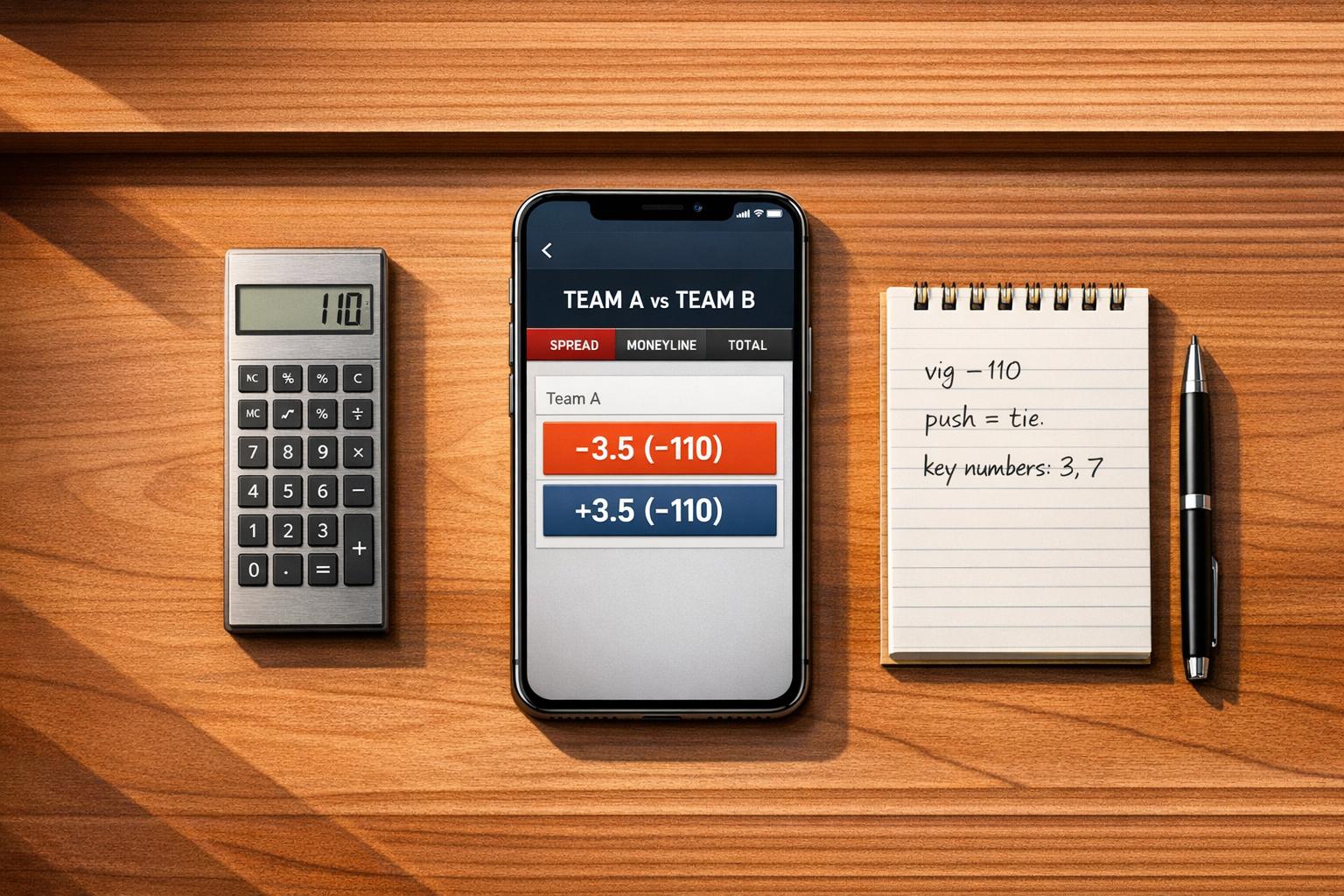
Point Spread Explained
Point spreads are a way to make sports betting more balanced and engaging, especially when one team is heavily favored. Instead of betting on who wins, you bet on the margin of victory. The favorite gets a negative spread (e.g., -3.5) and must win by more than that number to cover. The underdog gets a positive spread (e.g., +3.5) and can cover by winning outright or losing by fewer points than the spread.
Key points:
- Favorites (-): Must win by more than the spread.
- Underdogs (+): Can win outright or lose within the spread.
- Pushes: If the margin matches the spread, bets are refunded.
- Half-point spreads: Prevent ties, ensuring clear wins or losses.
- Odds (-110): Typical vig, meaning you bet $110 to win $100.
Understanding spreads involves knowing how odds, key numbers (like 3, 7, 10), and factors like injuries or weather can influence the betting lines. Using tools like calculators and odds converters can help you make smarter bets.
What is a Point Spread? Sports Betting Explained Part 1
sbb-itb-3ff9055
How Point Spreads Work
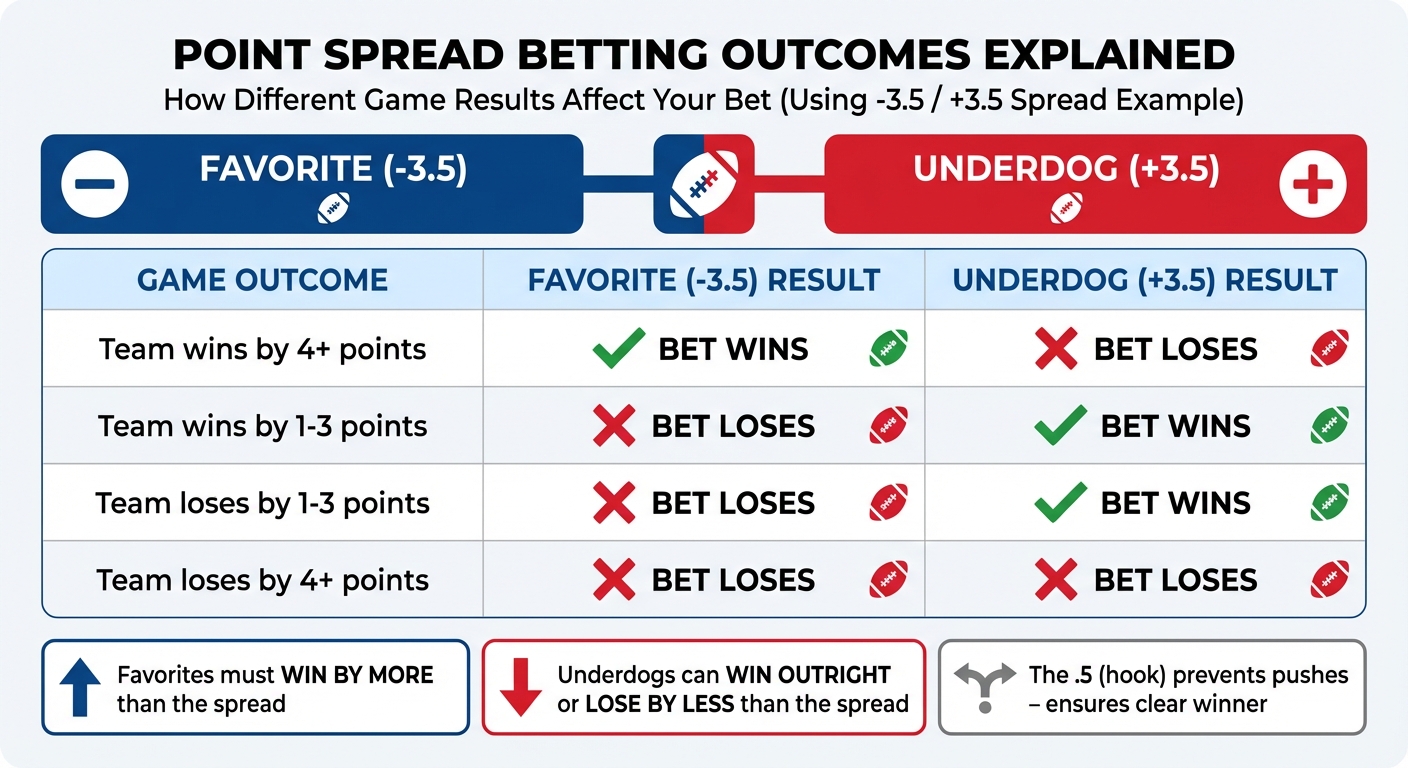
Point Spread Betting Outcomes: Favorites vs Underdogs
Point spread betting tweaks the final scores to determine wins, losses, or pushes, depending on whether you're betting on the favorite or the underdog.
Favorites vs. Underdogs
Favorites are identified with a minus sign (-) and need to win by more than the spread to cover. On the other hand, underdogs, marked with a plus sign (+), can cover by either winning outright or losing by less than the spread. For example, if the Philadelphia Eagles are listed at -9.5 against the New York Giants, the Eagles must win by at least 10 points to cover. Meanwhile, the Giants at +9.5 would cover if they win or lose by 9 points or fewer.
| Outcome | Favorite (-3.5) | Underdog (+3.5) |
|---|---|---|
| Team wins by 4+ | Bet Wins | Bet Loses |
| Team wins by 1-3 | Bet Loses | Bet Wins |
| Team loses by 1-3 | Bet Loses | Bet Wins |
| Team loses by 4+ | Bet Loses | Bet Loses |
Now, let’s dive into how pushes and half-point spreads impact betting results.
Pushes and Half-Point Spreads
A push happens when the final margin matches the spread. For instance, if a team is favored by 3 points (-3) and wins 23-20, the result is a push, and all bets are refunded.
To avoid pushes, oddsmakers often use half-point spreads, also called "the hook." Take the 2022 Super Bowl as an example: the Los Angeles Rams were -4.5 favorites against the Cincinnati Bengals. The Rams won 23-20, a 3-point victory. Since 3 is less than 4.5, Bengals bettors won their wagers despite the team losing the game. Because teams can't score half-points, the hook ensures every bet has a clear winner.
"The .5 on each bet's point spread is referred to as 'the hook', and it's there mostly to avoid the issue of tied bets." - Steven Petrella, Commercial Content Director, Action Network
That seemingly small half-point can be a game-changer, especially around key numbers like 3, 7, and 10 - common victory margins in NFL games.
Reading Point Spread Odds
This section dives into how to interpret and calculate point spread odds, helping you make smarter betting choices.
Understanding the Numbers
A typical point spread might look like this: Kansas City Chiefs -7.5 (-110) or Denver Broncos +7.5 (-110). The first number (-7.5 or +7.5) is the spread. It shows how many points the favorite needs to win by or how many points the underdog gets as a cushion. The second number (-110) is the vig, which is essentially the sportsbook's commission.
At -110 odds, you need to bet $110 to win $100 in profit. This setup gives sportsbooks a built-in edge of about 4.55%. To break even at -110, you’d need to win roughly 52.4% of your bets. That extra 2.4% is what covers the vig.
When there’s heavy betting on one side, sportsbooks might adjust the vig to -115 or -120 instead of changing the spread. Understanding these adjustments is key to making informed bets.
| Odds | Risk to Win $100 | Break-Even Win % |
|---|---|---|
| -105 | $105 | 51.2% |
| -110 | $110 | 52.4% |
| -115 | $115 | 53.5% |
| -120 | $120 | 54.5% |
Calculating Your Payout
Once you know the spread and vig, figuring out your potential payout is straightforward. For -110 odds, divide your stake by 110 and multiply by 100 to determine your profit. For example, if you wager $110 at -110 odds: ($110 ÷ 110) × 100 = $100 profit.
Your total return includes both your profit and your original stake. So, a $110 bet at -110 odds would return $210 total - $100 profit plus your $110 stake. The same math applies to smaller bets. For instance, betting $55 would yield a $50 profit, giving you a total return of $105.
Most betting slips display the total return. If you see a payout of $210 on a $110 bet, that figure includes both your profit and your stake.
Point Spread Examples
Understanding point spreads becomes easier with real-world examples. Let’s break down how they work using scenarios from the NFL and NBA.
NFL Point Spread Example
Imagine a January 2026 NFL game where the 49ers (-3) played the Steelers (+3). Here’s how different outcomes would impact bets, assuming standard -110 odds:
- If the 49ers win 24-20 (a 4-point margin), they cover the spread since they won by more than 3 points. A $110 bet on the 49ers would return $210 total ($110 stake + $100 profit). Meanwhile, Steelers bettors would lose their wager.
- If the 49ers win 21-20 (a 1-point margin) or if the Steelers win outright, the Steelers cover the spread. In this case, a $110 bet on the Steelers would return $210, while 49ers bettors would lose.
- If the 49ers win 23-20 (exactly a 3-point margin), the result is a push. Both sides would get their original stakes refunded, with no profit or loss.
For another perspective, let’s look at how spreads play out in an NBA game.
NBA Point Spread Example
In February 2026, the Hornets (-6.5) faced the Pelicans (+6.5). The half-point "hook" in this spread ensures there’s no possibility of a push.
- If the Hornets win 110-100 (a 10-point margin), they cover the spread by exceeding the 6.5-point requirement. A $110 bet on the Hornets would return $210 total.
- If the Hornets win 108-104 (a 4-point margin), they fail to cover the spread. Instead, the Pelicans cover, as they lost by fewer than 6.5 points. Pelicans bettors would win in this situation.
- If the Pelicans win outright, they also cover the spread, rewarding those who bet on them.
NBA games often have high scores and unpredictable finishes. Late-game fouls or free throws can quickly shift the score, making spread outcomes especially dynamic.
What Affects Point Spreads
Factors Oddsmakers Consider
Oddsmakers rely heavily on computer-generated power ratings to establish point spreads, but they fine-tune these numbers using a variety of situational factors. Chris Andrews, Sports Book Manager at South Point, explains:
"Power ratings give you a place to start".
Injuries can have a massive effect on spreads, especially when key players like starting quarterbacks are involved. For instance, a quarterback's absence might shift the spread by 3 to 6 points. In December 2023, the Tennessee Titans initially opened as 2-point favorites against the Houston Texans, expecting QB C.J. Stroud to sit out. However, unexpected public betting pushed the line to -3.5 by kickoff.
Home-field advantage also plays a role, though its value has diminished over time. While it used to be worth a standard 3-point boost, it's now typically assessed between 0.5 and 2 points, depending on the team and venue.
Weather conditions, particularly extreme cases like high winds, can also influence spreads. Other situational factors include teams playing on short rest, enduring long cross-country travel, or benefiting from extra preparation after a bye week.
Finally, public betting trends and sharp money often contribute to how spreads are adjusted.
How Public Betting Moves Lines
When too much money is wagered on one side, sportsbooks adjust either the line or the juice to manage their risk. Popular teams often attract heavy public betting, which forces oddsmakers to tweak spreads or juice to maintain balance.
Sharp bettors - professionals with proven track records - can also significantly shift lines. Even a few large bets from sharps can move a line by 2 points or more, regardless of the thousands of smaller public bets on the other side. A clear example of this is reverse line movement: if 70% of public bets are on a favorite at -7, but the line drops to -6, it often indicates sharp money backing the underdog.
Before making drastic changes to the spread itself, sportsbooks frequently adjust the juice. For example, they might move from -110 to -120 on the favored side, discouraging further bets without altering key numbers like 3, 7, or 10 - critical in NFL games. Lamarr Mitchell, Director of Trading at MGM Resorts and BetMGM, emphasizes the importance of setting the right line:
"If you don't [set the right line], it just becomes gambling for the house".
| Factor | Typical Impact on Spread |
|---|---|
| Elite Quarterback Injury | 3 to 6 points |
| Home-Field Advantage | 0.5 to 2 points |
| Sharp Money Action | 0.5 to 2+ points |
| Extreme Weather (Wind/Snow) | Variable; affects totals/spreads |
Using LearnSportsBetting Tools for Point Spreads

Tools for Point Spread Betting
LearnSportsBetting offers a range of tools designed to simplify and improve your approach to point spread betting. For starters, the Point Spread Calculator lets you input your stake, the spread (like -7.5), and the odds to instantly calculate your potential profit and return. The Odds Converter is another helpful tool that switches between American, Decimal, and Fractional odds formats while showing the break-even win percentage needed to make a profit. If you’re placing parlays, the Parlay Calculator comes in handy - it converts American odds to decimal, multiplies them, and calculates the potential payout.
Other tools include the Expected Value (EV) Calculator, which compares your predicted probability to the sportsbook’s implied probability, helping you spot mispriced lines. The Kelly Criterion Calculator guides you on how much of your bankroll to wager based on your perceived advantage. If you’re looking to hedge a bet, the Hedge Calculator tells you exactly how much to wager on the opposing side to either secure a profit or reduce your losses. Plus, the real-time odds feature gives you the ability to compare spreads and juice across multiple sportsbooks, ensuring you always find the best value. These tools are designed to help you make faster, more informed decisions while staying aligned with your betting strategy.
How to Use These Tools
To get the most out of these tools, start with the Odds Converter to understand the implied probabilities before placing a bet. For example, at -110 odds, you’ll need a win rate of 52.4% just to break even. Use the real-time odds feature to shop around for small differences, like securing +3.5 instead of +3 on a spread - this can turn a potential push into a win, especially when crossing key numbers. The vig on a standard -110 point spread bet is approximately 4.55%, so even minor improvements in odds can make a big difference over time.
When evaluating a spread bet, consider using the spread-to-moneyline converter to see if the favorite’s moneyline (e.g., -320) offers better value than the spread itself. And for managing your bankroll effectively, stick to risking only 1–2% of your total bankroll on any single point spread bet. This disciplined approach helps you stay in the game longer while minimizing the risk of significant losses.
Conclusion
Understanding point spreads is a must for anyone serious about sports betting. This system levels the playing field, and grasping concepts like favorites, underdogs, pushes, and key numbers lays the groundwork for smarter betting decisions.
For example, at -110 odds, you need to win about 52.4% of the time to counter the 4.55% house edge. Even small differences, like a spread of +3.5 instead of +3, can turn a potential push into a win when betting near key numbers. These nuances are crucial when refining your strategy with tools like calculators and converters.
LearnSportsBetting offers tools to simplify this process. Features like the Expected Value Calculator, Odds Converter, and real-time odds comparisons help you identify value, calculate payouts, and manage your bankroll effectively. A good rule of thumb is to wager only 1–2% of your bankroll per bet and always compare spreads across multiple sportsbooks to secure the best line.
FAQs
What is a half-point spread, and how does it prevent ties in sports betting?
A half-point spread is a point spread that includes a decimal, like 3.5 or 7.5. The purpose of the decimal is to eliminate the possibility of a tie, often called a "push", by ensuring the margin of the final score can’t match the spread exactly. This guarantees every bet ends in either a win or a loss, removing the need for refunds in cases where scores would otherwise result in a tie.
What causes point spreads to change before a game?
Point spreads don’t stay static - they can shift before a game for a variety of reasons. One key factor is how sportsbooks manage their risk. If they notice an overwhelming number of bets on one team, they might tweak the spread to attract more bets on the other side. This helps them balance their books and reduce potential losses.
Other factors also come into play, such as last-minute news. Player injuries, unexpected weather changes, or updates on a team’s form can alter public perception and influence betting patterns. By keeping an eye on these updates, you can get a better sense of why spreads move and possibly predict where they might go next.
What is the vig, and how does it impact my point spread winnings?
The vig, short for vigorish, is essentially the sportsbook’s fee for taking your bet. It’s usually baked into the odds, often represented as -110. This means you’d need to bet $110 to win $100. In simpler terms, the vig trims down your potential profit, ensuring the sportsbook earns money no matter the outcome.
For instance, if you place a $110 bet on a point spread and win, you’ll pocket $100 in profit along with your original $110 stake. Without the vig, your profit would be higher, but this fee is how sportsbooks cover their expenses and balance their risks.


