Over Under Betting
Guide to over/under (totals) betting: how lines are set, key factors like pace and weather, payout math, bankroll rules, and smart strategies.
Over Under Betting
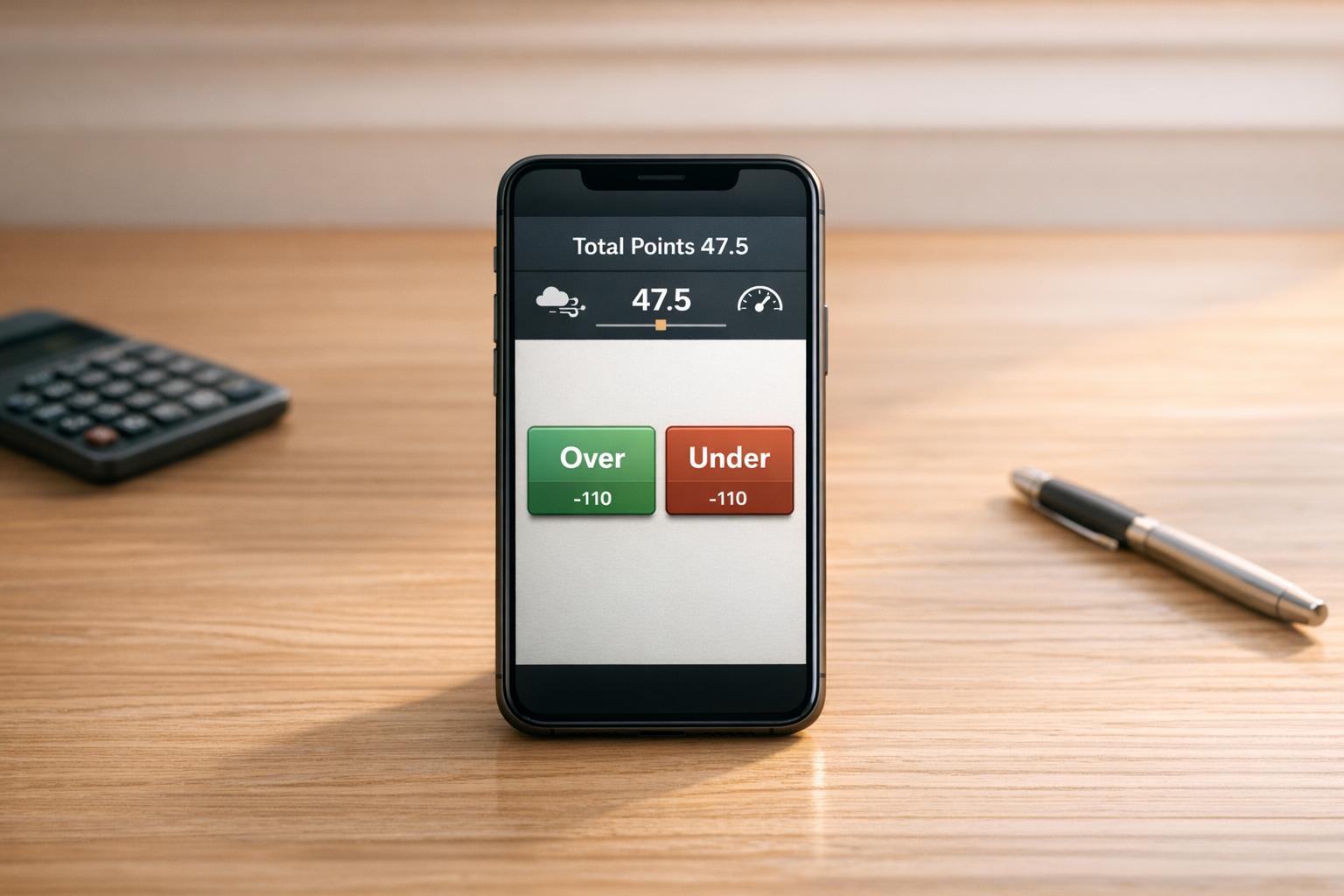
Over/under betting, or "totals", is about predicting if the combined score of a game will go above or below a number set by sportsbooks. It doesn’t matter who wins - just the total points. For example, if the line is 45.5 points:
- Bet the Over if you think the score will be 46 or more.
- Bet the Under if you think it’ll be 45 or fewer.
Key facts:
- Over/under is one of the top three betting markets, alongside point spreads and moneylines.
- Odds are typically -110, meaning a $110 bet wins $100.
- Factors like team pace, efficiency, weather, and injuries impact totals.
- Overtime points usually count toward the total.
Smart bettors analyze stats like recent performance, game pace, and betting trends. Tools like odds converters and calculators help improve decisions. Managing your bankroll - betting only 1-3% of it per wager - helps ensure long-term success.
Casual bettors often favor the Over, so lines may be higher than they should be. This bias creates opportunities for betting the Under, especially closer to game time.
How Over/Under Betting Works
What Are Totals?
A total represents the predicted combined score of both teams in a game, set by the sportsbook before the game begins. As a bettor, your task is to decide if the final score will be higher (over) or lower (under) than this number. Who wins the game doesn’t matter in this type of bet - only the total points scored.
Sportsbooks determine these totals using advanced algorithms and simulations. They consider key factors like a team’s pace (how quickly they play) and efficiency (how well their offense and defense perform). When the total is first released, professional gamblers - known as sharp bettors - often place early bets, which can influence the line. Sportsbooks then adjust the number based on this early activity before casual bettors get involved. Their ultimate aim isn’t to predict the exact score but to balance the betting action on both sides, reducing their risk.
If the final score lands exactly on the total, the bet is considered a push, and your original wager is refunded. Unless explicitly stated otherwise, overtime points are included in the final total.
Over/Under Betting Examples
Let’s break down how over/under bets work in different sports with real-world scenarios:
- NFL: In the September 2024 season opener between the Kansas City Chiefs and Baltimore Ravens, the total was set at 46.5 points. Betting the over meant the combined score needed to hit 47 or more to win. A final score of 31–20 (51 points) would cash the over, but a score of 24–20 (44 points) would favor the under.
- MLB: For an August 2025 game between the Washington Nationals and Los Angeles Dodgers, the total was set at 7.5 runs. The over was priced at –120 (bet $120 to win $100), while the under was offered at +100 (bet $100 to win $100). A game ending 5–4 (9 runs) would win the over, while a 3–2 result (5 runs) would win the under.
- NHL: In a matchup between the Boston Bruins and New York Islanders, the total was set at 5.5 goals, a common line when strong goalies are involved. A 4–2 final (6 goals) would win the over, while a 2–1 outcome (3 goals) would win the under.
- NBA: For a game between the Miami Heat and New York Knicks, the total was set at 211.5 points, reflecting the slower pace and defensive style of play. A combined score of 212 or more would win the over, while 211 or fewer would win the under.
Next, we’ll dive into the factors that influence how these totals are set and adjusted.
sbb-itb-3ff9055
What's an Over/Under Bet? | Totals Explained with Examples for Beginners | Sports Betting 101
Factors That Affect Over/Under Lines
Over/Under Betting Totals and Key Drivers by Sport
Sportsbooks consider a wide range of factors when setting totals, aiming to balance betting activity on both sides. Knowing what influences these numbers can help you spot opportunities when a total seems off.
Team Statistics and Playing Style
Pace and efficiency are major drivers of scoring. Faster-paced teams with high scoring efficiency naturally create more opportunities, while slower-paced teams limit them. Playing style also plays a big role. For example, in football, teams that focus on running the ball often eat up the clock, reducing scoring chances. On the flip side, pass-heavy offenses tend to generate more plays and extend drives.
A great example of how style impacts totals is the Army–Navy rivalry. From 2006 to 2021, the game went under the total 16 consecutive times because both teams used clock-draining triple-option offenses. Even in 2023, with an unusually low total of 28.5 points, the game ended 17–11, staying under yet again.
Coaching decisions also matter. Aggressive coaches who go for it on fourth down or attempt two-point conversions can lead to higher scores, while conservative coaches who settle for field goals or focus on clock management tend to favor lower totals. Red zone efficiency is another key metric - teams that struggle to convert drives into touchdowns might be better bets for the under, even if they move the ball effectively.
In the NFL, certain totals show up more frequently in final scores. For instance, a combined score of 41 occurs in about 3.9% of games, with other common totals including 37, 43, 44, and 45. These "key numbers" can influence whether you take a total of 44 or 44.5 points, as even a half-point difference can make a big impact.
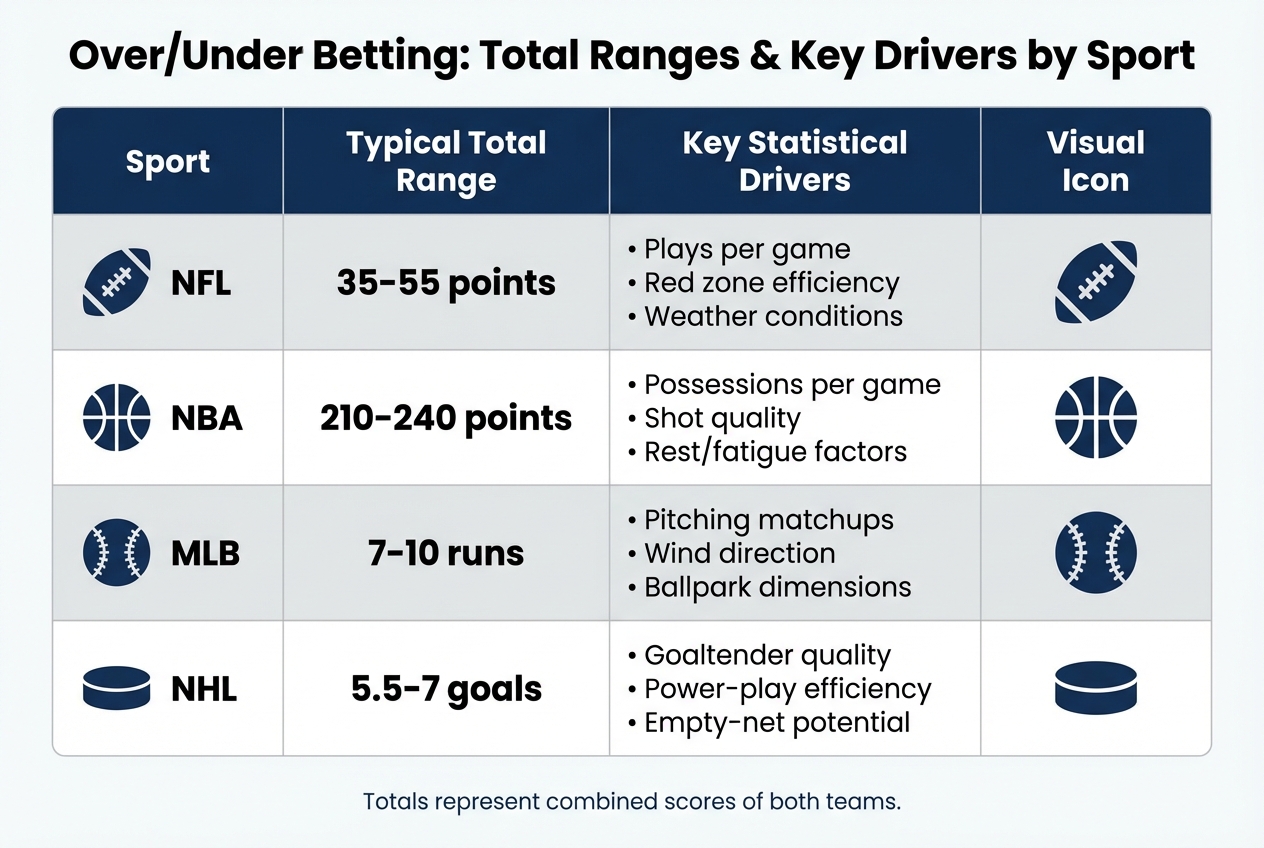
| Sport | Typical Total Range | Key Statistical Drivers |
|---|---|---|
| NFL | 35–55 points | Plays per game, red zone efficiency, weather |
| NBA | 210–240 points | Possessions per game, shot quality, rest/fatigue |
| MLB | 7–10 runs | Pitching matchups, wind direction, ballpark dimensions |
| NHL | 5.5–7 goals | Goaltender quality, power-play efficiency, empty-net potential |
Injuries and Weather Conditions
Injuries and weather can force sportsbooks to adjust totals significantly. For example, if a key offensive player like a quarterback or star wide receiver is injured, the total might drop by several points. On the other hand, defensive injuries typically have a smaller impact.
Weather is another major factor. High winds, for instance, can disrupt passing-heavy offenses and lead to lower scores. Take the December 2021 game between the New England Patriots and the Buffalo Bills - 30 mph winds led the Patriots to attempt just three passes, and the game ended with a low-scoring 14–10 result, hitting the under. Venue conditions also play a role. Indoor stadiums offer consistent environments, while outdoor venues can introduce variability, such as altitude effects or unpredictable weather. In baseball, ballpark dimensions are critical - Coors Field in Denver, known for its thin air, often sees higher scores compared to a more compact park like Fenway in Boston.
Public Betting Trends and Line Changes
Totals are set not to predict exact scores but to manage betting risk. Gambling Analyst Alyssa Waller puts it this way:
"The posted total isn't a prediction - it's a negotiation. Sportsbooks are setting a number that invites action on both sides."
Casual bettors tend to favor the over, drawn by the excitement of high-scoring games. This optimism bias can lead to inflated lines early on, making it more advantageous to bet the under closer to game time. Watching public behavior can also reveal where sharp money is going. For instance, if 80% of bets are on the over but the total drops from 51 to 49, it’s a sign that professional bettors are siding with the under. Late line moves, often within an hour of game time, can also indicate significant wagers or new information.
Shopping around for the best line is another essential strategy. Even a half-point difference - like 47 versus 47.5 - can be the difference between a win and a push. Considering the standard -110 vigorish (where you risk $110 to win $100, giving the house a 4.55% edge), finding better numbers can help you minimize that edge and improve your long-term results. Understanding these line movements is a key step in developing effective over/under betting strategies.
Over/Under Betting Strategies
Winning at over/under betting takes more than just luck - it demands a thoughtful, data-driven approach that combines statistical analysis, smart use of tools, and disciplined money management.
Analyzing Recent Team Performance
When evaluating over/under bets, focusing on recent performance often gives you a clearer picture than relying on full-season stats. A team’s dynamics can shift dramatically due to factors like the return of key players or strategic changes. Instead of looking at season averages, hone in on the last five to seven games to get a sense of how the team is currently performing.
Head-to-head matchups can also shed light on potential outcomes. Certain teams tend to produce high-scoring games when facing specific opponents due to their complementary playing styles, which might lead to more possessions and scoring chances. On the other hand, some matchups are naturally more defensive and slow-paced. Paying attention to metrics like pace and efficiency can provide deeper insights than broad season-long figures.
As Steven Petrella, Deputy Editor at The Action Network, points out:
A lot of math goes into predicting the over-under for a given match... but there are two main factors: pace (on offense) and efficiency (on both offense and defense).
By creating your own projections using these metrics, you can compare them to the sportsbook’s posted totals. If your numbers differ significantly, you might have found a potential value bet worth exploring.
Using Betting Tools and Calculators
Professional bettors don’t rely on intuition alone - they use tools to refine their strategies. For example, an EV (Expected Value) calculator helps you compare the sportsbook’s implied probability with your own analysis. If your calculated probability suggests a higher likelihood of success than the break-even rate, you may have a positive EV bet.
An odds converter is another handy tool. It translates various odds formats into implied probabilities, making it easier to determine if a wager offers fair value. Additionally, a hold calculator reveals the sportsbook's built-in advantage (or "juice"), which can directly affect your profitability over time.
Line shopping is equally important. Different sportsbooks often post slightly different totals, and even a half-point difference can turn a loss into a push - or a push into a win. Keeping a detailed record of your bets in a spreadsheet can help you identify patterns and refine your overall strategy.
Once you’ve used these tools to identify value, the next step is to manage your bankroll wisely.
Managing Your Betting Bankroll
Even with the best tools and analysis, protecting your bankroll is crucial for long-term success. Treat over/under betting as a form of entertainment rather than a primary income source. Set aside an amount you’re comfortable losing, and avoid chasing losses by increasing your bets after a bad streak.
Before placing a wager, calculate your risk-to-reward ratio. Tools like the Kelly Criterion calculator can help you determine the optimal bet size based on your perceived edge and bankroll. This approach minimizes financial risk during inevitable losing streaks.
If you have a strong read on one team but less confidence in the overall game, consider betting on team totals rather than the combined game total. Keep in mind, however, that most sportsbooks count overtime points toward the total, which can add extra uncertainty for under bettors.
Finally, stick to a conservative betting strategy by limiting each wager to 1-3% of your bankroll. This disciplined approach helps protect you from the unpredictable nature of sports while ensuring you can continue betting over the long haul.
How Over/Under Payouts Are Calculated
Once you've honed your betting strategy, understanding how payouts work is key to spotting real value in your wagers.
When calculating over/under winnings, you need to factor in the sportsbook's commission - known as the "vig" - which directly impacts your profit margins.
What Is Vig and How Does It Affect Odds?
The vigorish, or "vig", is essentially the sportsbook's fee for accepting your bet. For most over/under bets, the odds are set at -110 on both sides. This means you have to risk $110 to win $100 in profit - or, put simply, you risk $11 for every $10 of potential profit.
The -110 odds also highlight the built-in margin for the sportsbook. To break even over time at these odds, you need to win at least 52.4% of your bets. In a perfectly fair system, the implied probabilities of both sides of a bet would add up to 100%. However, with -110 odds on both sides, the implied probability for each side is 52.4%, totaling 104.8%. That extra 4.8% represents the sportsbook's margin, ensuring they profit regardless of the outcome.
As Scott Erskine from SportsLine puts it:
With every -110 wager you make, you pay a fee just under 10% to the sportsbook.
The vig can vary depending on the odds. For instance, a -105/-105 line has a lower vig of about 2.4%, while a -115/-115 line increases it to roughly 7%. While these differences might seem minor, they add up significantly over time. If you win 52% of 100 identical $100 bets at -105 odds, you'd walk away with a net profit of around $90. But at -115 odds, that same win rate would actually result in a $70 loss.
Payout Calculation Examples
Payouts are calculated differently depending on whether you're dealing with negative or positive odds. For negative odds (e.g., -110), divide your stake by the decimal conversion of the odds. For positive odds (e.g., +105), multiply your stake by the odds as a decimal.
| Stake | Profit at -110 | Total Payout (-110) | Profit at +105 | Total Payout (+105) |
|---|---|---|---|---|
| $10 | $9.09 | $19.09 | $10.50 | $20.50 |
| $50 | $45.45 | $95.45 | $52.50 | $102.50 |
| $100 | $90.91 | $190.91 | $105.00 | $205.00 |
For example, if you place a $50 bet at -110 odds, you calculate your profit as: $50 ÷ 1.10 = $45.45. Add your original $50 stake, and your total payout is $95.45. On the other hand, if you bet $50 at +105 odds, the profit is calculated as: $50 × 1.05 = $52.50. Adding your stake brings the total payout to $102.50.
Using the LearnSportsBetting Hold Calculator

To assess a sportsbook's edge, the LearnSportsBetting Hold Calculator is a handy tool.
This calculator helps you determine the sportsbook's commission on a given line. By converting American odds into implied probabilities, you can see the "overround" - the percentage above 100% that reflects the book's built-in advantage.
Here’s how it works: Input the odds for both the Over and Under. For example, if both sides are -110, the calculator will show a hold percentage of about 4.8%. If the odds are -105/-105, the hold drops to around 2.4%, offering a better deal for the bettor. A lower hold percentage means greater value and better chances of long-term profitability.
This tool is especially helpful when comparing lines across multiple sportsbooks. For instance, finding a line at -105 instead of -115 might not seem like a big deal, but over hundreds of bets, it could save you thousands of dollars - even if the actual totals are identical.
Conclusion
Over/Under betting thrives on careful preparation and a strategic mindset. As sports betting expert Alyssa Waller puts it:
Totals reward preparation, patience, and perspective. Master those, and Over/Under betting stops feeling like a coin flip - and starts becoming a long-term edge.
The key to success lies in spotting market misjudgments - whether in game tempo, offensive efficiency, or external factors like weather. Sportsbooks set lines to balance action, not to predict outcomes, leaving room for savvy bettors who dig beyond surface-level stats.
Here’s what the data says: Between 2016 and early 2022, "Unders" in NFL and NCAAF games achieved a 51.8% win rate. This edge often exists because casual bettors lean toward the "Over", pushing totals higher than they should be - especially during prime-time matchups.
To gain an advantage, focus on pace and efficiency metrics instead of just raw scoring numbers. Weather conditions, injuries, and even a half-point line difference can make all the difference between a win and a push. Tools like the LearnSportsBetting Hold Calculator and diligent line-shopping can help you squeeze maximum value from every bet.
FAQs
How do sportsbooks determine over/under totals for games?
Sportsbooks calculate over/under totals by diving into a mix of data points. They look at team performance, player stats, historical patterns, weather conditions, and even expert opinions. All of this helps them estimate a specific number - like the combined score of both teams in a game.
After setting the total, sportsbooks monitor betting activity closely. If one side (over or under) starts drawing more bets, they might tweak the total slightly. This adjustment helps keep the action balanced, reduces their risk, and ensures the betting market stays lively.
What should I consider when placing an over/under bet?
When you're placing an over/under bet, it's crucial to dive into the details of the teams involved. Start by looking at their offensive and defensive strengths, recent performances, and overall scoring trends. These elements play a big role in shaping the total points set by sportsbooks. Another key factor is the pace of play - teams with a fast-paced style often produce higher scores, while slower, defense-oriented teams tend to keep totals lower.
Don’t overlook external factors like weather conditions, injuries, or last-minute lineup changes. For instance, heavy rain or snow can slow down the game and reduce scoring opportunities. Similarly, if a team's star offensive player is sidelined, it could significantly impact the total. Keep an eye on line movement too - sharp changes before the game might indicate new information or shifts in betting activity.
Finally, consider the game’s context. High-stakes matchups, like playoff games or heated rivalries, often bring unique dynamics that can affect scoring patterns. By combining these factors, you’ll be better equipped to make informed decisions when betting on over/under totals.
What is the vig, and how does it impact my payouts in over/under betting?
The vig - short for vigorish or juice - is the fee sportsbooks charge for processing your bet. It’s baked into the odds, subtly reducing your potential winnings. For instance, if the odds for both the over and under are listed at -110, you’d need to wager $110 to win $100. That extra $10? That’s the sportsbook’s commission.
This fee directly impacts your payouts by lowering the return on winning bets, which can make turning a long-term profit more challenging. A higher vig means smaller payouts, while a lower vig gives you a better chance to maximize your profits. By understanding how the vig works, you can better evaluate the value of your bets and make more informed choices when betting on over/under totals.


