Moneyline Betting
A clear guide to moneyline betting: read U.S. odds (+/−), calculate payouts, understand implied probability, and manage your bankroll.

Moneyline Betting
Moneyline betting is one of the simplest forms of sports betting: you’re just picking the winner. Here’s what you need to know:
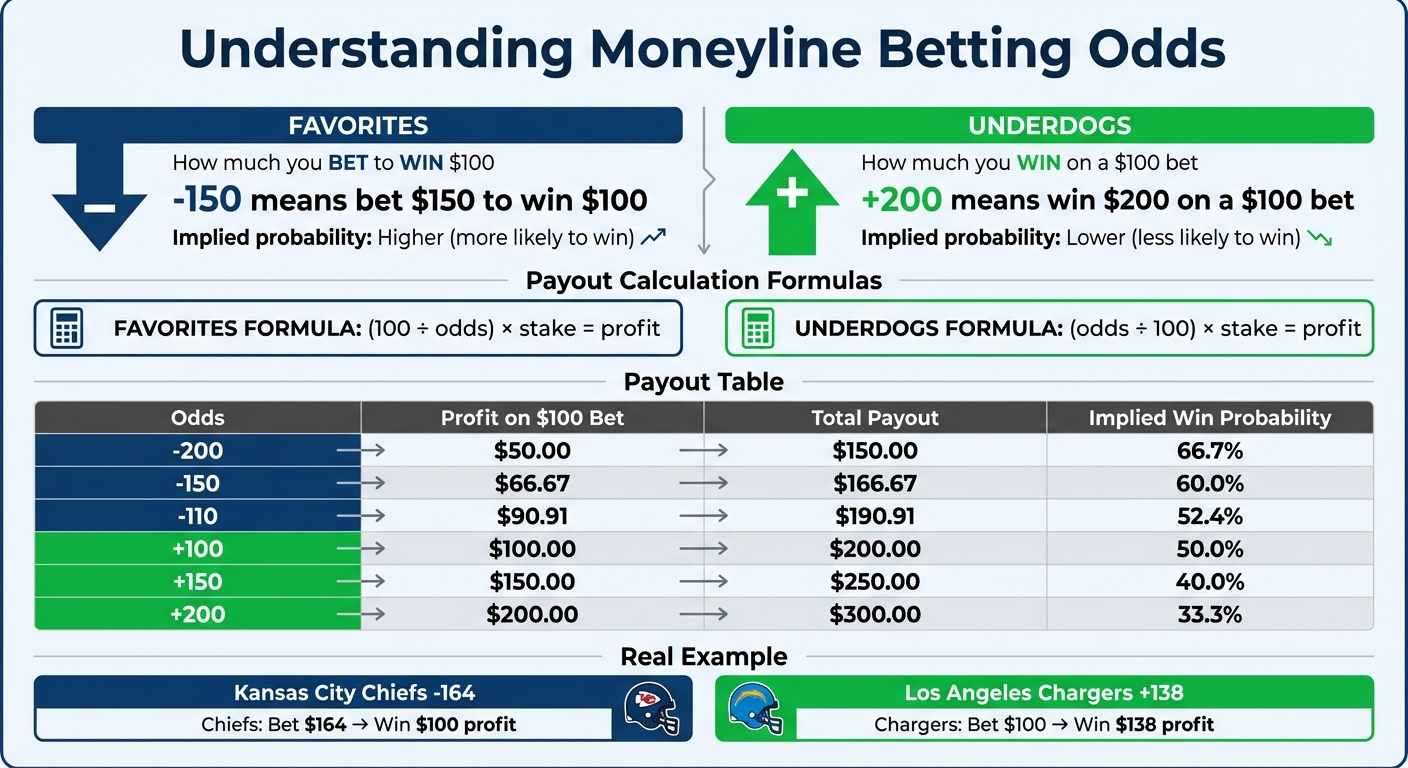
- Favorites are marked with a minus sign (-). For example, -150 means you need to bet $150 to win $100.
- Underdogs are marked with a plus sign (+). For example, +200 means a $100 bet wins you $200.
- Payouts depend on the odds, and calculating them is straightforward:
- For favorites:
(100 ÷ odds) × stake = profit. - For underdogs:
(odds ÷ 100) × stake = profit.
- For favorites:
Moneyline bets are popular in low-scoring sports (e.g., baseball, hockey) or when betting on underdogs for higher payouts. They’re ideal for beginners due to their simplicity but come with risks, especially when betting on heavy favorites. Understanding odds, implied probabilities, and managing your bankroll are crucial for long-term success.
This guide breaks down how moneyline odds work, calculates payouts, and provides tips for smarter betting.
Sports Betting 101: Mastering the Moneyline Bet | A Beginner's Guide
sbb-itb-3ff9055
How to Read Moneyline Odds
Moneyline Odds Calculator: Favorites vs Underdogs Payout Guide
How Moneyline Odds Work
In the U.S., moneyline odds revolve around a plus (+) and minus (-) system based on $100. These symbols help identify the favorite and the underdog in a matchup.
Negative odds (-) represent the favorite. The number shows how much you need to bet to win $100. For instance, if the Kansas City Chiefs are listed at -164, you'd have to wager $164 to make $100 in profit. This was the exact price for the Chiefs in Week 1 of the 2025 NFL season against the Los Angeles Chargers at FanDuel Sportsbook.
Positive odds (+) indicate the underdog, meaning the less likely team to win. The number reflects the profit you'd earn on a $100 bet. In the same matchup, a +138 line meant that a $100 bet would return $138 in profit.
Additionally, moneyline odds reveal the implied probability of a team's chances to win. Negative odds suggest a higher probability (e.g., -200 translates to about 66.7%), while positive odds show a lower probability (e.g., +200 equals roughly 33.3%). Once you understand this, you can move on to calculating payouts.
Calculating Payouts From Odds
Here’s how to calculate payouts for both favorites and underdogs:
- Favorites (negative odds): Divide 100 by the odds and multiply the result by your stake. For example, if you bet $50 on a team at -150, the calculation would be (100 ÷ 150) × $50 = $33.33 profit. Add your original $50 stake for a total payout of $83.33.
- Underdogs (positive odds): Divide the odds by 100 and multiply by your stake. A $50 bet on a team at +200 would be calculated as (200 ÷ 100) × $50 = $100 profit. Including your $50 stake, the total payout would be $150.
These formulas make it easy to estimate your returns before betting. To give you a clearer picture, here’s how specific odds translate into profits for a standard $100 bet:
| Odds | Profit on $100 Bet | Total Payout | Implied Win Probability |
|---|---|---|---|
| -200 | $50.00 | $150.00 | 66.7% |
| -150 | $66.67 | $166.67 | 60.0% |
| -110 | $90.91 | $190.91 | 52.4% |
| +100 | $100.00 | $200.00 | 50.0% |
| +150 | $150.00 | $250.00 | 40.0% |
| +200 | $200.00 | $300.00 | 33.3% |
For example, during the May 2024 Eastern Conference Finals, the Indiana Pacers were listed as -154 favorites against the New York Knicks (+129) in Game 4. A $154 bet on the Pacers would yield $100 in profit, while a $100 wager on the Knicks would return $129 in profit.
Moneyline Betting Examples in Popular Sports
NFL Moneyline Example
Imagine a game featuring the Kansas City Chiefs at -125 and the San Francisco 49ers at +105. Here’s what those numbers mean: the Chiefs are the favorite (indicated by the minus sign), while the 49ers are the underdog (shown by the plus sign).
If you bet $125 on the Chiefs, you’d earn a $100 profit if they win outright. That brings your total payout to $225 - your original $125 stake plus the $100 profit. On the flip side, a $100 bet on the 49ers would return $105 in profit if they manage to win, giving you a total payout of $205.
With moneyline bets, all that matters is picking the winner. The margin of victory doesn’t affect your payout. Whether the Chiefs win by a field goal or blow out the 49ers, your bet pays the same. This principle also applies to basketball moneyline bets.
NBA Moneyline Example
Basketball moneyline bets operate the same way. Take a matchup between the Los Angeles Lakers at -200 and the Denver Nuggets at +170. Here, the Lakers are the clear favorite.
To win $100 on the Lakers, you’d need to wager $200, reflecting an implied win probability of 66.67%. If you’re backing the Nuggets as the underdog, a $100 bet would result in a $170 profit if they pull off the win, with an implied probability of 37.04%.
Heavy Favorite Scenarios
In college football, you’ll sometimes see extreme moneyline odds when a dominant team faces a much weaker opponent. For instance, Indiana was listed at -2500 in their 2024 season opener against Old Dominion (+1100). At those odds, you’d need to bet $2,500 just to win $100.
Another example: Ohio State was a -400 favorite over Notre Dame (+300) in the 2025 College Football Playoff national championship. Betting $400 on Ohio State would yield a $100 profit, with an implied win probability of 80%. While heavy favorites tend to win more often, a single upset can wipe out profits from multiple successful bets.
"Moneyline betting can be a smart move... However, when betting on the favorite, the potential payout can often be quite small." - Brandon DuBreuil, Head of Covers
To increase potential returns, many bettors combine heavy favorites into parlays. For example, parlaying three favorites with odds of -650, -400, and -340 could result in combined odds of about -115. This strategy turns smaller individual payouts into a more appealing overall profit.
Pros and Cons of Moneyline Betting
Advantages of Moneyline Bets
Moneyline betting is as straightforward as it gets: just pick the winner. This simplicity makes it a perfect starting point for beginners who may feel overwhelmed by more complex betting systems.
One of the biggest perks is the opportunity for big payouts when betting on underdogs. For instance, placing $100 on a +300 underdog could net you $300 in profit, while a point spread bet at standard -110 odds might only yield $91 for the same wager. This potential for higher returns is a major draw for many bettors. To quote former Oakland Raiders owner Al Davis:
"Just win, baby".
While easy to understand and potentially lucrative, moneyline betting does come with its own set of challenges.
Disadvantages of Moneyline Bets
Betting on favorites often means risking a lot for a small return. Fox Sports sums it up well:
"The bigger the minus number, the more heavily that team is favored - and the less profit you will earn".
For example, wagering $400 on a -400 favorite might only win you $100, tying up a large chunk of your bankroll for a relatively low reward.
Another drawback is the "vig" or "juice" that sportsbooks build into the odds. This commission ensures the house profits no matter the outcome. As BettingUSA explains:
"The gap between two moneylines is where the VIG originates".
For example, a -200/+150 line includes a vig of about 6.25%, meaning the implied probabilities exceed 100%. Over time, this house edge can eat into your earnings, particularly if you consistently bet on favorites. SportsLine’s Scott Erskine cautions:
"The most attractive potential payouts are the most difficult to win".
This highlights the inherent risk in betting on underdogs - they may offer bigger payouts, but they win less often.
Moneyline vs. Point Spread: Side-by-Side Comparison
| Factor | Moneyline Betting | Point Spread Betting |
|---|---|---|
| Simplicity | High - just pick the winner | Moderate; consider margin of victory |
| Payout Potential | High for underdogs, low for favorites | Standard; usually around -110 on both sides |
| Risk Profile | Higher stakes for favorites; riskier for underdogs | Balanced; point spread levels the playing field |
| Vig/Juice | Can vary, often higher (e.g., 6.25% for -200/+150) | Typically standardized at 4.54% for -110 lines |
| Common Sports | Baseball, hockey, soccer, UFC | Football, basketball |
Moneyline Betting Tips and Bankroll Management
When to Use Moneyline Bets
Moneyline bets are particularly useful when favorites are priced at -150 or less, as this avoids the risk of a team winning but failing to cover a narrow spread. For instance, if the Kansas City Chiefs are listed at -140 on the moneyline and -3 on the spread, a close win could cost you the spread bet. However, with the moneyline, you only need the team to win outright.
Underdog betting on the moneyline can also be lucrative. In MLB, underdogs win outright about 40% of the time, which means payouts can be much higher when an upset occurs. Keep an eye on line movement from the opening odds to game time. For example, in live betting, if a favorite drops from -200 to -110, you might find a better price while still expecting them to win. These factors highlight the importance of disciplined bankroll management.
Bankroll Management Techniques
The key to long-term success in sports betting is managing your bankroll effectively. A popular approach is the unit system, where each unit equals 1–2% of your total bankroll. For example, if you have a $1,000 bankroll, a 2% unit means you’d wager $20 per bet. If your bankroll decreases to $900, your unit size adjusts to $18.
Experienced bettors often use the Kelly Criterion, which calculates optimal bet sizes based on your perceived edge. Many adopt a fractional Kelly approach, wagering only 25% to 50% of the recommended amount to reduce volatility while still capitalizing on value.
It's also crucial to understand the math behind your bets. At standard -110 odds, you need a win rate of about 52.4% just to break even. To track your performance, record every wager and analyze trends to identify what’s working. Additionally, line shopping - comparing odds across sportsbooks - can make a big difference. For instance, a 10-cent difference in odds (like -130 versus -140) can significantly impact your long-term profits.
Discipline is non-negotiable. Set strict loss limits, such as 5% of your bankroll per day or 20% per month, to avoid chasing losses. As betting analyst Josh Inglis puts it:
"Picking winners isn't the end-all of being a profitable sports bettor. It's how you managed your money that determines that ultimate goal of a positive ROI".
LearnSportsBetting Tools for Better Betting

To refine your betting strategy, take advantage of tools designed to improve decision-making. LearnSportsBetting's odds converter, for instance, translates American odds into implied probabilities. This helps you identify value bets - if odds of +150 imply a 40% win probability, but your analysis suggests a 50% chance, you’ve found value.
Another helpful tool is the parlay calculator, which shows the true risk and reward of combining multiple moneyline bets. Be cautious, though - stacking heavy favorites can backfire, as one upset could ruin the entire wager.
LearnSportsBetting also offers real-time odds, expert advice, and public betting trend data, giving you the insights needed to make smarter bets. These resources, combined with disciplined bankroll management, can set you up for sustainable success.
Conclusion
Moneyline betting boils down to one simple goal: picking the outright winner. Favorites are marked with a minus sign, while underdogs are identified by a plus sign.
But there's more to long-term success than just picking winners. It’s about spotting value. This means finding situations where your calculated probability of an outcome is higher than the sportsbook's implied probability. Savvy bettors also know the importance of comparing odds across different sportsbooks. Even small differences - like -350 versus -380 - can make a noticeable impact over time. And don’t forget, standard -110 odds mean you’ll need to win more than 50% of your bets to come out ahead.
Smart wagering goes hand in hand with disciplined bankroll management. Stick to a consistent unit system, only risking a small percentage of your total bankroll on each bet - typically 1% to 2% is a safe range. Tools like LearnSportsBetting’s odds converter, parlay calculator, and real-time odds tracker can be incredibly useful for spotting value bets and making informed choices.
Finally, always bet responsibly. Set strict loss limits, avoid chasing losses, and never wager money you can’t afford to lose. When approached with care and discipline, moneyline betting can be both enjoyable and potentially profitable.
FAQs
How can I calculate the implied probability from moneyline odds?
To figure out the implied probability from moneyline odds, the calculation changes depending on whether the odds are positive or negative:
- For positive odds (like +150), the formula is:
100 / (Odds + 100). - For negative odds (like -150), the formula is:
|Odds| / (|Odds| + 100).
This gives you a percentage that reflects the implied chance of an outcome happening. For instance, with odds of +200, the implied probability would be 100 / (200 + 100) = 33.33%. On the other hand, if the odds are -200, the calculation becomes 200 / (200 + 100) = 66.67%.
Knowing implied probability can help you assess if a bet aligns with your expectations and whether it’s worth placing. It’s a handy tool for making more informed betting choices.
What are the risks of betting on strong favorites in moneyline bets?
Betting on strong favorites in moneyline wagers might seem like a safer choice, but it comes with its own set of challenges. Even teams or players expected to win with an implied probability of 85% or more can face unexpected losses. Upsets are a regular part of sports, and when they happen, your bet can quickly go south.
Another issue is the limited value offered by odds on favorites. The potential payout often doesn't align with the risk you're taking, especially after factoring in the bookmaker's cut. This means you might be risking a lot for relatively small returns. Plus, focusing solely on favorites could mean missing out on the bigger payouts that underdog bets sometimes provide.
To navigate these risks, it's crucial to assess whether the odds accurately represent the chances of an outcome. Avoid relying entirely on favorites if you're aiming for consistent success in your betting strategy.
What’s the best way to manage my bankroll when placing moneyline bets?
Managing your bankroll wisely is crucial for staying in control and boosting your chances of long-term success with moneyline betting. A practical strategy is to wager only a small percentage of your total bankroll - typically 1-5% per bet. This approach helps safeguard your funds during losing streaks and minimizes the risk of substantial losses.
Keep a detailed record of every bet, noting the date, amount, odds, and outcome. This habit allows you to identify patterns and fine-tune your strategy over time. Additionally, set firm boundaries, like stop-loss rules, to avoid impulsive decisions and keep your spending in check. By staying disciplined and betting only what you can afford, you'll position yourself for more steady and manageable results.


