 LearnSportsBetting
Sports Betting For Beginners
Learn sports betting basics: read American odds, compare lines, use moneyline/spread/totals, and manage bankroll with 1–3% units to bet responsibly.

Sports Betting For Beginners
Sports betting is growing fast in the U.S., with over $100 billion wagered in 2023 and legal betting now available in 38 states and Washington, D.C. If you're new to betting, it's important to understand the basics before placing your first wager. Here's what you need to know:
- How Odds Work: American odds use "+" for underdogs (e.g., +200 means a $100 bet wins $200) and "-" for favorites (e.g., -150 means you bet $150 to win $100). Odds also include the sportsbook's profit margin, called the "vig."
- Types of Bets: The most common bets are:
- Moneyline: Bet on who wins.
- Point Spread: Bet on the margin of victory.
- Over/Under: Bet on the total points scored.
- Bankroll Management: Set a budget, bet only 1–3% of it per wager, and track your bets. This helps you avoid losses from emotional betting.
- Avoid Mistakes: Don't chase losses or settle for bad odds. Compare odds across sportsbooks to get the best value.
Sports betting can be fun if you treat it as entertainment, not a way to make money. Stick to a strategy, bet responsibly, and enjoy the experience.
Sports Betting 101: Gambling Tutorial for Beginners
sbb-itb-3ff9055
Understanding Odds and How They Work
Sports Betting Odds Guide: How to Read American Odds and Calculate Payouts
Odds represent the likelihood of an outcome and determine how much you can win on a bet. Think of them as the sportsbook's way of assigning a price to every possible result in a game. When you see odds, you're looking at both the bookmaker's probability assessment and their built-in commission.
Odds come in different formats - American (commonly used in the U.S.), Decimal, and Fractional. However, American odds are the standard among U.S. bettors. Most sportsbooks allow you to switch between these formats in their settings.
Here’s where it gets tricky: sportsbooks include a commission, often called the "vig" or "juice". For example, a fair coin flip has true odds of +100 (a 50/50 chance). However, sportsbooks often list each outcome at -105, reflecting a 51.22% implied probability. That extra 1.22% is how they make money.
Understanding this concept is crucial because it influences every bet you place. Odds are shaped by factors like statistics, injury updates, and betting trends. Now, let’s break down how American odds work.
How to Read American Odds
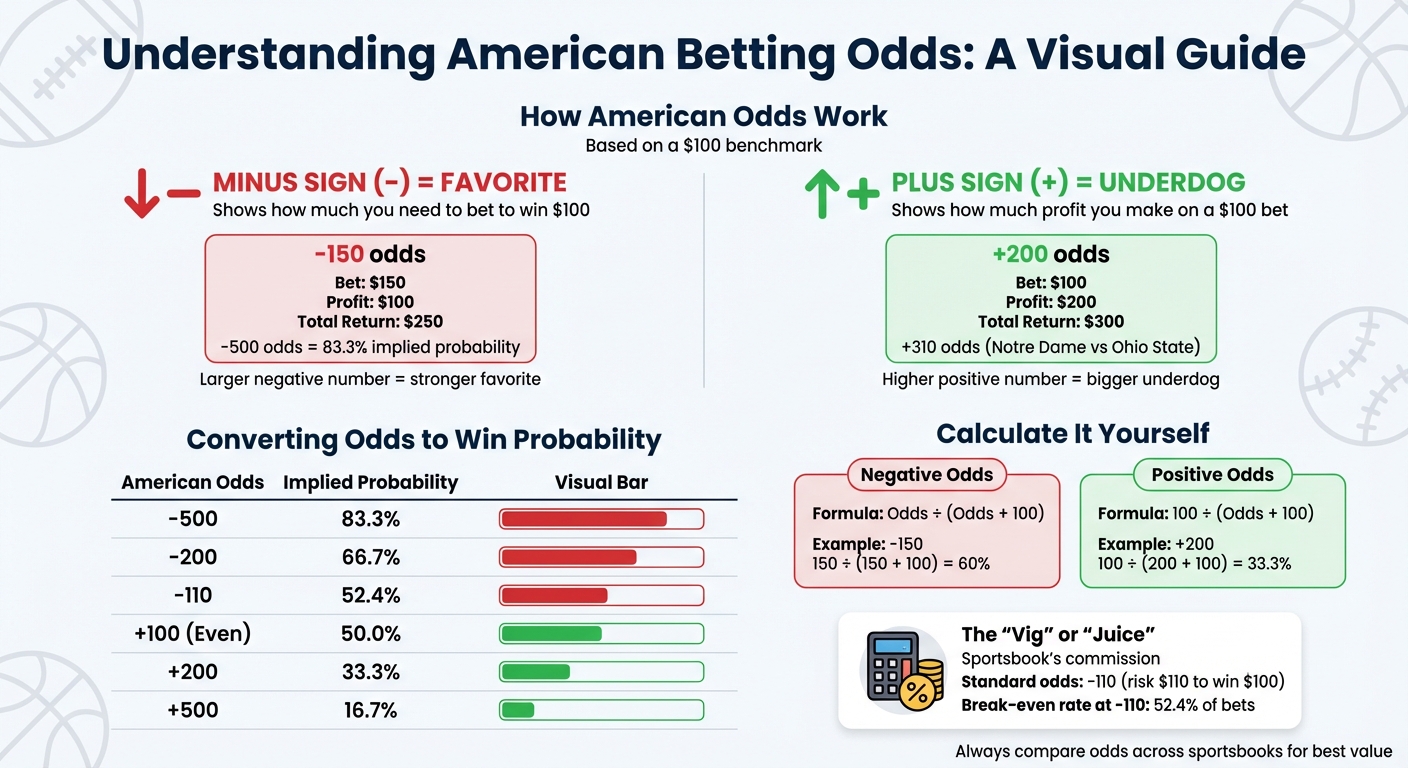
American odds are based on a $100 benchmark and use plus (+) and minus (-) signs to distinguish underdogs from favorites.
- Favorites: Marked with a minus sign (-), these odds show how much you need to wager to win $100 in profit. For instance, odds of -150 mean you must bet $150 to win $100. A $150 wager at -150 would return $250: your $150 stake plus $100 profit. The larger the negative number, the stronger the favorite. Odds of -500, for example, mean you’d need to risk $500 to win $100, which reflects an 83.3% implied probability.
- Underdogs: Marked with a plus sign (+), these odds show how much profit you’d make on a $100 bet. For example, odds of +200 mean a $100 bet would return $200 in profit, plus your original $100 stake, for a total payout of $300.
During the 2025 College Football Playoff Championship Game, Ohio State was listed as -400 favorites against Notre Dame, which had +310 odds. A bettor would need to wager $400 on Ohio State to win $100, while a $100 bet on Notre Dame would yield $310 in profit. These odds reflected the sportsbook's view that Ohio State was the clear favorite.
The math scales with your bet size. For example, a $50 bet at +200 odds would return $100 in profit, while a $50 bet at -150 odds would yield about $33.33 in profit. Most sportsbooks calculate payouts for you when you enter your stake, but knowing the math helps you assess whether a bet is worth it.
For standard point spread and over/under bets, odds are usually -110, meaning you risk $110 to win $100. This 10% commission is how sportsbooks earn their cut. To break even at -110 odds, you’d need to win 52.4% of your bets over time.
Converting Odds to Probability
Every set of odds corresponds to an implied probability - the percentage chance the sportsbook assigns to an outcome. Converting odds into probability shows whether a bet offers good value. If your research suggests a team has better chances than the implied probability, you might have a profitable opportunity.
Here’s how to calculate implied probability:
- For negative odds, divide the absolute value of the odds by (absolute value + 100). For example, with -150 odds: 150 ÷ (150 + 100) = 60% implied probability.
- For positive odds, divide 100 by (odds + 100). For example, with +200 odds: 100 ÷ (200 + 100) = 33.3% implied probability.
| American Odds | Implied Probability |
|---|---|
| -500 | 83.3% |
| -200 | 66.7% |
| -110 | 52.4% |
| +100 (Even) | 50.0% |
| +200 | 33.3% |
| +500 | 16.7% |
"Understanding implied probability completes your grasp of odds. It connects odds, payouts, and probability into a single framework." - Topend Sports
Instead of calculating this manually, you can use an odds converter tool, which is available on most sportsbook websites and betting education platforms.
Knowing implied probabilities also makes line shopping - comparing odds across sportsbooks - much easier. Even small differences in odds can impact your long-term success. For example, if one sportsbook offers -105 and another lists -110 for the same bet, the -105 line is better because it requires less risk for the same potential payout.
Types of Bets Explained
Once you’ve got a handle on how odds work, it’s time to dive into the different types of bets you can place. The three most common options are moneyline, point spread, and over/under (totals) bets. Each of these offers its own approach, giving you flexibility in how you wager. Let’s break them down to help you shape your betting strategy.
Moneyline Bets
Moneyline bets are as straightforward as it gets - you’re simply betting on which team will win. The margin of victory doesn’t matter. Whether your team wins by a single point or dominates by 50, you win the bet.
"A moneyline bet means you simply pick the winner of a game. It's the most popular and straightforward bet in all of sports. It doesn't matter if the team you back wins by one or 100 points. If they win, you win." – Ryan Hagen, Sports Betting Writer
Payouts depend on whether you’re backing the favorite or the underdog. For example, betting $760 on a heavy favorite at -760 (like the Chiefs) would win you $100. On the flip side, a $100 bet on an underdog at +585 would net you $585 if they pull off the upset. Moneyline bets are especially popular in sports like baseball and hockey, where games are often decided by narrow margins.
Point Spreads
Point spreads make things more competitive by giving the underdog an advantage and requiring the favorite to win by a certain margin. If a favorite is listed as -7, they need to win by more than 7 points to "cover" the spread. Meanwhile, an underdog at +7 can lose by up to 6 points - or win outright - and still cover the spread.
"The spread levels the contest between favorites and underdogs." – Sloan Piva, Content Producer, Sporting News
Take a March 2022 NBA game between the Brooklyn Nets (+4.5) and the Philadelphia 76ers (-4.5). The Nets lost 120-117, but adding the 4.5-point spread to their score gave them an adjusted total of 121.5, meaning they covered the spread. If the final score lands exactly on the spread (e.g., a 7-point favorite wins by 7 points), it’s called a "push", and your bet is refunded. To avoid this, sportsbooks often use half-point spreads like -7.5 or +3.5.
Over/Under (Totals) Bets
Over/under bets, also called totals, focus on the combined score of both teams rather than picking a winner. The sportsbook sets a total, and you bet on whether the final score will be over or under that number.
For instance, if the Miami Heat and New York Knicks have a set total of 222.5 points, and the game ends 114-112 (a combined score of 226), the "Over" bet wins. Using a half-point, like 222.5, eliminates the possibility of a push, ensuring there’s always a clear result.
Both point spread and over/under bets typically come with -110 odds, meaning you’d need to risk $110 to win $100.
| Bet Type | Objective | Example Odds | Payout Logic |
|---|---|---|---|
| Moneyline | Pick the winner | -150 / +130 | Bet $150 to win $100 (Fav) or $100 to win $130 (Dog) |
| Point Spread | Bet on margin of victory | -7 (-110) | Favorite must win by 8+ points to "cover" |
| Over/Under | Wager on total points | 220.5 (-110) | Combined score must be 221+ for "Over" to win |
Getting familiar with these bet types not only strengthens your understanding of odds but also sets the foundation for managing your bankroll wisely.
Managing Your Bankroll
Understanding odds is crucial, but managing your bankroll is what truly sets successful bettors apart. Your bankroll refers to the funds you’ve specifically set aside for sports betting - think of it as your operating budget, not a shortcut to instant wealth. Treating it this way helps you approach betting strategically rather than emotionally.
Here’s a harsh truth: 90% of sports bettors lose money in the long run, even those with a winning record. Why? Poor bankroll management. Even skilled bettors with a solid 55% win rate face a 1.7% chance of enduring a 10-bet losing streak. Without careful planning, those inevitable cold streaks can wipe out your bankroll before your strategy has a chance to deliver results.
"The key to sustainable betting success lies in treating stake sizing as a percentage of a rolling, conservative bankroll estimate. This approach prevents emotional over-betting after wins or losses and maintains long-term profitability." – Robert J. Wood, PhD, Exercise Physiologist, University of Western Australia
Setting a Betting Budget
Start by deciding on a fixed amount of disposable income that you can afford to lose without impacting your day-to-day life. This is money meant purely for entertainment. Professional bettors rarely wager more than 1% of their bankroll on a single event, and beginners should adopt the same approach.
The 1% rule acts as a safety net. For example, with a $1,000 bankroll, you’d bet just $10 per wager. While this might feel overly cautious, it would take 100 consecutive losses to deplete your funds. Compare that to someone betting $50 per game - they’re out after just 20 losses.
To simplify, use the unit system: one unit equals a fixed percentage (typically 1–3%) of your bankroll. This system automatically adjusts as your bankroll grows or shrinks.
| Betting Level | Starting Bankroll | Unit Size (1–3%) | Survival Buffer (10-Loss Streak) |
|---|---|---|---|
| Beginner / Casual | $200 – $500 | $2 – $15 | 67–250 units remaining |
| Serious Hobbyist | $500 – $2,000 | $5 – $60 | Comfortable cushion |
| Semi-Pro | $2,000 – $10,000 | $20 – $300 | High resilience to variance |
Keep your bankroll in a separate account from your personal funds. This separation helps you avoid dipping into money meant for bills or other expenses and makes tracking your performance much easier. At standard -110 odds, you’ll need to win at least 52.4% of your bets just to break even. Treating this as a structured hobby rather than a gamble is critical.
Tracking Your Bets
Once your budget is set, tracking your bets becomes non-negotiable. Relying on memory alone is unreliable - you’re likely to remember the big wins while conveniently forgetting the losses. A betting log provides an objective record of your performance, showing what’s working and what’s not.
For each wager, document the date, event, bet type, odds, stake, and outcome. This data can uncover trends you’d otherwise miss - maybe you excel at NFL spreads but struggle with NBA totals, or perhaps your so-called "high-confidence" bets are consistently underperforming. Tools like Excel spreadsheets or LearnSportsBetting’s automated trackers can make this process easier.
Adjust your unit size based on your current bankroll. For instance, if your $1,000 bankroll grows to $1,200, your 1% unit increases from $10 to $12. On the flip side, if your bankroll drops to $800, your unit decreases to $8. These adjustments ensure your risk stays proportional and prevent emotional overreactions, like chasing losses with oversized bets.
Mastering bankroll management is a cornerstone of a successful betting strategy.
Common Mistakes Beginners Make
Even experienced bettors can stumble into common traps. The most harmful mistakes often come from emotional decisions rather than sticking to a well-thought-out strategy. These missteps can quickly derail even the most promising start, undermining the principles of odds analysis and bankroll management.
Chasing Losses
Chasing losses happens when you make impulsive bets in an attempt to recover previous losses quickly. It's one of the fastest ways to burn through your bankroll. Instead of following your planned betting strategy and unit size, you start placing bigger bets driven by frustration rather than logic or research.
"Do not chase: Chasing occurs when you go on tilt, lose your discipline and risk more than you should because you're upset about losing your previous bet." – Jeff Edelstein, Journalist and Columnist, Sports Handle
Here’s the problem: each bet is independent. A losing streak doesn’t mean a win is "due", and trying to double down to recover losses rarely works. Even professional bettors only win about 54% to 55% of their wagers, so losing streaks are part of the game - even for the best. The key is consistency. Stick to your pre-determined unit size (such as 1% of your bankroll) and trust in your long-term strategy. Success doesn’t hinge on the next bet but rather on performance over hundreds of wagers.
Not Comparing Odds
Just like managing your bankroll, finding the best odds is crucial. Failing to shop around for better odds is essentially leaving money on the table. Many beginners settle for the first odds they see, but even small differences in odds can add up significantly over time.
For example, at standard -110 odds, you need to win 52.4% of your bets to break even. But if you consistently find -105 odds, your break-even rate drops to 51.2%. Over 250 bets, this could mean three fewer wins needed to stay profitable. Sportsbooks also differ on spreads and totals. One might offer a +7 spread while another provides +7.5. That extra half-point, also known as "the hook", can be the difference between a win and a loss.
To make the most of your bets, open accounts with multiple sportsbooks such as FanDuel, DraftKings, and BetMGM. This allows you to compare lines quickly and ensure you’re getting the best value. Use tools designed for line shopping to streamline the process and make it a routine part of your betting strategy.
Getting Started with Sports Betting
You're ready to place your first bet, but before diving in, double-check that sports betting is permitted where you live. As of 2025, it’s regulated in about 38 to 40 U.S. states, along with Washington, D.C.. With the U.S. online sports betting industry expected to pull in $17.23 billion in annual revenue by 2025, you'll have plenty of licensed platforms to choose from.
Once you've confirmed the legalities, it's time to approach betting responsibly. Start by setting aside a dedicated betting budget - typically between $200 and $500 - and stick to betting only 1%–3% of that budget per wager. For a deeper dive into managing your bankroll effectively, check out the previous section.
"Always stick with sports you know, and don't forget to bet logically, not emotionally." - Investopedia
Now that your budget is in place, focus on simple bets and keeping detailed records. Start with straightforward options like moneylines or over/unders. Track every bet carefully, noting details such as the date, sport, stake, odds, and outcomes. To avoid overspending, set clear deposit and loss limits before you begin. And if gambling ever feels overwhelming, reach out to the National Problem Gambling Helpline at 1-800-GAMBLER for support.
Finally, take the time to learn and practice. Platforms like LearnSportsBetting provide tools such as calculators and bankroll management guides to help you improve your strategy over time. Keep in mind that success in sports betting isn’t about hitting a massive win right away - it’s built on the discipline of making hundreds of well-thought-out wagers.
FAQs
What’s the best way to manage my bankroll as a beginner in sports betting?
Managing your bankroll wisely is crucial for betting responsibly and keeping sports betting enjoyable. Start by setting a clear budget - decide how much money you’re comfortable dedicating to betting, and stick to that amount. Think of this as entertainment spending, not a financial investment.
A practical guideline is to wager only a small percentage of your bankroll on each bet, typically between 1% and 5%. For instance, if your bankroll is $500, keep individual bets between $5 and $25. This strategy helps safeguard your funds during losing streaks, ensuring you can continue betting without depleting your entire budget.
To maintain discipline, you might want to divide your bankroll into units. Each unit represents a set amount, and you base your bets on a specific number of units. This system keeps your betting consistent and helps you avoid impulsive decisions. The key is to focus on making thoughtful, calculated bets while keeping the experience enjoyable and manageable.
What are the biggest mistakes beginners make in sports betting?
Beginners in sports betting often stumble into a few common pitfalls that can derail their success. One major issue is failing to practice smart bankroll management. This includes not setting a clear budget or wagering more than they can comfortably afford to lose. These mistakes often lead to chasing losses or making impulsive bets, which can snowball into even bigger losses.
Another mistake is overlooking or misunderstanding betting odds. Many new bettors fail to focus on finding wagers with positive expected value, which can result in poor decisions and missed chances to make a profit. Instead of relying on research and analysis, some beginners lean on gut feelings or luck - an approach that rarely pays off in the long run.
Overbetting on parlays is another common misstep. While the potential payouts from parlays can be tempting, the risk is much higher. Losing just one leg of a parlay means losing the entire bet. To improve your betting strategy, focus on managing your bankroll, understanding odds, conducting thorough research, and steering clear of overly risky bets like excessive parlays. These habits lay the foundation for a more disciplined and thoughtful approach to sports betting.
How can I figure out the implied probability from American betting odds?
To figure out the implied probability from American odds, you can use these straightforward formulas:
- Positive odds (e.g., +150): Divide 100 by the sum of the odds and 100. The formula looks like this:
100 / (Odds + 100). For example, if the odds are +150, the implied probability is 40%. - Negative odds (e.g., -150): Take the absolute value of the odds, then divide it by the sum of the absolute value and 100. The formula is:
|Odds| / (|Odds| + 100). For instance, -150 odds translate to an implied probability of 60%.
Grasping implied probability is a key part of evaluating bets. It helps you assess whether a wager aligns with your expectations for an event’s outcome and whether it offers any potential value.


