 LearnSportsBetting
Point Spread vs Moneyline: Which Bet Type Is Better?
Compare point spread and moneyline bets: how they work, risk profiles, payouts, and when to use each for different sports and strategies.

Point Spread vs Moneyline: Which Bet Type Is Better?
When betting on sports, you have two main options: point spread and moneyline bets. Here's the gist:
- Point Spread: You bet on whether a team will win or lose by a specific margin. It’s great for high-scoring sports like the NFL or NBA and offers standardized odds (usually -110). However, even if your team wins, they must "cover the spread" for you to win the bet.
- Moneyline: You simply pick the outright winner. It’s straightforward and works well for low-scoring sports like baseball, hockey, or soccer. Underdogs can offer big payouts, but betting on favorites often requires risking a lot for small returns.
Key Differences
- Point Spread: Focuses on the margin of victory. Payouts are consistent but require careful analysis of scores.
- Moneyline: Focuses on who wins. It’s simpler but riskier for favorites due to lower returns.
Quick Comparison
| Feature | Point Spread | Moneyline |
|---|---|---|
| Focus | Margin of victory | Outright winner |
| Complexity | Moderate (requires analysis) | Simple |
| Risk | Medium to high | Low for favorites; high for underdogs |
| Best For | High-scoring sports (NFL) | Low-scoring sports (MLB) |
| Payouts | Standardized (-110 odds) | Variable (better for underdogs) |
Your choice depends on your goals. If you prefer consistent returns, go with point spreads. If you’re confident in an underdog or want simplicity, moneylines are a better fit.
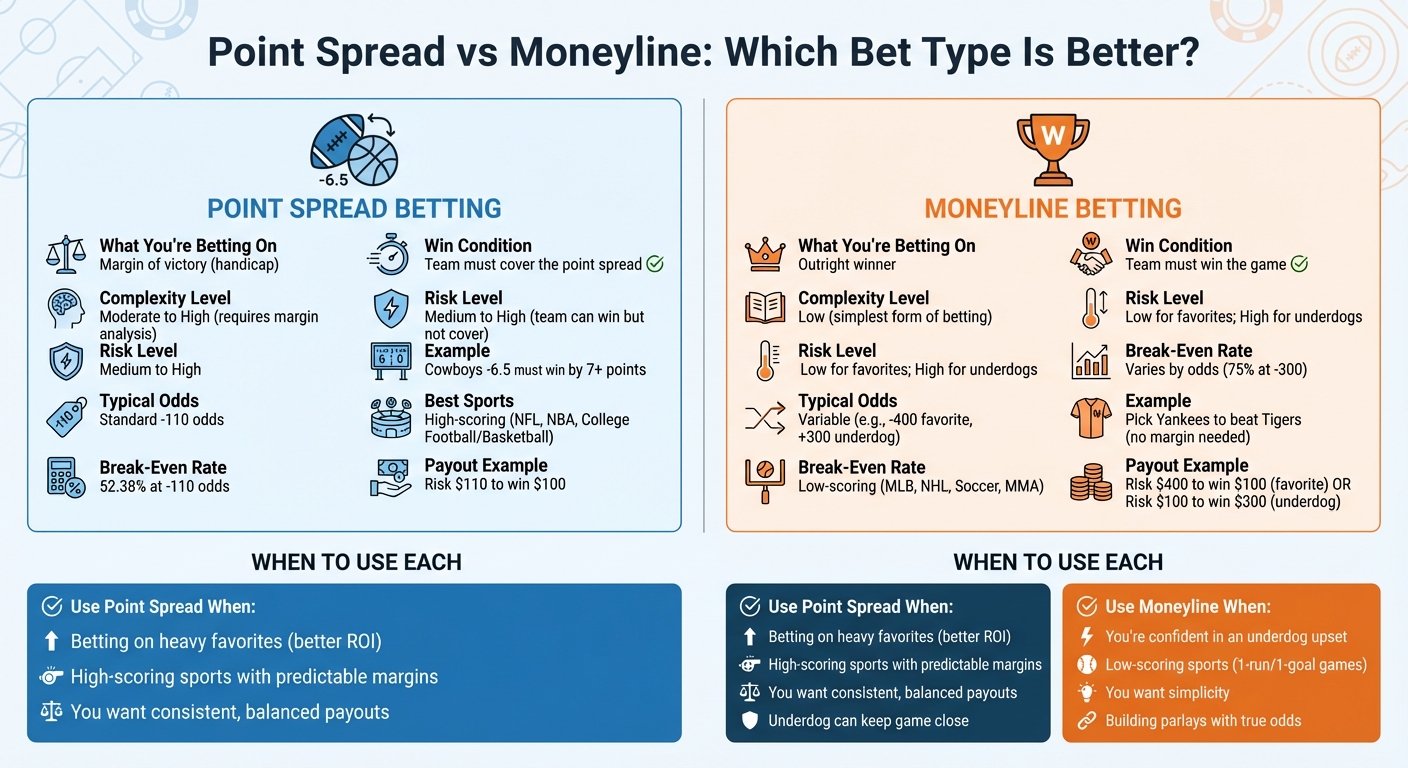
Point Spread vs Moneyline Betting Comparison Chart
Which bet is best? Money line or point spread?
sbb-itb-3ff9055
What Is Point Spread Betting?
Point spread betting is all about predicting how much a team will win or lose by. Sportsbooks create spreads to even the playing field between two teams, making the betting experience more balanced.
Here’s how it works: the favorite is marked with a minus sign (e.g., -7). For a bet on the favorite to win, they need to win by more than the spread. On the flip side, the underdog is marked with a plus sign (e.g., +7). A bet on the underdog wins if they either win outright or lose by less than the spread. Let’s break this down further with some examples.
How Point Spreads Work
Imagine a game between the Cowboys and the Giants with a spread of Cowboys -6.5 vs. Giants +6.5. In this case, the Cowboys need to win by at least 7 points for a bet on them to pay off. Meanwhile, a bet on the Giants would win if they either win the game outright or lose by 6 points or fewer.
To avoid ties, sportsbooks often include a half-point (called the "hook"). Since teams can’t score half-points, this ensures there’s always a clear winner and loser in terms of betting. For instance, if the spread were a whole number like -6 and the favorite won by exactly 6 points, the result would be a "push", meaning all bets are refunded. The hook eliminates this possibility.
Now let’s see how this plays out in real-world betting.
Point Spread Betting Example
The way spreads affect betting outcomes can be seen in actual sports matchups. Take Super Bowl LVI in February 2022, for example. The Los Angeles Rams were 4.5-point favorites (-4.5) against the Cincinnati Bengals (+4.5). Although the Rams won the game 23-20, the 3-point margin wasn’t enough to cover the spread. So, bettors who took the Bengals +4.5 won their wagers, even though Cincinnati lost the game.
Let’s say you bet $110 on the Bengals at -110 odds. You’d walk away with $210 - your original $110 plus $100 in profit. However, if you had bet on the Rams -4.5, you’d lose your entire $110 stake.
Another example comes from NFL Week 11 in November 2021. The Buffalo Bills were 13.5-point favorites (-13.5) against the New York Jets. The Bills dominated the game, winning 45-17. With a 28-point margin, the Bills easily covered the spread, rewarding those who bet on them with a payout.
These examples show how crucial it is to understand spreads before placing your bets. Every point matters!
What Is Moneyline Betting?
Moneyline betting is one of the simplest ways to wager on sports. All you have to do is pick the outright winner of the game - no worrying about point spreads or margins. If your chosen team wins, so does your bet.
"The easiest way to think of moneyline betting odds is that you are only betting on who wins the game. It does not matter how many points or goals they win by, all that matters is who wins." - ExplainBettingOdds.com
In the U.S., sportsbooks typically use American odds to display moneyline bets. Favorites are shown with a minus sign (-), such as -200, while underdogs are shown with a plus sign (+), like +150. These numbers indicate how much you need to wager or how much you stand to win based on a $100 bet.
Moneyline betting is especially popular in sports with lower scores, such as baseball (MLB), hockey (NHL), and soccer. These games are often decided by narrow margins, making point spreads less relevant. For instance, underdogs in Major League Baseball win outright about 40% of the time.
Now let’s break down how these odds translate into risk and reward.
How Moneyline Odds Work
Once you understand how to read the odds, calculating potential payouts becomes straightforward. For favorites (negative odds), the number tells you how much you need to bet to earn $100 in profit. For underdogs (positive odds), the number shows how much profit you’d make on a $100 wager.
For example:
- Betting on a favorite at -200 means risking $200 to win $100 in profit. Your total payout would be $300 (your $200 stake plus $100 profit).
- Betting on an underdog at +150 means a $100 wager would earn $150 in profit, for a total payout of $250.
These ratios scale depending on your wager. A $50 bet on a -200 favorite would yield $25 in profit, while the same $50 on a +150 underdog would bring in $75.
The risk structure of moneyline betting is different from point spreads. With moneylines, betting on favorites involves risking more than you stand to win, whereas betting on underdogs gives you the chance to win more than you risk. For instance, a -400 favorite requires a $400 bet to win $100, and a single upset could erase the profits from four previous wins.
Let’s look at some examples to see how this plays out in real-world scenarios.
Moneyline Betting Example
Here’s an example from Major League Baseball. In September 2025, the New York Yankees faced the Detroit Tigers. The Yankees were listed as -400 favorites, while the Tigers were +330 underdogs.
- A $400 bet on the Yankees would have resulted in a $100 profit (total payout: $500) if they won. However, that’s a lot of money to risk for a relatively small return.
- On the other hand, a $100 bet on the Tigers would have earned $330 in profit (total payout: $430) if they pulled off an upset.
Now consider the 2025 College Football Playoff national championship. Ohio State was a -400 favorite against Notre Dame, listed as +300 underdogs.
- A $400 bet on Ohio State would have brought in $100 in profit if they won.
- A $100 bet on Notre Dame would have returned $300 in profit if they managed to win.
These examples highlight why moneyline betting is ideal when you’re confident about the outright winner but don’t want to stress over the margin of victory. It’s straightforward - just pick the team you believe will win.
Point Spread vs Moneyline: Main Differences
The key distinction between point spread and moneyline bets lies in what you're betting on. With a moneyline bet, you're simply picking the outright winner of the game. In contrast, a point spread bet involves predicting whether a team will win or lose by a specific margin.
Complexity is another factor to consider. Moneyline bets are straightforward - you just need to choose the winner. Point spreads, however, require analyzing margins, such as NFL "key numbers" like 3 and 7. This means a team can win the game but still lose you money if they don’t cover the spread.
The risk profile also varies. Moneyline bets, especially on favorites, are less risky since you only need the team to win. However, the payout is often modest - for example, betting $400 on a -400 favorite would only net $100. Point spreads, on the other hand, carry a different kind of risk. A team might win the game but fail to cover the spread, turning what seems like a victory into a losing bet.
Payouts differ significantly as well. Point spread bets typically use standard -110 odds, offering balanced returns. Moneyline payouts depend on the odds - underdogs can bring in higher returns, while favorites yield smaller profits. The table below highlights the main differences between these two betting types.
Comparison Table: Point Spread vs Moneyline
| Feature | Point Spread Betting | Moneyline Betting |
|---|---|---|
| Core Focus | Margin of victory (handicap) | Outright winner |
| Win Condition | Cover the point handicap | Win the game outright |
| Complexity | Moderate to High; requires margin analysis | Low; simplest form of betting |
| Risk Level | Medium to High (favorite can win but not cover) | Low to Medium (for favorites); High (for underdogs) |
| Payouts | Usually balanced (standard -110 odds) | Variable; high for underdogs, low for favorites |
| Best Sports | High-scoring (NFL, NBA) | Low-scoring (MLB, NHL, Soccer, MMA) |
| Break-Even Rate | Approximately 52.38% at -110 odds | Varies by odds (e.g., 75% at -300) |
Pros and Cons of Each Bet Type
When choosing between point spread and moneyline betting, it’s crucial to weigh their strengths and weaknesses. Each option has its own impact on your strategy and bankroll, and understanding these differences can help you make smarter bets. Let’s break it down.
Point Spread Betting:
Point spread betting is popular for its standardized odds (typically -110), which make payouts more consistent. It’s also a better choice for managing your bankroll when wagering on heavy favorites. For instance, risking $110 at -110 odds to make a $100 profit is far more efficient than risking $400 at -400 odds. However, there’s a catch: even if your team wins, failing to cover the spread means you lose. There’s also the chance of a "push" if the final score matches the spread exactly, which can feel like a missed opportunity.
Moneyline Betting:
Moneyline betting keeps things simple - just pick the winner. This straightforward approach is ideal for spotting underdog upsets, especially in sports like MLB, where underdogs win outright about 40% of the time. But here’s the downside: betting on heavy moneyline favorites requires a significant investment for a relatively small return. For example, a -400 favorite has an implied win probability of 80%, but one upset could erase the profit from four successful bets. This makes it riskier for those who rely on heavy favorites.
Comparison Table: Pros and Cons
| Bet Type | Advantages | Disadvantages |
|---|---|---|
| Point Spread | - Standardized odds (-110) offer consistent payouts - Better ROI on heavy favorites - Underdogs get a "cushion" and don’t need to win outright - More efficient bankroll usage |
- Winning the game doesn’t guarantee covering the spread - Requires careful analysis of scoring margins - Risk of a "push" if the score matches the spread - Half-point "hooks" (e.g., -3.5) can lead to losses |
| Moneyline | - Simple: just pick the winner - High returns for underdog wins - No margin analysis needed - Great for low-scoring sports (MLB, NHL, Soccer) |
- Heavy favorites require large stakes for small returns - One upset can erase profits from several wins - Underdogs win less often, increasing volatility - Ties up more of your bankroll on favorites |
Both bet types have their place in a solid betting strategy. Whether you value the consistency of point spreads or the simplicity of moneylines, understanding when and how to use each can make all the difference.
When to Use Point Spread Betting
Point spread betting works best in high-scoring sports like the NFL, NBA, College Football, or College Basketball. These sports naturally produce a range of scoring margins, making spreads more predictable and potentially more rewarding. When there’s a clear favorite and underdog, the spread helps level the playing field and offers better value than betting on a heavy favorite through the moneyline.
For instance, betting a heavy favorite on the moneyline might require risking $300 to win just $100. In contrast, a spread bet at -110 odds only requires $110 to win $100. This makes spread betting a more efficient use of your bankroll, especially when compared to the higher stakes needed for a modest profit on the moneyline.
Point spreads are particularly useful when betting on "live underdogs" - teams that might not win outright but can keep the game close. In the NFL, underdogs cover the spread roughly 50% of the time. If you think an underdog can stay competitive, the spread can provide a safety net.
Best Situations for Point Spread Betting
Point spread betting shines in situations where game dynamics create predictable margins. It’s especially effective when betting on heavy favorites but you want to avoid the steep cost of moneyline odds. It’s also a smart choice when certain factors - like weather or game conditions - could influence how close the final score will be. For example, in the NFL, bad weather like wind or snow can lower scoring, increasing the likelihood of underdogs covering the spread. In the NBA, late-game fouling can create wild swings in the spread, even if the game’s outcome is already decided.
Advanced bettors often use "middling" to take advantage of line movements. For example, if you bet the Dallas Cowboys at -3 early in the week and the line shifts to -7 by game time, you could then bet the New York Giants at +7. If the Cowboys win by 4, 5, or 6 points, you win both bets. This strategy requires closely monitoring line movements across multiple sportsbooks and acting quickly when spreads change significantly. At standard -110 odds, you need a win rate of about 52.4% to break even against the vig.
When to Use Moneyline Betting
Moneyline betting is perfect when you want a straightforward approach. With this type of wager, all you need to do is pick the winning team - no need to worry about margins or other factors like late-game scoring that can complicate point spread bets. As sports betting writer Ryan Hagen explains:
"If you are starting out in sports betting, the moneyline is probably your best bet. It's a straightforward wager that requires you to pick only a winner or loser".
This simplicity makes moneyline bets an excellent choice for beginners and sets them apart from the more intricate spread betting.
Moneyline bets are especially effective in low-scoring sports like baseball, hockey, and soccer. For instance, Major League Baseball games are often decided by just one run, and in the NHL, a single goal can determine the winner. When MLB games have projected totals of 7 or fewer runs, one-run outcomes are common, making moneyline bets a better option. In these cases, point spreads lose their appeal because the final margins are typically narrow.
Another advantage of moneyline betting is the potential value in backing underdogs. With underdogs, the higher odds (often referred to as "plus-money" odds) can make up for a lower win rate. Unlike point spread bets - which usually hover around -110 odds no matter which team you choose - moneyline bets on underdogs can provide a much larger payout.
Best Situations for Moneyline Betting
To maximize the benefits of moneyline betting, focus on situations where it offers the most value. As with any betting strategy, understanding the sport and your comfort with risk is key.
Moneyline bets are particularly attractive when you strongly believe an underdog will win outright. The payout difference can be substantial. For example, betting $100 on a +300 underdog could net you a $300 profit, while taking the same team on a spread at -110 might yield just $91. If you anticipate an upset, the moneyline lets you capitalize on the full potential of that prediction.
Another great use for moneyline bets is in parlays. Unlike point spread parlays, which often use fixed payout tables that favor the sportsbook, moneyline parlays calculate returns by multiplying the true odds of each leg. This approach ensures a fairer payout structure over time. If you're building a multi-leg parlay, moneyline bets can help you accurately reflect each leg's risk in your potential winnings.
However, it's wise to avoid betting on heavy favorites. For example, a -400 moneyline means risking $400 to win just $100, and a single upset could wipe out the gains from several successful bets. While NFL favorites win outright more than 60% of the time, it's important to compare the return on investment. Sometimes, a spread bet at -110 offers better value than tying up a large chunk of your bankroll on a heavily favored moneyline.
Which Bet Type Fits Your Strategy?
Selecting between point spreads and moneylines isn’t about picking the "better" option - it’s about aligning the bet type with your goals, risk tolerance, and bankroll. If you’re drawn to consistent wins, moneyline favorites might appeal to you. They often come with high win probabilities but can be risky to your bankroll. For example, betting on a heavy favorite at -400 odds means you’d need to risk a significant amount to make a smaller profit. Just one loss could erase the gains from multiple wins.
On the other hand, moneyline underdogs provide the chance for larger payouts, though they come with higher variance. With plus-money odds, you could stay profitable even if your win rate is below 50%. Point spreads, however, strike a middle ground. With odds typically around -110, they offer close to 50% win probabilities and help you manage your bankroll more evenly without putting too much at stake on a single bet.
Matching the right bet type to your strategy is a critical step toward betting success.
Matching Bet Types to Your Goals
Your choice between point spreads and moneylines should reflect your financial goals and risk appetite. For those focused on minimizing risk, point spreads can be a more efficient choice. Consider this: to win $100 on a heavy favorite at -400, you’d need to risk about 40% of your bankroll. By contrast, with a -110 spread, you’d only risk around 11% for the same profit. This allows for better diversification and provides a buffer to handle losing streaks.
If you’re chasing higher rewards, betting on a +300 underdog offers a compelling payout - $100 could return $300 in profit. Compare that to approximately $91 profit on a -110 spread bet. To break even on spread bets, you’d need to win roughly 52.4% of the time. Regardless of the approach, sticking to disciplined bankroll management, such as wagering 1% to 2% of your bankroll per bet, is crucial for surviving the inevitable cold streaks.
Once your goals are clear and your bet type is aligned, incorporating analytical tools can take your strategy to the next level.
Using LearnSportsBetting Tools to Improve Your Betting
Informed decisions beat gut feelings every time. LearnSportsBetting offers a range of tools designed to sharpen your strategy. For example, the Kelly Criterion Calculator helps you figure out the ideal percentage of your bankroll to wager based on your perceived advantage. Meanwhile, the Expected Value (EV) Calculator can show whether a bet - like a point spread with lower win probability - might still be more profitable over time when the payout outweighs the risk.
Pair these tools with smart line shopping to maximize your edge. For instance, finding odds at -105 instead of -110 reduces the break-even win rate from 52.4% to 51.2%. By combining these resources, you can craft a consistent and profitable betting approach that aligns with your goals and risk tolerance.
FAQs
What makes point spread betting a better option than moneyline betting?
Point spread betting comes with some clear perks, especially when compared to moneyline betting. One of the biggest draws? It levels the playing field. By assigning a handicap to the favorite and an advantage to the underdog, it keeps things competitive. For the favorite to "cover the spread", they need to win by a certain margin. Meanwhile, the underdog can still reward bettors even if they lose, as long as they stay within that margin.
Another appeal is the consistent odds. In most cases, both sides of a point spread bet have odds around -110. This steadiness can make payouts easier to predict, unlike moneyline bets where odds can skew heavily, especially for strong favorites. It’s a format that works particularly well for sports like football and basketball, where the score difference often plays a big role in the outcome.
For those who prefer a more strategic approach or want to focus on the game’s dynamics rather than just the winner, point spread betting offers an engaging way to bet with less emphasis on outright results.
How can I choose between point spread and moneyline bets for a specific sport?
Choosing between point spread and moneyline bets boils down to your betting goals, comfort with risk, and the sport you're wagering on.
Point spread bets are especially popular in sports like football and basketball, where the margin of victory often plays a big role. These bets level the playing field by assigning the underdog a points advantage or giving the favorite a points handicap. If you believe a team will not only win but also exceed a specific margin, point spread bets can offer a more enticing payout.
On the flip side, moneyline bets are much simpler - they’re all about picking the outright winner. These are a go-to choice for sports like baseball, soccer, or MMA, where the exact margin of victory doesn’t matter as much. Moneyline bets are great if you’re confident about an underdog pulling off a win or if you prefer a straightforward wager without factoring in point spreads.
The right choice depends on how confident you feel about the outcome, how well you know the sport, and the level of risk you’re comfortable with. You can even combine both approaches depending on the game or situation.
What should I consider when placing a moneyline bet on an underdog?
When placing a moneyline wager on an underdog, there are a few essential factors to consider. Start with the odds and implied probability. For instance, higher odds like +300 or more indicate the underdog has a lower chance of winning, but the potential payout is much larger if they pull off an upset. It's important to balance the potential reward with the inherent risk.
Next, dig into the team's recent performance, injuries, and matchups. Sometimes, underdogs have hidden strengths - like favorable conditions or a surge in momentum - that the odds might not fully account for. Pay attention to line movement as well. If the odds for the underdog are shortening, it might suggest growing confidence from bettors or experts.
Betting on underdogs successfully requires a mix of thorough research, a solid grasp of the odds, and a strategy that aligns with your risk tolerance.


