 LearnSportsBetting
Pleasers vs Teasers
Compare teasers and pleasers: how point shifts affect risk, payouts and break-even rates, plus when to use each in NFL/NBA parlays.
Pleasers vs Teasers
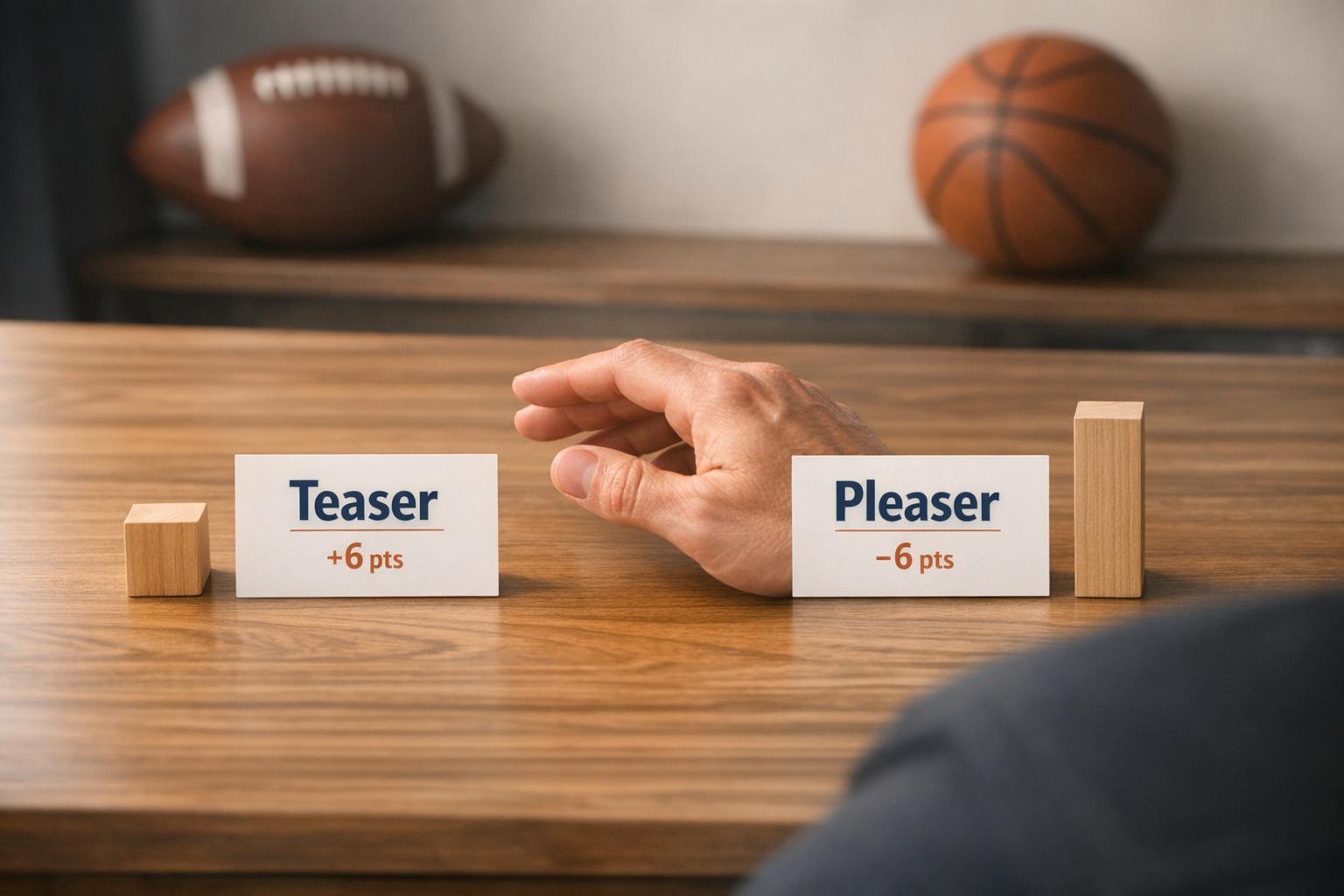
Teasers and pleasers are two types of parlay bets that adjust point spreads or totals, but they work in opposite ways. Teasers make bets easier to win by shifting the line in your favor, offering lower payouts. Pleasers, on the other hand, make bets harder to win by moving the line against you, offering much higher payouts as compensation. Both require every leg of the bet to win for a payout.
Key Differences:
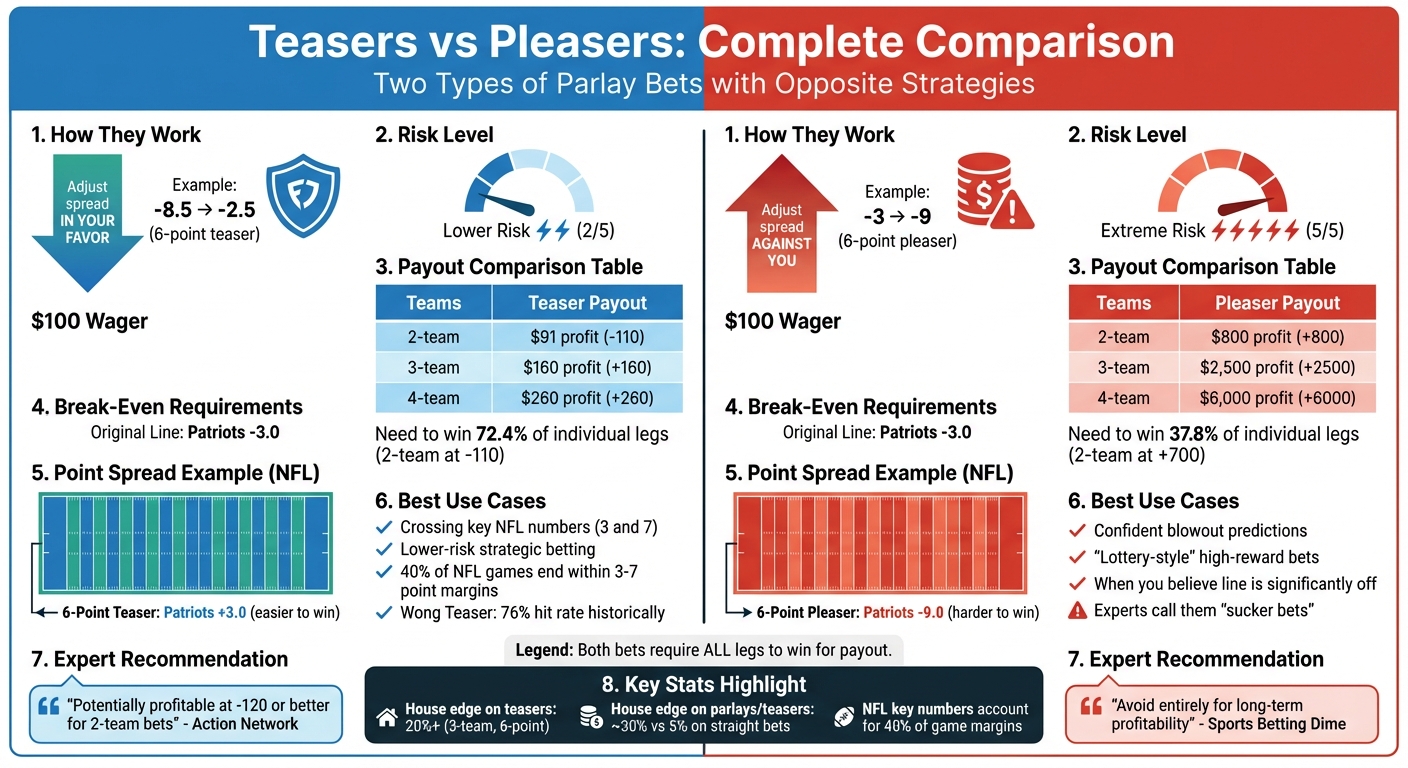
- Teasers: Lower risk, lower payouts. Adjust the line to your advantage (e.g., shifting a -8.5 favorite to -2.5). Common for football and basketball.
- Pleasers: Higher risk, higher payouts. Adjust the line against your favor (e.g., moving -3 to -9). Suitable for confident bets on blowouts.
Quick Overview:
- Teasers: Ideal for crossing key numbers like 3 and 7 in NFL games. Payouts typically range from -110 to +265 for 2-4 legs.
- Pleasers: High-risk, lottery-style bets with payouts reaching +800 to 750/1 for 2-6 legs.
Which should you choose? Teasers work best for those seeking safer, strategic bets. Pleasers are for those willing to take on significant risk for massive potential rewards. Both require careful planning and understanding of payout structures.
Teasers vs Pleasers: Risk, Payouts, and Point Spread Adjustments Comparison
NFL Betting: Teasers vs. Pleasers: Betting Guide
sbb-itb-3ff9055
What Are Teasers?
A teaser is a type of parlay bet that gives you the option to adjust point spreads or totals in your favor across multiple games by "buying" points to make each leg easier to win. For example, if the Kansas City Chiefs are favored by –8.5 points, a 6-point teaser would adjust that line to –2.5, making it easier for the Chiefs to cover the spread.
While teasers improve the chances of winning each individual leg, they come with lower payouts compared to standard parlays. For instance, a 2-team NFL teaser with a 6-point adjustment typically offers odds between –110 and –120, whereas a standard 2-team parlay using the original lines would pay closer to +260.
How Teasers Work
Teasers are most commonly available for football (NFL and college) and basketball (NBA and college), as these sports rely heavily on point spreads and totals. In football, the standard adjustment is 6 points, although some sportsbooks offer 6.5 or 7-point options. For basketball, teasers usually allow 4, 4.5, or 5 points.
Here’s how it works: If you’re betting on a favorite, the teaser reduces the number of points the team needs to win by. If you’re backing an underdog, it increases the points they can lose by and still cover. The same logic applies to over/under bets, where you can shift the total up or down to improve your chances. However, every leg of the teaser must win for the bet to pay out - just one loss voids the entire wager.
Payouts are determined by the number of teams in the teaser and the point adjustment. For example, a 3-team, 6-point NFL teaser might pay between +160 and +180, while a 4-team teaser could pay closer to +265. Adding more legs increases the potential payout but also heightens the risk of losing.
Why Bettors Choose Teasers
Bettors often favor teasers because they increase the likelihood of winning in certain situations, particularly in the NFL. Nearly 40% of NFL games end with a scoring margin between 3 and 7 points, making these adjustments especially appealing.
"Almost 40% of NFL scores end with margins of 3-7 points... If you can get -120 or better on the 6-point, two-team teaser, it's likely to be profitable over the long term." - Steven Petrella, Deputy Editor, Action Network
Experienced bettors often use teasers strategically, focusing on key scenarios. For example, they might adjust favorites from -7.5 or -8.5 down to -1.5 or -2.5, or boost underdogs from +1.5 or +2.5 up to +7.5 or +8.5. This approach, known as a "Wong Teaser", has historically been effective, with qualifying legs hitting around 76% of the time.
However, teasers aren’t without criticism. Some experts argue that they rarely offer positive expected value, particularly when betting on more than two legs or when the adjusted points don’t significantly impact the outcome.
What Are Pleasers?
A pleaser is a type of parlay bet where you adjust the point spread or total against your favor in exchange for a much higher payout. Think of it as the reverse of a teaser - while teasers make bets easier to win, pleasers make them significantly harder. For example, if the Dallas Cowboys are favored by –3 points, a 6-point pleaser would shift the line to –9. In this case, the Cowboys would need to win by at least 10 points for your bet to cash.
Pleasers are often referred to as "reverse teasers". By taking on this increased difficulty, you’re giving the sportsbook a bigger edge, but the potential rewards are much higher. For instance, a 2-team, 6-point pleaser typically pays +600 (6/1), compared to around +260 for a standard 2-team parlay.
These bets are mainly offered in football (NFL and college) and basketball (NBA and college), where point spreads and totals dominate the betting landscape. In football, pleaser adjustments are usually 6, 6.5, or 7 points, whereas basketball pleasers involve shifts of 4, 4.5, or 5 points. Let’s explore how these bets work and why they’re so challenging.
How Pleasers Work
Unlike teasers, which shift the line to your advantage, pleasers do the opposite - they make the bet harder to win. Essentially, you’re "selling points" back to the sportsbook. For favorites, this means increasing the margin they need to win by, while for underdogs, it reduces the cushion they have to cover. The same concept applies to totals, where the adjustment moves the number in a less favorable direction for your bet.
The payouts for pleasers scale dramatically based on the number of teams included and the point adjustment. For example, a 3-team, 6-point NFL pleaser might pay around +1750 (17.5/1), while a 6-team pleaser with a 7.5-point adjustment can offer staggering odds of 750/1. That means a $100 bet could return $75,000. However, the difficulty skyrockets when the adjusted spread crosses key NFL numbers like 3 and 7, making these bets even tougher to hit.
To break even on a 2-team, 6-point pleaser, you’d need to win roughly 37.8% of your individual legs. Additionally, most sportsbooks handle ties by removing the tied leg and recalculating the payout based on the remaining teams.
Why Bettors Choose Pleasers
The main draw of pleasers is their massive payout potential. They give bettors the chance to turn a small wager into a huge return. If you’re confident that a sportsbook’s line is way off - like believing a favorite will crush the spread by multiple touchdowns - pleasers let you bet on that conviction with enormous upside.
That said, pleasers are considered extremely high-risk bets with a significant house edge. Many experts even label them "sucker bets" because the odds rarely justify the added difficulty. For this reason, most experienced bettors stick to 2-team pleasers, as adding more teams doesn’t meaningfully improve the break-even percentage per leg. A niche strategy some bettors use is to "please" underdogs from +13.5 down to +7.5, but such opportunities are rare.
Main Differences Between Pleasers and Teasers
The key distinction between pleasers and teasers lies in how they adjust the point spread or total. Teasers work in your favor by "buying" points, making the bet easier to win, while pleasers shift the line in the sportsbook's favor by "selling" points, which makes the bet harder to hit. This change directly impacts both the level of risk and the potential payout.
Teasers lower your risk by providing a cushion against the original spread, but this comes at the cost of reduced payouts compared to a standard parlay. On the other hand, pleasers increase your risk by requiring you to overcome a tougher line, offering much higher payouts as compensation. For example, a $100 three-team, 6-point teaser in the NFL might yield a profit of around $165, whereas the same three-team pleaser could return a massive $1,750.
Risk and Payout Comparison
A two-team parlay at standard odds typically pays around +260. However, a two-team, 6-point teaser pays much less, usually between -110 and -130, because the adjusted line makes the bet easier to win. In contrast, a two-team, 6-point pleaser offers payouts between +600 and +800, reflecting the increased difficulty of winning.
To break even on a two-leg, 6-point NFL teaser at -110 odds, you need to win roughly 72.4% of the individual legs. For a two-leg, 6-point pleaser at +700 odds, each leg only needs to win about 37.8% of the time. While teasers are seen as lower-risk multi-bets, pleasers are often labeled "sucker bets" by experts due to their steep house edge.
When to Use Each Bet Type
Knowing these differences can help you decide when to use teasers or pleasers. Teasers are ideal when you can adjust the spread across key NFL numbers like 3 and 7, which account for about 40% of game margins. For instance, teasing a -8.5 favorite down to -2.5 crosses both critical numbers, giving you a strategic advantage. Teasers are a better fit for bettors who prefer lower risk and a higher chance of winning, even if the payouts are smaller.
Pleasers, however, should only be considered when you're confident a favorite will win by a large margin, well beyond the spread. Since adding more teams to a pleaser significantly increases the difficulty, experts suggest sticking to two-team pleasers if you decide to try them. Most experienced bettors avoid pleasers altogether, viewing them as high-risk, "lottery ticket" bets rather than a serious strategy.
How Payouts Work for Pleasers and Teasers
Understanding how payouts are calculated for teasers and pleasers highlights the balance between risk and reward. Unlike standard parlays, where odds for each leg are multiplied, teasers and pleasers use fixed payout tables provided by sportsbooks. Your potential return depends on the number of teams in your bet and the points you adjust.
Teasers come with lower payouts compared to standard parlays because you're essentially buying points to make your bet easier to win. For instance, a typical two-team, 6-point NFL teaser pays around -110. Marc Tersigni from betstamp explains:
A three-team six-point teaser, for example, has a house edge of over 20%.
This structure makes teasers a safer but less lucrative option compared to pleasers.
Pleasers, on the other hand, offer much higher payouts to balance the increased difficulty of winning. As Patrick Cwiklinski, a sportsbook expert, puts it:
The more you move the spreads or totals in the bookmaker's favor, the larger your potential payout becomes. Of course, your risk also increases substantially with each point given away.
For example, a two-team, 7-point pleaser might pay around +800, while a six-team pleaser could offer odds as high as 750/1. The more teams and point adjustments you add, the higher the potential payout. However, every selection must win for the bet to cash, making pleasers significantly riskier.
Payout Examples by Team Count
Here’s a breakdown of potential payouts for $100 wagers using 6-point teasers and 7-point pleasers:
| Number of Teams | 6-Point Teaser Payout | 7-Point Pleaser Payout | Difference |
|---|---|---|---|
| 2 Teams | $91 profit (-110) | $800 profit (+800) | $709 |
| 3 Teams | $160 profit (+160) | $2,500 profit (+2500) | $2,340 |
| 4 Teams | $260 profit (+260) | $6,000 profit (+6000) | $5,740 |
As the table shows, the payout gap between teasers and pleasers grows significantly with more teams. For example, a four-team pleaser pays over 23 times more than a four-team teaser on the same $100 bet. However, the difficulty of winning pleasers increases exponentially, which is why they’re often described as “lottery-style” bets.
These payout examples highlight the importance of using tools like the LearnSportsBetting parlay calculator to make informed wagering decisions.
Examples of Pleasers and Teasers in Action
Let’s break down how teasers and pleasers work using examples from the NFL. During Week 5 of the 2021 season, the Jets–Falcons and Patriots–Texans games provide clear illustrations of how these betting adjustments play out.
In the Jets–Falcons matchup, the Jets entered as 2.5-point underdogs. The final score? Falcons 27, Jets 20 - a 7-point margin. Without any adjustments, the Jets failed to cover the +2.5 spread. But with a 6-point teaser pushing the line to +8.5, the Jets easily covered. Now, look at the Patriots–Texans game. The Patriots were 7-point favorites but only squeaked out a 25–22 victory - a 3-point margin. They didn’t cover the original –7 spread, but a 6-point teaser adjusted the line to –1, which they did cover.
This highlights how a 6-point adjustment can flip a losing bet into a winning one. For example, if you placed a $120 wager at –120 odds, you’d see a total return of $220 - $100 in profit.
These examples underscore how point adjustments can dramatically influence betting outcomes.
NFL Point Spread Examples
Now, let’s look at how teasers and pleasers adjust spreads using a simple comparison. The table below shows how a 6-point teaser and a 6-point pleaser alter the lines for typical NFL matchups:
| Team | Original Spread | 6-Point Teaser Line | 6-Point Pleaser Line |
|---|---|---|---|
| New England Patriots | -3.0 | +3.0 | -9.0 |
| Dallas Cowboys | +4.0 | +10.0 | -2.0 |
| Green Bay Packers | +2.5 | +8.5 | -3.5 |
Here’s what these adjustments mean: a teaser allows the Patriots to lose by up to 3 points and still win the bet. On the flip side, a pleaser requires them to win by more than 9 points. For the Cowboys, a teaser turns them from 4-point underdogs into 10-point underdogs, while a pleaser makes them 2-point favorites.
The risk and reward also shift significantly. A 2-team pleaser might return around $600 on a $100 wager. Meanwhile, a 2-team teaser typically requires risking $110 to $130 to win $100.
Choosing Between Teasers and Pleasers
Deciding between teasers and pleasers comes down to your risk tolerance and overall betting strategy. Teasers are ideal if you want to improve your chances of winning by adjusting key game margins in your favor. On the flip side, pleasers offer much higher payouts but at significantly greater risk, as they require you to beat less favorable spreads.
Sharp bettors often lean toward two-team teasers, especially when they can cross key numbers at advantageous pricing. Steven Petrella, Deputy Editor at Action Network, explains:
If you can get -120 or better on the 6-point, two-team teaser, it's likely to be profitable over the long term.
This strategy focuses on leveraging favorable margin shifts to increase profitability. The approach contrasts sharply with pleasers, which rely on betting that the original line is significantly off - by at least a touchdown or more. As Patrick Cwiklinski, Sportsbook Expert, points out:
Anyone who's spent a bit of time betting point spreads will tell you that it's challenging enough to hit three or more picks even when the lines are not adjusted against you.
To break even on a standard two-team pleaser, you'd need to win individual legs at a rate of about 37.8%. That’s a tough benchmark, especially when the line is shifted in the sportsbook's favor.
The difference in pricing underscores the risk-reward dynamic. A two-team teaser generally requires a $110–$120 bet to win $100, while a two-team pleaser can return $600 on a $100 wager. However, sportsbooks hold roughly 30% on parlays and teasers, compared to just 5% on straight bets. These numbers highlight the trade-off between potential payout and long-term viability.
Pros and Cons of Each Bet Type
Here’s a quick breakdown of the main advantages and drawbacks for each type of bet:
| Feature | Teasers | Pleasers |
|---|---|---|
| Win Probability | Higher; lines shift in your favor | Lower; lines shift against you |
| Payout Potential | Modest (often below even money for 2 teams) | Very high (can exceed 100/1 for larger parlays) |
| Risk Level | Moderate; requires multiple legs to win | Extremely high; relies on unlikely outcomes |
| Best Use Case | Crossing key NFL numbers (3 and 7) | Confident bets on mispriced lines or blowouts |
| Long-term Viability | Potentially profitable with specific strategies (e.g., Wong teasers) | Generally a "-EV" bet, often seen as recreational |
| Strategic Edge | Strong when crossing key numbers at favorable odds (-120 or better) | Minimal; more for "lottery-style" betting fun |
This comparison highlights the calculated approach required for teasers versus the high-risk, high-reward nature of pleasers. Each has its place, but understanding these dynamics is crucial to making informed betting decisions.
Using Calculators for Pleaser and Teaser Payouts
When it comes to figuring out potential payouts for pleasers and teasers - especially with multiple legs and adjusted odds - precision is key. That’s why a parlay calculator can be a game-changer. These tools work hand-in-hand with payout breakdowns to give you a clear picture of what you could win before placing your bet. For example, LearnSportsBetting's parlay calculator is designed to show exactly how much your wager could return.
To use one, start by selecting the point spread adjustment and entering the number of legs in your bet (anywhere from 2 to 12 or more). Then, input the adjusted odds for each leg as provided by your sportsbook, such as –120 for a teaser or +800 for a pleaser. With this information, the calculator will quickly generate your potential payout. It’s a straightforward process that provides clarity before you commit to your wager.
One important factor to check before running calculations is whether your sportsbook uses "Fixed Pricing" (standard odds for all teasers) or "Dynamic Pricing" (odds that shift based on the advantage of the line move). A great example of this comes from Action Network's Steven Petrella, who analyzed teaser pricing during NFL Week 2 in September 2024. He found that an "optimal" teaser - adjusting the Buffalo Bills from +2.5 to +8.5 and the Detroit Lions from –7.5 to –1.5 - had odds of –142. On the other hand, a less favorable teaser involving the Bills and Cincinnati Bengals (adjusting from +5.5 to +11.5) came with odds of –115.
Understanding the break-even percentage is also critical. For instance, a standard 2-team, 6-point pleaser with +700 odds requires you to win individual legs at a rate of 37.8% to simply break even. Dave Rathmanner, Founder & CEO of Odds Assist, highlights the difficulty of these bets:
Pleasers are hands down one of the hardest types of sports bets to win... winning a parlay is hard enough, let alone shifting the lines against you.
Using a calculator can help you visualize these odds and determine if the payout is worth the risk. Simply click "Calculate" to see updated results. Comparing different scenarios with the calculator ensures you’re making informed decisions and that the potential reward aligns with the level of risk.
Conclusion
Deciding between pleasers and teasers ultimately comes down to how much risk you're willing to take. Teasers improve your chances of winning by adjusting spreads in your favor, but pleasers offer the allure of much higher payouts - though at a far greater risk. As Patrick Cwiklinski, Sportsbook Expert at Sports Betting Dime, puts it:
You'll be hard-pressed to find an experienced bettor who suggests betting pleasers can be a profitable enterprise over the long run. Most would advise you to avoid them entirely.
For context, a 2-team, 6-point pleaser requires you to win about 37.8% of individual legs just to break even. On the other hand, well-structured teasers - like Wong teasers targeting favorites between -7.5 and -8.5 - can yield a positive return when priced at -120 or better. Always check your sportsbook's push rules and pricing details, as these factors can significantly impact your expected value. Sticking with 2-leg teasers is often a safer approach, balancing risk and potential reward.
A parlay calculator is a handy tool to better understand potential returns and break-even percentages. Whether you're experimenting with a 6-point teaser at -110 or considering a high-risk 3-team pleaser at +2500, these calculators can help you make smarter, more informed bets.
FAQs
What are the benefits of using teasers in sports betting?
Teasers in sports betting let you tweak point spreads or totals to work in your favor, making it easier for your selections to cover the spread. This adjustment can be a game-changer, especially when you're dealing with tight or tricky lines, as it helps reduce the overall risk of your bet.
One more advantage is the chance to combine several bets into a single wager with adjusted lines. This approach can offer more consistent outcomes compared to betting on individual games. The downside? Lower payouts, as your chances of winning increase with the adjusted lines. Teasers are a handy option for bettors aiming to balance risk and reward while customizing their bets to fit their strategy and comfort zone.
Why are pleasers considered high-risk bets, and when should you consider using them?
Pleasers are considered high-risk wagers because they adjust point spreads or totals in a way that works against the bettor, making it much harder to win. Unlike teasers, which shift the lines to benefit the bettor and reduce risk, pleasers do the opposite - tilting the odds heavily in favor of the sportsbook. On top of that, every leg of a pleaser bet must hit for it to pay out, much like a parlay, but with even steeper odds.
Despite the steep challenge, pleasers can attract bettors who are confident in their predictions and willing to take on significant risk for the chance at a big payout. These bets are typically better suited for seasoned gamblers who understand the risks and have a high tolerance for potential losses, as the likelihood of winning is extremely slim.
What’s the difference in payout structures between teasers and pleasers?
The payout structures for teasers and pleasers are built around their distinct balance of risk and reward.
Teasers tilt the odds in your favor by adjusting the point spread or total to make bets easier to win. The trade-off? Lower payouts. Since the risk is reduced, the potential reward shrinks accordingly.
In contrast, pleasers do the opposite - they move the line against you, making the bet harder to win. But with higher risk comes the chance for much bigger payouts. Winning a pleaser requires more precision, but the payoff can be substantial.
In short, teasers are about playing it safer with smaller rewards, while pleasers are for those willing to take on more risk for a shot at larger returns.


