 LearnSportsBetting
Moneyline Betting Explained
Practical moneyline betting guide explaining odds, implied probability, payout math, sportsbook vig, and when to back favorites or underdogs.
Moneyline Betting Explained
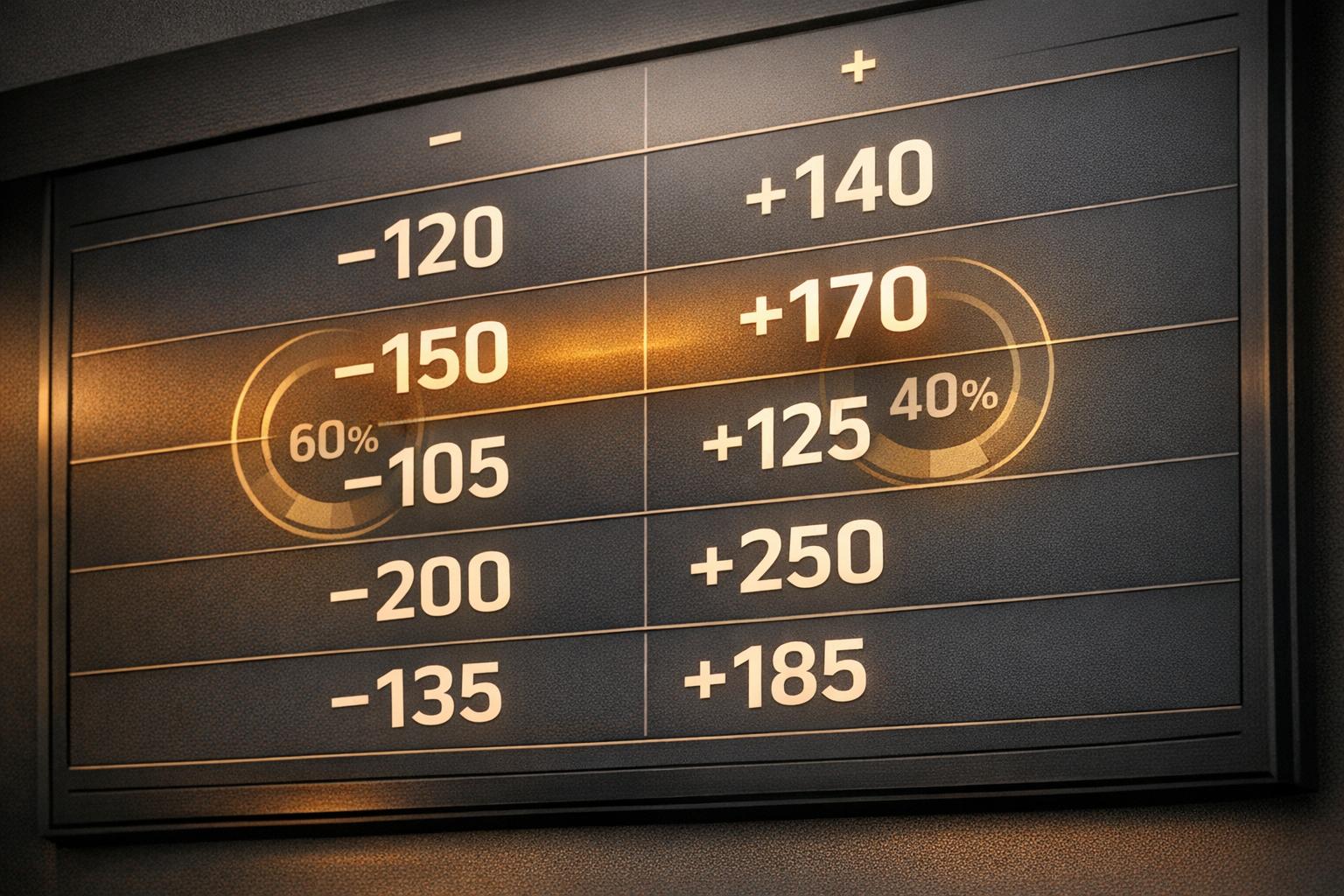
Moneyline betting is the simplest way to bet on sports: you just pick the winner of a game or event - no spreads, no extra rules. Odds are displayed with either a "+" (underdog) or "–" (favorite), showing how much you could win or need to bet. For example, at -150, you’d risk $150 to win $100, while +200 means a $100 bet earns $200.
Here’s what you need to know:
- Favorites have negative odds (e.g., -200); you risk more to win less.
- Underdogs have positive odds (e.g., +300); you risk less to win more.
- Implied probabilities help you see the chance of winning based on odds (e.g., -200 = 66.7%).
- Payouts depend on your stake and the odds (e.g., $50 at +150 = $75 profit).
Moneyline bets are great for low-scoring sports like baseball, hockey, and soccer, or when you’re confident about a team winning outright. Be cautious with heavy favorites, as the risk often outweighs the reward. Always shop for the best odds and calculate implied probabilities to spot good value.
What's a Moneyline Bet? | Outright Winner Explained with Examples for Beginners | Sports Betting 101
sbb-itb-3ff9055
What Is a Moneyline Bet?
A moneyline bet is one of the simplest forms of sports wagering. Here, you're betting on which team or individual will win - without worrying about the margin of victory. Whether your pick wins by a single point or a massive lead, your payout remains the same.
"Moneyline bets are straightforward wagers where bettors simply pick the winner, without considering the margin of victory." - Investopedia
Odds are displayed with a "+" for underdogs and a "–" for favorites. For example, during Week 1 of the 2025 NFL season, FanDuel Sportsbook listed the Kansas City Chiefs at -164 and the Los Angeles Chargers at +138. This means you'd need to risk $164 on the Chiefs to earn $100 in profit, while a $100 bet on the Chargers would net you $138 if they won. These symbols are essential for understanding how payouts work in moneyline betting.
Moneyline Betting Basics
Moneyline bets are common across many sports, but they shine in low-scoring games - like baseball, hockey, or soccer - where predicting a margin of victory can be tricky. They're also popular for individual sports like tennis, boxing, or UFC, where team scores don't factor in.
Most moneyline bets have two possible outcomes: one side wins, and the other loses. However, in sports like soccer, where ties are frequent, you may encounter a three-way moneyline. This includes options for either team to win or the match to end in a draw. If you bet on a team and the game ends in a tie, you lose - unless your bet was specifically on the draw.
Moneyline vs. Point Spread Bets
The difference between these two types of bets is straightforward: moneyline bets only care about who wins, while point spread bets factor in the margin of victory. With a point spread, the favorite must win by a specific number of points, while the underdog can lose but still "cover" the spread if the margin is small enough.
For instance, if the Chiefs are favored by 7 points, they need to win by 8 or more for a point spread bet to pay out. On the other hand, an underdog losing by 6 points or fewer would still result in a successful spread bet for those who backed them.
| Feature | Moneyline Bet | Point Spread Bet |
|---|---|---|
| Winning Condition | Team wins the game | Favorite wins by more than the spread; underdog loses by less than the spread |
| Primary Use | Low-scoring sports (e.g., MLB, NHL, UFC) | High-scoring sports (e.g., NFL, NBA) |
| Odds/Payout | Based on team strength | Typically fixed near -110 for both sides |
Moneyline bets are ideal when you believe an underdog has a chance to win outright or when you're confident a favorite will win but aren't sure they'll cover the spread. On the flip side, point spread bets are great for balancing odds on a heavy favorite or betting on an underdog to keep the game close. Understanding this distinction is crucial before diving into odds calculations and advanced betting strategies. Up next, we'll break down how these odds translate into potential payouts.
How Moneyline Odds Work
Moneyline odds use plus (+) and minus (–) signs to indicate the favorite and the underdog, while also showing potential profits. A negative sign (–) represents the favorite, and a positive sign (+) marks the underdog. The size of the number tells you how strong the favorite or underdog is.
Positive and Negative Odds Explained
Negative odds, like -150, mean you need to bet $150 to win $100. The larger the negative number, the heavier the favorite. For example, -400 means you’d have to wager $400 to win $100.
Positive odds work the other way around. If the odds are +150, a $100 bet earns you $150 in profit if the underdog wins. A higher positive number, such as +350, signals a bigger underdog. Odds of +100 or "EVEN" mean the matchup is evenly balanced, so a $100 wager wins you $100.
When the gap between odds is small (e.g., -110), it suggests the teams are closely matched. A wider gap, such as -400 versus +330, points to a clear favorite. For instance, in a 2025 MLB game, the New York Yankees were listed at -400 against the Detroit Tigers, who were at +330. This reflected the Yankees as heavy favorites.
How Odds Reflect Win Probability
Moneyline odds also imply win probabilities, which sportsbooks calculate based on factors like team history, recent performance, injuries, home-field advantage, and even weather conditions.
For example:
- A -200 favorite has an implied win probability of 66.67%.
- A +200 underdog has an implied probability of 33.33%.
- Standard -110 odds equate to a 52.38% chance of winning.
To illustrate, during Week 1 of the 2025 NFL season, the Kansas City Chiefs were listed at -164 against the Los Angeles Chargers. This implied the Chiefs had about a 62.1% chance of winning.
In another case, the Pittsburgh Steelers faced the Chiefs with odds of +585. This meant bookmakers gave the Steelers only a 15% chance of pulling off an upset. Grasping these probabilities can help you decide if a bet offers good value or if it’s more of a long shot. Next, we’ll explore how these odds translate into your potential winnings.
Calculating Moneyline Payouts
Moneyline Odds Calculator: Favorites vs Underdogs Payout Guide
Once you understand the odds, the next step is figuring out your potential winnings. The math is simple, but it changes depending on whether you're betting on a favorite or an underdog.
Payout Formulas for Positive and Negative Odds
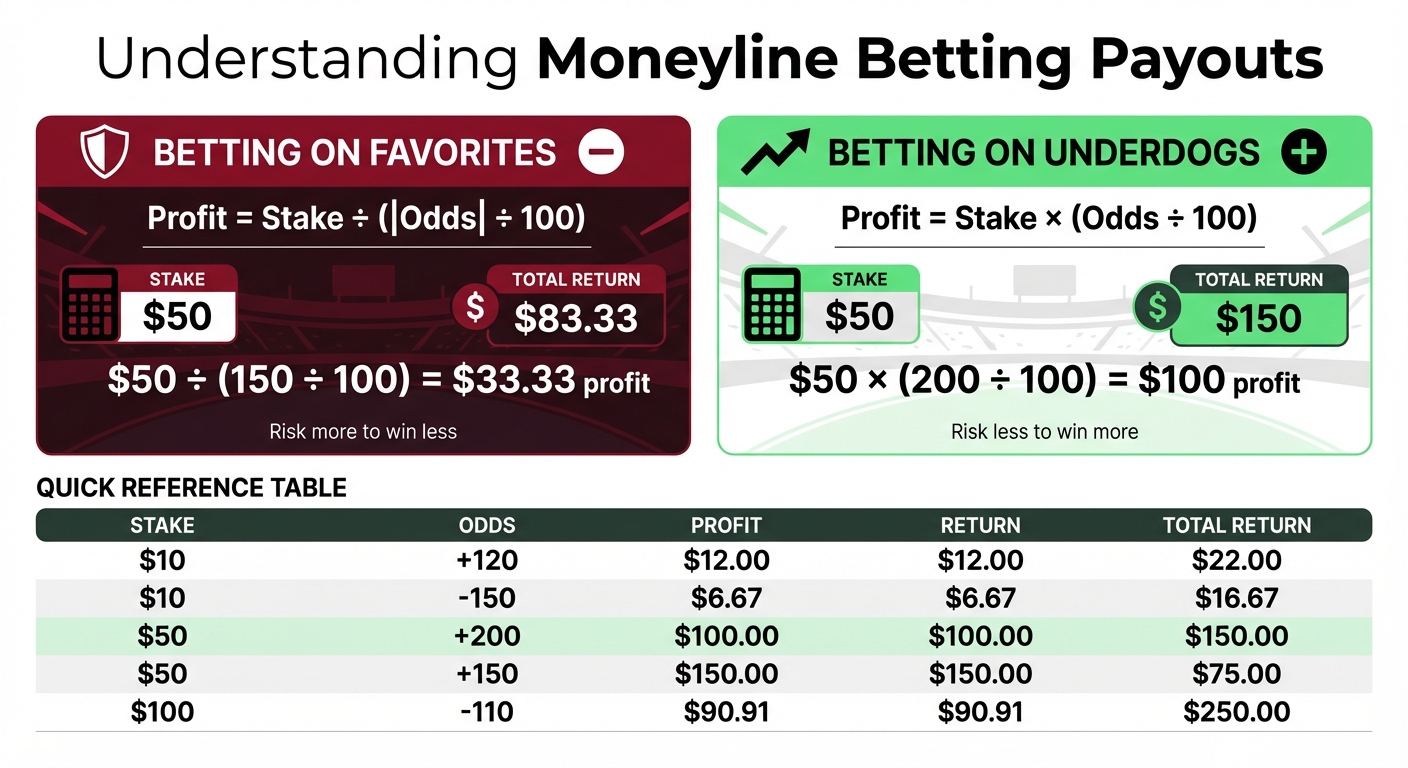
For positive odds (underdogs), the formula is: stake × (odds ÷ 100). For example, if you place a $50 bet on a team with +200 odds, the calculation looks like this:
$50 × (200 ÷ 100) = $100 in profit. Adding your original $50 stake, your total return would be $150.
For negative odds (favorites), the formula is slightly different: stake ÷ (odds ÷ 100). For instance, if you bet $50 on a team at -150 odds, you calculate:
$50 ÷ (150 ÷ 100) = $33.33 in profit. Including your $50 stake, your total return would be $83.33.
Below are examples to help clarify these calculations.
Payout Examples for Common Bet Amounts
Here’s how different wagers and odds translate into profits and total returns:
| Stake | Odds | Profit | Total Return |
|---|---|---|---|
| $10 | +120 | $12.00 | $22.00 |
| $10 | -150 | $6.67 | $16.67 |
| $50 | +200 | $100.00 | $150.00 |
| $50 | -200 | $25.00 | $75.00 |
| $100 | +150 | $150.00 | $250.00 |
| $100 | -110 | $90.91 | $190.91 |
As you can see, betting on favorites typically requires a larger stake to generate smaller profits. For example, a $100 bet on a -110 favorite yields $90.91 in profit. On the other hand, the same $100 bet on a +150 underdog would bring in $150 in profit.
Moneyline Betting in Different Sports
How Moneyline Odds Vary by Sport
Moneyline odds shift depending on the sport, largely due to differences in scoring and competitiveness. In low-scoring sports like baseball and hockey, moneylines are the preferred betting format since the margins of victory are often too slim for meaningful point spreads. For example, in MLB, moneyline odds typically hover around -120, reflecting the high level of parity across a grueling 162-game season.
In high-scoring sports like basketball and football, point spreads tend to dominate, but moneyline bets are still available. However, when there’s a significant mismatch in talent, moneyline odds can become extremely lopsided. Take the 2024 college football season as an example: Indiana opened as a -2500 favorite against Old Dominion (+1100) at FanDuel. This means bettors would need to risk $2,500 just to earn a $100 profit due to the clear disparity. Similarly, during the 2025 College Football Playoff national championship, Ohio State was listed at -400, while Notre Dame was at +300.
The NBA follows a similar pattern. In the 2024 Eastern Conference Finals, the Indiana Pacers were -154 favorites in Game 4 against the New York Knicks (+129). Knowing how odds differ by sport can help you adapt your betting strategy to specific scenarios.
Draws and Push Scenarios
Some sports introduce additional outcomes beyond the standard win/lose format. Soccer is a prime example, often using a 3-way moneyline with options for Team A, Team B, and Draw. If you bet on a team to win and the match ends tied after 90 minutes, your bet loses - only those who wagered on the draw win. Alternatively, a 2-way "Draw No Bet" market refunds your stake if the game ends in a draw.
Hockey offers both 2-way and 3-way formats. The standard NHL moneyline includes overtime and shootouts to decide a winner. However, sportsbooks also provide "60-minute lines", which are 3-way bets where only the regulation result counts. If the game is tied after three periods, you lose - even if your team wins in overtime.
In the NFL, ties are rare but can happen. If a game ends tied after the overtime period and you placed a standard 2-way moneyline bet, the wager is generally refunded as a "push." Baseball games almost never end in ties due to extra innings, but certain markets, like "First 5 Innings", can result in a push if the score is tied after five innings.
"A money line is the most basic type of sports wager there is: You are betting on whether a team will win a game, match or event." - Brandon Gustafson, Betting Expert
Before placing a moneyline bet, double-check whether it’s a 2-way or 3-way line. This distinction is crucial, as it determines how your bet is affected if the game ends in a draw.
Moneyline Betting Strategies
Once you understand moneyline odds, the next step is to apply strategic thinking to make smarter bets.
Weighing Risk vs. Reward
Moneyline betting boils down to a simple tradeoff: betting on favorites comes with lower risk but smaller payouts, while underdogs carry higher risk but offer bigger potential returns. For example, a -200 moneyline means you'd need to risk $200 to win $100, while a +200 moneyline means a $100 bet could win you $200.
The tricky part with favorites is that you need to win at a very high rate to stay profitable. Let’s say you bet $100 on five favorites at -250 odds and win three out of five. Despite a winning record, you’d still end up losing money overall. This is why blindly betting on favorites can drain your bankroll faster than you’d expect.
The key is spotting value. If you think a team’s actual chances of winning are better than what the sportsbook suggests, that’s a value bet. For instance, if an underdog is priced at +150 (implying a 40% chance to win) but you believe their chances are closer to 50%, you’ve found an edge. Use formulas to compare your estimated probabilities with the sportsbook's implied odds to identify these opportunities.
Another approach is combining several heavy favorites into a parlay. This turns multiple -250 or -300 bets into a single wager with higher potential payouts. However, keep in mind that all legs of the parlay need to win, which increases the overall risk. Also, always shop around for the best lines - small differences, like +115 versus +125, can add up over time.
With these strategies in mind, let’s examine when moneyline bets are most effective.
When to Use Moneyline Bets
Moneyline bets work particularly well in low-scoring sports like baseball, hockey, and soccer. Since predicting exact margins of victory in these sports is tough, the moneyline offers a simpler and more direct option compared to spreads or puck lines.
In football and basketball, moneyline bets can be a smart choice when point spreads are very narrow. For example, if a team is favored by just -1 or -2 points, taking the moneyline eliminates the risk of the team winning the game but failing to cover the spread. This tactic is especially useful when external factors - like bad weather, major injuries, or back-to-back games - make the margin of victory harder to predict.
Underdog bets can also be profitable under certain conditions. Situational factors, like revenge games or high-stakes playoff matchups, can motivate underdogs to perform better than expected. Keeping an eye on injury reports and locking in bets before sportsbooks adjust the odds can give you an edge.
"Just win, baby." - Al Davis, Former Owner, Oakland Raiders
That said, avoid moneyline bets on heavy favorites with extreme odds (e.g., -2,500 or higher). The risk far outweighs the reward in these cases, as one upset could erase weeks of profits. Instead, focus on bets where the potential reward aligns with your bankroll and the actual probability of the outcome.
Implied Probability and Sportsbook Margins
Understanding how moneyline odds work isn't just about placing bets - it’s about recognizing how sportsbooks stay profitable and learning to spot opportunities for value in the betting market.
How to Calculate Implied Probability
Implied probability translates moneyline odds into a percentage that reflects the sportsbook's expectations. This percentage also represents your break-even rate - the win rate you need to avoid losing money in the long run.
Here’s how to calculate implied probability for moneyline odds:
- For negative odds (favorites):
|Odds| / (|Odds| + 100) × 100 - For positive odds (underdogs):
100 / (Odds + 100) × 100
Let’s break it down with examples:
- A team listed at -150 has an implied probability of:
150 / (150 + 100) × 100 = 60%. - An underdog at +150 has an implied probability of:
100 / (150 + 100) × 100 = 40%.
In real-world betting markets, the total implied probabilities for both sides of a wager often exceed 100%. That extra percentage is where sportsbooks make their profit.
| Odds | Implied % | Break-even Frequency |
|---|---|---|
| -200 | 66.7% | Must win 2 out of 3 bets to break even |
| -110 | 52.4% | Must win 52.4 out of 100 bets to break even |
| +100 | 50.0% | Must win half your bets to break even |
| +200 | 33.3% | Must win 1 out of 3 bets to break even |
| +500 | 16.7% | Must win 1 out of 6 bets to break even |
Before placing any bet, it’s essential to calculate the implied probability. For example, a +500 bet may seem appealing, but it means you’re statistically expected to lose more than 5 out of 6 times. Knowing these numbers helps you approach betting with a clearer perspective.
Understanding the Vig
Sportsbooks don’t offer odds purely based on fair probabilities. They include a vig (short for vigorish), also called juice or overround, which is their built-in profit margin.
Here’s how it works: when you add up the implied probabilities for both sides of a bet, they should total 100% in a fair market. However, sportsbooks inflate these figures so the total exceeds 100%. That extra percentage is their edge. For example, in a standard point spread market with -110 odds on both sides, the total implied probability is 104.76%. The additional 4.76% is the vig, which means the sportsbook takes about 4.55% of every dollar wagered.
The vig has a direct impact on your payouts. At -110 odds, you need to win 52.38% of your bets just to break even, compared to 50% in a fair market. This means even a slight edge over a coin flip isn’t enough to make a profit long-term.
"Implied probability is the mathematical foundation that separates informed bettors from casual punters." - OddsIndex
Different betting markets come with varying levels of vig. For instance, standard NFL games usually carry a vig of around 4.76%. However, futures markets, such as betting on championship winners, can have implied probabilities that add up to over 140%. The larger the gap, the harder it is to find profitable opportunities.
This is why line shopping is crucial. Finding a sportsbook offering -105 odds instead of -110 can nearly halve the vig, reducing it from 4.55% to 2.44%. Over time, these small differences can significantly impact your bottom line.
Conclusion
Moneyline betting is one of the simplest ways to wager on sports - just pick who you think will win, without worrying about point spreads or handicaps. The key is understanding how negative odds indicate favorites and positive odds point to underdogs. This basic knowledge forms the backbone of every moneyline bet.
But there’s more to it than just picking a winner. To truly succeed, you’ll need to dive into the numbers behind the odds. For example, odds of -200 mean you’d need to win 66.67% of your bets just to break even. That’s where calculating implied probability becomes essential - it helps you decide whether a bet is worth the risk or if it’s better to pass.
Moneyline betting shines in sports where games are often decided by slim margins. Think baseball, hockey, or soccer - sports where the final result is what matters, not how close the score is. This makes moneyline bets a practical choice for these types of games.
To improve your odds, consider strategies like shopping around at different sportsbooks for better lines, keeping an eye on injury updates before odds shift, and understanding the vig. Even a small difference - like +115 versus +125 - can add up over time. For instance, that extra bump could mean an additional $100 profit on a $1,000 wager. Small advantages add up quickly.
Whether you’re backing a favorite or taking a chance on an underdog, knowing your risk and break-even point is critical. The key to success in moneyline betting lies in applying these principles with discipline and a sharp eye for value.
FAQs
How can I calculate the implied probability from moneyline odds?
To figure out the implied probability from moneyline odds, you convert the odds into a percentage that represents the chance of an event happening.
For positive odds (like +150), the formula is:
100 / (odds + 100)
For negative odds (like -150), the formula is:
|odds| / (|odds| + 100)
This calculation gives you the implied probability as a percentage. For instance, odds of +200 mean a 33.33% implied probability, while odds of -200 indicate a 66.67% implied probability. Knowing this helps you assess whether a bet is worth taking based on the likelihood of the outcome.
Why is moneyline betting a good option for low-scoring sports?
Moneyline betting is a simple and effective option for sports like hockey, baseball, soccer, or tennis. Instead of dealing with point spreads or worrying about the margin of victory, all you need to do is predict which team or player will win. This straightforward approach lets you focus entirely on the game's outcome.
In low-scoring sports, where final results are often close, factors like overtime or even weather can have a significant impact. Moneyline bets eliminate the stress of losing because of small score differences. You simply bet on the winner, making it a less complicated and more manageable choice.
Another advantage is that moneyline odds often reflect the actual likelihood of a team winning. This transparency helps you better assess potential payouts and risks. For beginners or anyone who prefers a direct approach, moneyline betting offers a clear and uncomplicated way to get started.
What is the vig, and how does it affect moneyline payouts?
The vig - short for vigorish or juice - is the built-in commission sportsbooks include in their odds to guarantee a profit, no matter how the game turns out. In moneyline betting, the vig is already factored into the odds, which directly affects how much you can win.
For instance, if the odds on a favorite are set at -150, you’d need to wager $150 to earn a $100 profit. That calculation already accounts for the sportsbook's cut. The higher the vig, the smaller your profit compared to your wager. Knowing how the vig works is key to identifying better betting value.
To improve your potential payouts, focus on finding odds with a lower vig or more favorable lines. This often means comparing odds across different sportsbooks to uncover the best deals.


