 LearnSportsBetting
What Is Line Shopping in Sports Betting?
Compare odds across multiple sportsbooks to get better payouts, lower your break-even rate, and boost long-term returns by consistently finding reduced juice.
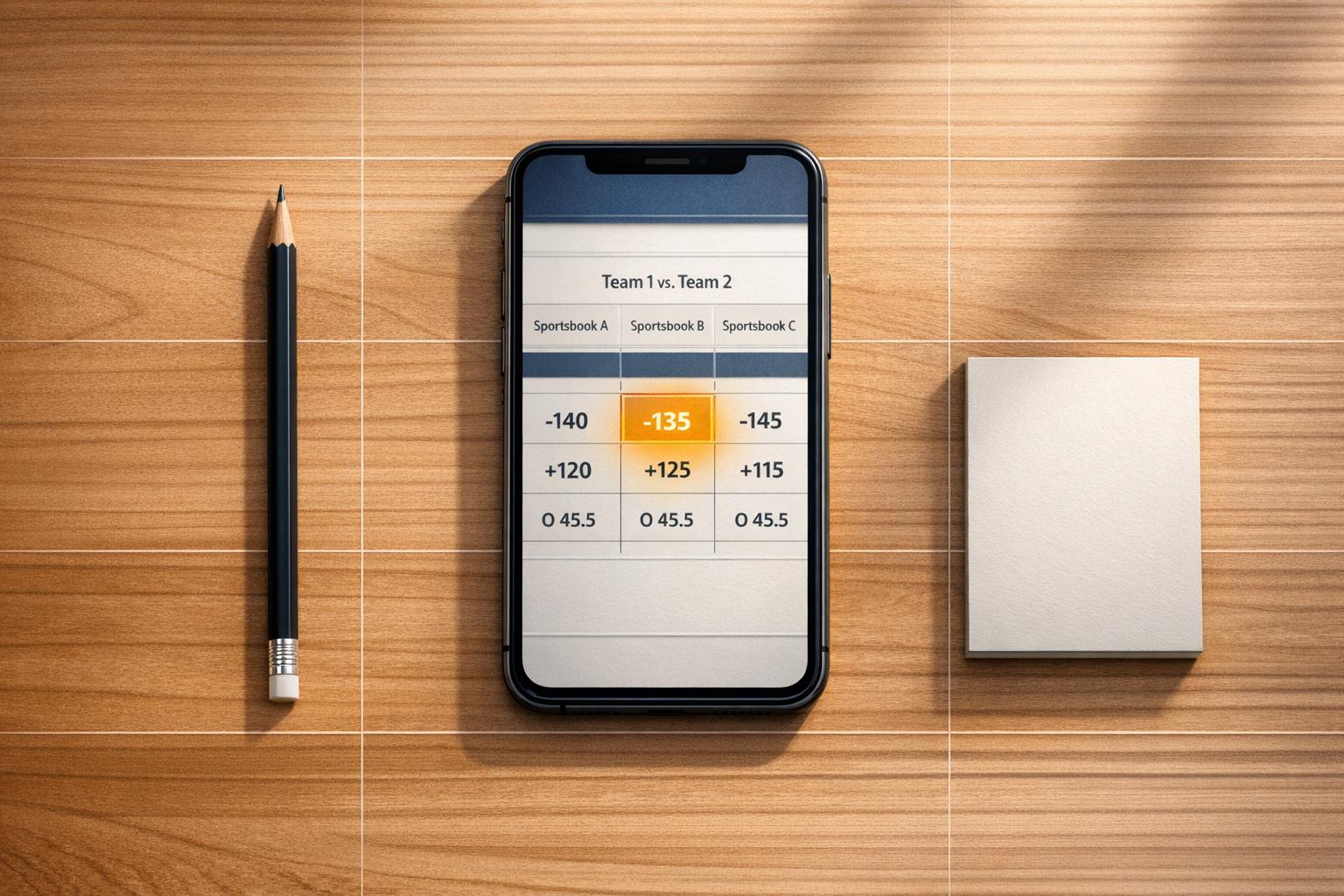
What Is Line Shopping in Sports Betting?
Line shopping is the process of comparing odds across multiple sportsbooks to find the best deal for your bet. It’s like hunting for discounts when shopping online, but here, it’s about maximizing your potential payout and minimizing the sportsbook’s edge. Even small differences in odds - like betting at -105 instead of -110 - can significantly impact your profits over time.
Here’s why it matters:
- Better Odds = Higher Returns: A $100 bet at -105 gives you $95.24 in profit, compared to $90.91 at -110.
- Lower Break-Even Rates: You need to win 52.38% of bets at -110 to break even, but only 51.22% at -105.
- Long-Term Gains: Over 1,000 bets, choosing -105 odds instead of -110 could add $1,160 to your profit.
To start, open accounts with 3–5 sportsbooks, use real-time odds tools to compare lines, and always check multiple platforms before placing a bet. Whether it’s spreads, moneylines, or props, finding better odds consistently can turn a losing season into a winning one.
What is Line Shopping | Sports Betting Education
sbb-itb-3ff9055
What Is Line Shopping?
Line shopping is all about finding the best deal on your bets. It means comparing odds and lines across different sportsbooks to get the most favorable terms for the same wager. Instead of settling for the first sportsbook you check, you take a moment to see if another one offers better odds or a smaller risk for the same potential payout.
"Line shopping is the smart play of scanning multiple betting sites to find the most favorable odds for the exact same bet." - BettorEdge
Here's why this works: sportsbooks set their lines independently, based on factors like their own risk management, betting volume, and liabilities. For example, one sportsbook might list the Dallas Cowboys at -3 with -110 odds, while another lists them at -3 with -105 odds. Both bets require the Cowboys to win by more than three points, but the second option lets you risk less money for the same reward. Some sportsbooks generate their own lines using expert models, while others adjust their lines based on market trends or their competitors. These differences create opportunities for bettors who know how to shop around.
How Line Shopping Works
Not all sportsbooks adjust their lines at the same pace or in the same way. When something big happens - like a key player injury or a major weather change - some sportsbooks react immediately, while others take longer. This creates brief windows where one sportsbook may offer much better odds than another.
Regional biases can also play a role. For example, a sportsbook in Chicago might set more favorable odds for the Bears' opponent because of heavy local betting on the Bears. These differences give line shoppers an edge by allowing them to find better value.
The process is straightforward: compare the point spread and juice (the sportsbook's commission) for the same game across different platforms. For instance, a -105 line is better than -110 because you risk less money for the same potential outcome. Even small differences like this can add up over time, leading to noticeably higher returns.
Benefits of Line Shopping
The biggest perk of line shopping is that it helps you reduce the house edge and keep more of your winnings. Sportsbooks make money by adding a vig (their cut) to every bet. By hunting for better odds, you’re effectively cutting into that vig and improving your profitability.
It also helps minimize losses. Sometimes, just a half-point difference in a spread - known as “the hook” - can turn a loss into a push, where you get your money back. In NFL games, where final scores often have margins of 3 or 7 points, this half-point can increase your win probability by 1–3%. Over the course of a season, these small advantages can make a big difference in your bankroll.
"Every single sharp in the industry utilizes line shopping into their daily plan." - Adam Thompson, Bookies.com
How Line Shopping Increases Your Returns
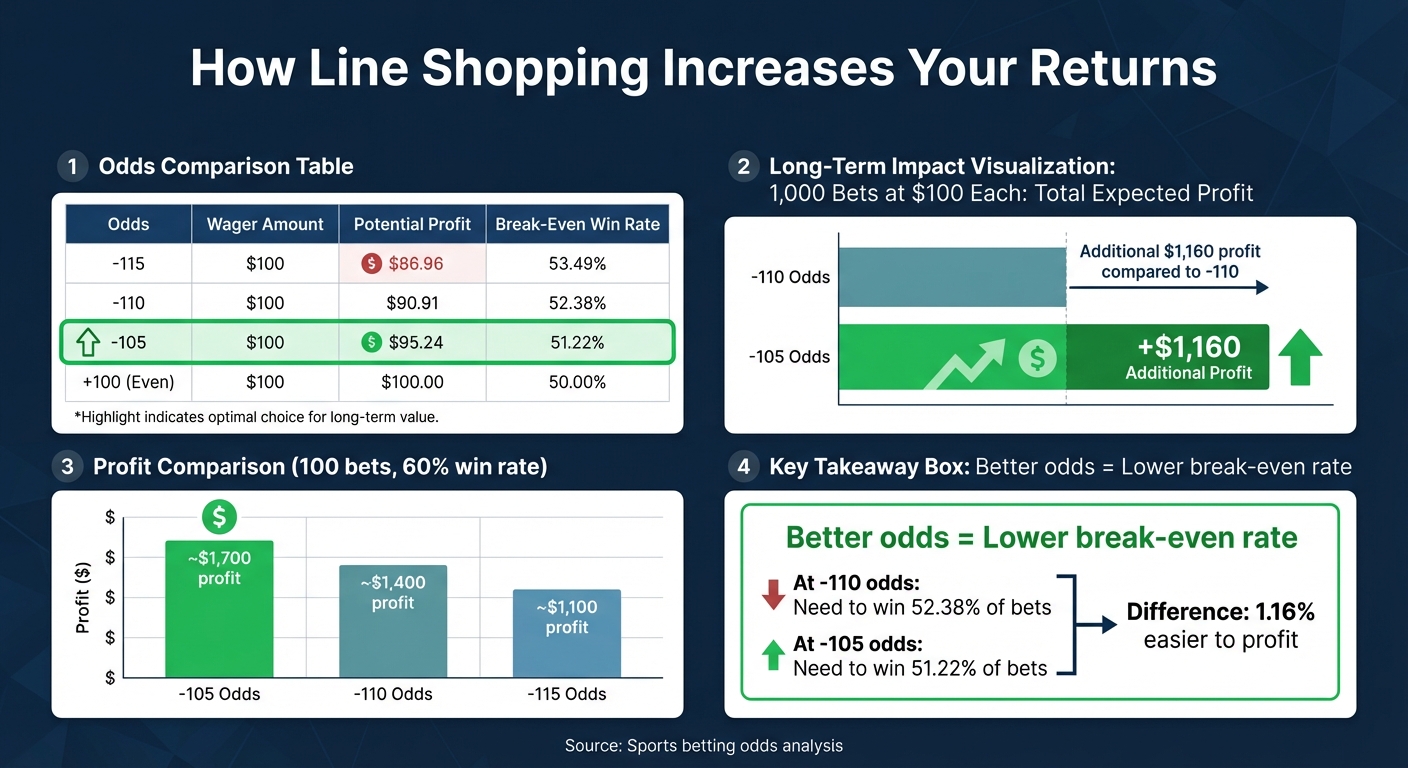
Line Shopping Odds Comparison: How Better Odds Increase Sports Betting Returns
Understanding Odds Differences
Getting better odds isn’t just about saving a few bucks - it directly impacts your bottom line. For instance, placing a $100 bet at -105 odds gives you a profit of $95.24. Compare that to the same bet at -115 odds, which only nets you $86.96. That’s a noticeable difference.
Here’s a quick breakdown of how odds affect your returns:
| Odds | Wager Amount | Potential Profit | Break-Even Win Rate |
|---|---|---|---|
| -115 | $100 | $86.96 | 53.49% |
| -110 | $100 | $90.91 | 52.38% |
| -105 | $100 | $95.24 | 51.22% |
| +100 (Even) | $100 | $100.00 | 50.00% |
Notice the break-even win rate - it’s the percentage of bets you need to win to avoid losing money. At standard -110 odds, you’d need to win 52.38% of your bets. But with -105 odds, that number drops to 51.22%. That lower threshold can significantly improve your overall profitability.
Let’s crunch the numbers over a larger scale. Imagine placing 1,000 bets of $100 each. Choosing -105 odds over -110 odds could add an extra $1,160 to your expected profit. At a 60% win rate over 100 bets, your profit would look something like this:
- -105 odds: Around $1,700
- -110 odds: Around $1,400
- -115 odds: Around $1,100
"Any edge, no matter how small or slight, is advantageous in the long-run. The margins for profitability in sports betting are low, to begin with, and line shopping is one way to beat the 'vig'."
- Paul Costanzo, Sportsbook Expert, SportsBettingDime
By consistently finding better odds, you’re not just increasing your profit per bet - you’re also cutting into the sportsbook’s edge, which can make a huge difference over time.
Reducing the House Edge
Better odds don’t just pad your winnings; they also shrink the sportsbook’s built-in profit margin, known as the vig or house edge. On standard point spreads, this edge typically ranges between 4% and 5%. By shopping for lines, you can often find reduced juice, which lowers the vig and leaves more money in your pocket.
For example, betting at -105 odds instead of -110 odds nearly cuts the house edge in half. That’s a game-changer, especially for professional bettors who aim for win rates between 53% and 56%. Even a small improvement in odds can turn a losing season into a winning one.
The numbers back this up. Bettors using no-vig or reduced-vig exchanges show a 40% profitability rate, compared to just 2% at traditional sportsbooks. Even casual bettors can benefit. A $25 bettor wagering a total of $5,000 could save $109 just by consistently betting at -105 odds instead of -110.
How to Line Shop
Opening Accounts at Multiple Sportsbooks
To get the best odds, it's smart to open accounts with 3–5 reputable sportsbooks. This gives you access to a range of lines without overwhelming yourself with too many platforms. But here's the catch: avoid signing up for multiple sportsbooks that rely on the same technology provider, like SBTech, since their odds are often nearly identical. Instead, aim for diversity by selecting sportsbooks that operate on different platforms.
Keep your accounts funded and familiarize yourself with each app's interface. This ensures you're ready to place bets quickly when favorable lines pop up. Don’t forget to take advantage of welcome bonuses - they can give your starting bankroll a nice boost.
Using Real-Time Odds Tools
Once you've got accounts set up, the next step is using tools to make line shopping efficient. Odds aggregators are a game-changer. They display lines from multiple sportsbooks side by side, helping you spot the best price instantly. These tools save you from manually checking each sportsbook, which can be time-consuming.
Platforms like LearnSportsBetting take this a step further by offering real-time odds updates. This feature allows you to compare lines quickly without having to jump between different websites. Pair these tools with calculators to easily identify profitable opportunities.
Comparing Odds Before Every Bet
When you're ready to place a bet, make sure you're getting the best possible line. Comparing odds should become a habit. Check at least three sportsbooks to compare both the line (like the spread or total) and the juice before finalizing your bet.
Timing matters. Look at the lines as soon as they open to catch softer numbers, and then check again right before kickoff when betting activity solidifies the odds. Keep an eye out for "steam" - sudden shifts in odds by 5% or more - which often indicate professional bettors are influencing the market.
To track your success, record the lines you bet on and compare them to the best available lines. This will help you measure the extra profit you're earning through line shopping. As expert bettor Robert Dellafave explains:
"Line shopping is one of the most conceptually simple cost savings vehicles in sports betting... it's not much different than price shopping for groceries."
Line Shopping for Different Bet Types
Line shopping isn't one-size-fits-all. The approach you take can vary depending on the type of bet you're placing. Here's how to get the most out of spreads, totals, moneylines, props, parlays, and futures.
Spreads, Totals, and Moneylines
When betting spreads, that extra half-point - known as the "hook" - can make all the difference. For example, betting on –2.5 instead of –3 could turn a potential push into a win if the team wins by exactly three points. In the NFL, key numbers like 3, 6, and 7 come up often, so grabbing a –2.5 instead of –3 could improve your long-term edge by about 1–3%.
For totals, the principle is similar. If you're betting the Under, aim for the highest total available (e.g., 203.5 instead of 203). On the flip side, Over bettors should look for the lowest number to maximize their chances.
Moneyline bettors need to focus on payout differences. Even small variations matter, especially for underdogs. For instance, choosing +112 over +105 on a $100 wager adds an extra $7 to your profit. For favorites, the goal is to risk less for the same return. A line of –110 instead of –120 means you’re risking less money on each bet. Even if spreads or totals are identical across sportsbooks, the juice (or vigorish) might differ. A juice of –105 instead of the standard –110 can significantly improve your profitability over time.
Props, Parlays, and Futures
Player props often offer opportunities because these markets are less refined. Sportsbooks may set less accurate lines for individual player stats, creating chances to find softer numbers. For example, you might find a prop line of 79.5 yards at –115 on one sportsbook versus 82.5 yards at –110 on another. That difference can be substantial over time.
Futures bets are another area where odds can vary widely. Since sportsbooks manage their long-term risks differently, you might see one book offering +600 on a team while another lists them at +750. Shopping around for the best odds is crucial here.
For parlays, even small differences in the odds for individual legs can add up when combined. Always compare the cumulative odds offered by different sportsbooks. Features like parlay insurance and profit boosts can further improve your returns. To avoid account limitations, consider mixing mainstream bets with high-value props in your parlays.
Line Shopping by Sport
Betting strategies differ depending on the sport, as scoring patterns, key numbers, and market behavior vary widely. To get the most out of your wagers, it’s essential to understand how these factors play out in the NFL, NBA, and MLB. Tailoring your approach to each sport can make a noticeable difference in your results.
NFL: Spreads and Totals
In the NFL, spreads revolve around key numbers like 3, 6, and 7 - common margins of victory. A half-point shift around these numbers can be the difference between winning and losing. Adam Thompson, Senior Handicapper, explains:
"Lines centering around 3, 6 or 7 points can dramatically change in value with a simple half-point line move."
For instance, betting on +3.5 instead of +3 protects you from a push if the favorite wins by exactly three points. Similarly, taking –2.5 instead of –3 can turn a potential push into a win. This small adjustment can improve your edge by 1%–3%.
When it comes to totals, the distribution of outcomes is broader, so a half-point difference is less impactful. Instead, focus on finding differences of 1–2 points to maximize value. Thompson advises:
"The best times to do your line shopping [for NFL] is right when the odds are released and right before kickoff."
These periods often bring the most line movement, giving you opportunities to grab favorable numbers.
NBA: Spreads and Over/Unders
In the NBA, small differences in spreads - especially around key victory margins like 5, 7, or 8 points - can turn a push into a win. While high-scoring games make individual half-points less critical than in the NFL, over the course of an 82-game season, those small edges add up.
The NBA also presents unique opportunities due to its sensitivity to injury news. When star players are ruled out, lines can shift quickly. Some sportsbooks may lag behind, leaving "stale lines" available for a short time. Keeping accounts funded across multiple sportsbooks allows you to act fast when these chances arise.
For totals, betting early can be advantageous. NBA totals often increase throughout the day as public bettors favor the Over. Locking in a lower total early gives Over bettors an edge. Additionally, compare the juice - one sportsbook might offer –5 at –105 while another lists it at –110. That small difference lowers your required win rate from 52.4% to 51.2%.
While spreads and totals dominate in the NFL and NBA, MLB offers a different focus with its moneyline and run line markets.
MLB: Moneylines, Run Lines, and Totals
In MLB, moneylines take center stage. Odds can vary significantly between sportsbooks - for example, +160 at one book means $10 more profit on a $100 bet compared to +150 at another. Always compare at least three sportsbooks before placing your moneyline wager.
Run lines, which are typically set at +/– 1.5, require attention to the price rather than the spread itself. For example, betting at –105 instead of –115 on a run line can have a big effect on your long-term returns.
In a low-scoring sport like baseball, a half-run difference can often decide the outcome. When betting totals, Under bettors should aim for the higher number (e.g., 8.5 instead of 8.0), while Over bettors should target the lower number. Be especially vigilant when starting pitchers are confirmed or scratched, as lines can shift quickly. Acting fast on stale lines before sportsbooks adjust can give you an edge.
Conclusion
If you're serious about sports betting, line shopping isn't just a nice-to-have; it's essential. Over the course of 1,000 bets at $100 each, the difference between -110 and -105 odds adds up to an additional $1,160 in expected profit. Better odds don't just mean more money - they also lower your required win rate from 52.4% to 51.2%.
Eric Kithinji, Senior Writer at BestOdds, sums it up perfectly:
"Line shopping could ultimately be the difference between being a positive or a negative sports bettor."
Why? Because this strategy directly cuts into the house edge. Even finding a half-point advantage on key numbers can make a noticeable difference. For example, over a 250-game stretch, betting at -105 instead of -110 means you need three fewer wins just to break even. That kind of edge not only boosts your profitability but also makes your overall betting approach simpler and more efficient.
Incorporating line shopping into your routine doesn’t have to be complicated. Start by opening accounts with three to five sportsbooks and use real-time odds tools to compare prices side-by-side. Check the lines both when they open and close to catch any shifts. Tools like LearnSportsBetting’s real-time odds updates (https://learnsportsbetting.com) can save you time by spotting discrepancies across sportsbooks without the need to manually check each one.
Every bet you place is an opportunity to grab the best possible value. Whether it’s getting +3.5 instead of +3 on an NFL spread or finding +165 instead of +150 on an MLB moneyline, these small differences add up. Over time, line shopping transforms betting from guesswork into a disciplined, data-driven process that delivers measurable results.
FAQs
How can I choose the best sportsbooks for line shopping?
When you're diving into line shopping, it's all about finding variety and value. The first step? Open accounts with several trustworthy sportsbooks that each use their own odds-setting methods. Why? Because this broadens your chances of spotting the best possible lines for your bets.
Focus on sportsbooks that stand out for their competitive odds, special promotions, and easy-to-use platforms. Some might even sweeten the deal with perks like deposit bonuses or boosted payouts, giving your returns a helpful nudge. By spreading your options across multiple platforms, you'll have a better shot at comparing lines effectively and squeezing the most out of your wagers.
What are the best ways to compare odds across sportsbooks?
When you're trying to compare odds across different sportsbooks, specialized tools can be a game-changer. These tools give you real-time updates on betting lines, making it easier to pinpoint the best odds out there. This way, you can make more informed bets and potentially boost your returns.
Some platforms go a step further by offering features like odds comparison, calculators for advanced betting strategies, and up-to-the-minute updates. These can help you identify discrepancies in odds, giving you an edge and improving your chances of long-term success as a bettor.
Why is it important to know key numbers in sports betting?
Key numbers in sports betting are the most frequent margins of victory or point totals in a game. For football, these often include 3, 7, and 10. These figures matter because they highlight where a betting line might offer an edge, especially in point spread betting.
Knowing these key numbers can lead to smarter choices and improve your chances of success over time. By spotting these patterns, you can identify situations where the odds or spreads could tilt in your favor.


