 LearnSportsBetting
How To Bet On NFL
Learn NFL betting basics: moneyline, spreads, totals, odds, bankroll management, props, parlays, futures, and responsible tips for beginners.
How To Bet On NFL
NFL betting involves predicting game outcomes and placing wagers on aspects like winners, point spreads, or total scores. It’s a billion-dollar industry, with $35 billion legally wagered during the 2025–26 season. Here’s what you need to know:
-
Types of Bets:
- Moneyline: Bet on the outright winner.
- Point Spread: Predict the margin of victory.
- Over/Under: Wager on total combined points.
-
Odds Explained:
- Negative odds (e.g., -150) indicate favorites; you risk more to win.
- Positive odds (e.g., +200) indicate underdogs; you risk less to win more.
- Legal Status: Betting is legal in 38–39 states plus D.C. Geolocation ensures compliance with state laws.
-
Strategies:
- Line Shopping: Compare odds across sportsbooks for better value.
- Bankroll Management: Bet 1–2% of your total bankroll per wager.
- Key Numbers: Focus on spreads around 3 and 7 points, as these are common NFL scoring margins.
-
Advanced Bets:
- Props: Bet on player or team stats.
- Parlays: Combine multiple bets for higher payouts but increased risk.
- Futures: Predict long-term results like Super Bowl winners or MVPs.
NFL betting requires careful planning, understanding odds, and managing risks. Start small, stay informed, and always bet responsibly.
NFL Betting Types and Odds Explained: Moneyline, Point Spread, and Over/Under
How to Read NFL Betting Odds
American Odds Explained
American odds, the standard in U.S. sportsbooks, revolve around a $100 baseline. You'll notice either a plus (+) or minus (-) sign next to the odds, which tells you whether you're betting on a favorite or an underdog.
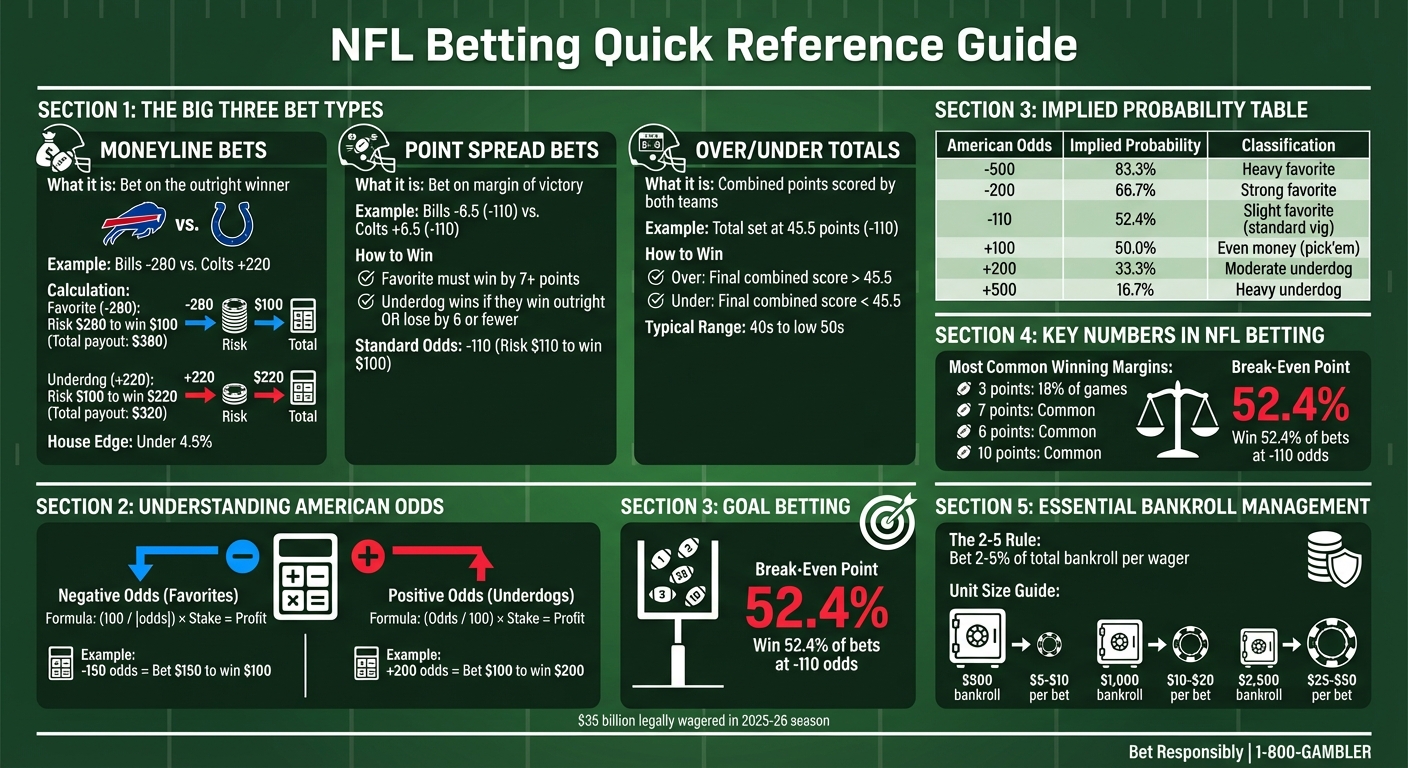
A negative number means the team is favored to win. For example, odds of -150 mean you need to bet $150 to win $100 in profit. If your bet wins, your total payout is $250 - your original $150 stake plus $100 profit.
A positive number signals the underdog. Odds of +200 mean a $100 bet would earn you $200 in profit, resulting in a total payout of $300.
The math works proportionally for any amount. A $50 bet at -110 odds would bring in about $45.45 in profit. To calculate this:
- For negative odds: (100 / |odds|) × Stake
- For positive odds: (Odds / 100) × Stake
Calculating Implied Probability from Odds
Odds don’t just determine payouts - they also reveal the likelihood that a sportsbook assigns to an outcome. This is called implied probability, and converting odds into percentages can help you understand how likely the sportsbook thinks an event is to happen.
For negative odds, divide the absolute value of the odds by the sum of the absolute value and 100, then multiply by 100. For example, -200 odds have an implied probability of 66.7%:
200 / (200 + 100) = 0.667
For positive odds, divide 100 by the sum of the odds and 100, then multiply by 100. For example, +150 odds have an implied probability of 40.0%:
100 / (150 + 100) = 0.40
To break even at -110 odds, you need to win about 52.4% of your bets. Betting consistently where the required win rate exceeds the implied probability is a losing strategy over time.
| American Odds | Implied Probability | What It Means |
|---|---|---|
| -500 | 83.3% | Heavy favorite |
| -200 | 66.7% | Strong favorite |
| -110 | 52.4% | Slight favorite (standard vig) |
| +100 | 50.0% | Even money (pick'em) |
| +200 | 33.3% | Moderate underdog |
| +500 | 16.7% | Heavy underdog |
Mastering these calculations is essential for evaluating NFL bets effectively.
NFL Odds Examples
Let’s look at a hypothetical NFL matchup: the Kansas City Chiefs versus the Las Vegas Raiders.
- Moneyline: Chiefs -280, Raiders +230. The Chiefs are the favorite, and the Raiders are the underdog. A $280 bet on the Chiefs would win $100, while a $100 bet on the Raiders would win $230.
- Point Spread: Chiefs -6.5 (-110), Raiders +6.5 (-110). For a bet on the Chiefs to win, they must win by at least 7 points. A bet on the Raiders wins if they either win outright or lose by 6 points or fewer. The -110 odds represent the sportsbook's commission, known as the vigorish.
- Over/Under: Total set at 47.5 points (-110). You can bet on whether the combined score of both teams will be over or under 47.5. If the Chiefs win 28-24, the total is 52 points, and the over wins.
"Sportsbooks do not always think alike with setting odds. Football spreads tend not to vary by more than a point, but the difference with a key threshold line (i.e., 6.5 and 7.5 or 2.5 and 3.5) can be significant." - Mike Tierney, SportsLine Expert
Key numbers matter in NFL betting. For instance, about 18% of NFL games end with a margin of exactly 3 points. Betting on a -2.5 spread instead of -3 can give you an edge, as you win if the team wins by exactly 3 points. Similarly, opting for a +3.5 spread rather than +3 protects you from losing by a 3-point margin.
These examples lay the groundwork for understanding the different types of bets you can make in NFL wagering.
sbb-itb-3ff9055
Main Types of NFL Bets
Moneyline Bets
A moneyline bet is as straightforward as it gets: you’re betting on which team will win. The favorite is marked with a minus sign and negative odds, while the underdog is shown with a plus sign and positive odds.
For example, if the Bills are listed at -280, you’d need to bet $280 to earn a $100 profit, making your total payout $380. On the flip side, if the Colts are +220, a $100 wager would net you $220 in profit, bringing your total payout to $320.
The house edge for NFL moneyline bets is typically under 4.5%, which is slightly better than what you’d find with point spreads. As a rule of thumb, a team favored at -400 on the moneyline is statistically expected to win by around 9 points. In cases where the game ends in a tie, most sportsbooks classify it as a "push", meaning your original stake is refunded.
"The gambler's dilemma is born. Favorites might be 'supposed' to win, but successful moneyline underdog bets can be extremely profitable." - Chase Kiddy, BetMGM
Let’s move on to point spread bets, which add a layer of complexity by factoring in the margin of victory.
Point Spread Bets
Point spread betting isn’t just about picking the winner - it’s about predicting the margin by which a team will win or lose. For the favorite to "cover", they need to win by more than the spread. On the other hand, the underdog covers by either winning outright or losing by fewer points than the spread.
Take a Bills vs. Colts matchup as an example. If the Bills are listed as -6.5 favorites, they need to win by at least 7 points for a spread bet on them to pay out. If they win by just 2 points, they’ve failed to cover, and bettors who took the Colts at +6.5 would win.
Most point spread bets come with standard odds of -110, meaning you’d risk $110 to win $100. The half-point, often called the "hook" (like the .5 in -6.5), eliminates the possibility of a tie. However, if the spread is a whole number and the game lands exactly on it, the bet results in a "push", and your stake is refunded.
Interestingly, teams that cover the spread at halftime tend to maintain that trend: favorites do so 73.3% of the time, while underdogs hold their cover 76.7% of the time.
"The spread is a way of leveling the playing field: In order to cover the spread, the favored team not only needs to win the game – they must do so by a specified number of points." - Patrick Cwiklinski, Evergreen Manager, SportsBettingDime
Now, let’s dive into over/under bets, which focus entirely on total scoring.
Over/Under Totals
Over/under bets, also known as totals, are all about the combined points scored by both teams. The sportsbook sets a benchmark total, and you simply bet on whether the final score will be over or under that number.
For instance, if the total is set at 45.5 points with standard -110 odds, you’d risk $110 to win $100. The half-point ensures there’s no tie - if the total is a whole number like 46 and the final score matches it exactly, all bets are refunded. Don’t forget, overtime points are included in the total.
NFL totals generally range from the 40s to low 50s, with key numbers like 40, 41, 44, 47, and 51 being particularly common.
Here’s an example: In January 2026, a Cowboys vs. Giants game had a total set at 44.5. If the final score was 27-21 (48 points combined), the over would win. If it ended 20-17 (37 points combined), the under would cash.
| Bet Type | What You're Betting On |
|---|---|
| Moneyline | Which team wins the game |
| Point Spread | Margin of victory after handicap |
| Over/Under | Combined points scored |
Additional NFL Betting Options
Player Props and Team Props
Prop bets let you wager on specific in-game events. Player props focus on individual stats like passing yards, rushing yards, or receiving yards. On the other hand, team props deal with outcomes such as total points scored or which team hits 10 points first.
Most prop bets are structured as over/under wagers and often include a half-point "hook" to avoid ties. For instance, you could bet on whether Patrick Mahomes throws for over or under 299.5 passing yards. In "Anytime Touchdown" markets, only the player who physically carries or catches the ball into the end zone wins the bet - quarterbacks don’t earn credit for passing touchdowns.
"Bettors pursue prop bets to exploit pricing errors behind the belief that because oddsmakers produce such a high volume of them, they are more likely to release inaccurate odds."
- Josh Nagel, SportsLine Expert
To maximize your chances, look for undervalued players by analyzing matchups and comparing lines across sportsbooks. Different books may offer varying totals for the same player, giving you an edge. If a player is inactive or doesn’t play, most sportsbooks will void the bet and refund your money.
Once you’ve explored props, consider combining multiple outcomes into a single wager.
Parlays and Same-Game Parlays
Parlays offer higher payouts but require every leg of the bet to win. A traditional parlay combines bets from different games, while a same-game parlay (SGP) stacks multiple outcomes from the same contest - like pairing a quarterback’s passing yards with a receiver’s anytime touchdown.
Since outcomes in SGPs are often correlated (e.g., a quarterback’s performance directly impacts a receiver’s stats), sportsbooks typically reduce payouts compared to traditional parlays. For example, betting on a team to win alongside their running back scoring a touchdown reflects events likely to occur together, so the odds are adjusted.
Keep in mind, the house edge grows with each added leg. A two-leg parlay might have a 10% hold, while a four-leg parlay could reach around 31.25%. To manage risk, experts suggest sticking to two- or three-leg parlays. For example, in Week 1, betting $100 on two favorites separately (at -120 and -115) would yield an $85.14 profit. However, parlaying those bets together could result in a $242.75 payout.
If you’re looking for long-term betting options, futures might be worth exploring.
Futures Bets
Futures bets focus on events decided weeks or months down the road, like predicting the Super Bowl winner, division champions, or individual awards such as MVP. For example, as of February 2026, the Kansas City Chiefs are listed at +650 to win Super Bowl LX, while the Baltimore Ravens sit at +850. Individual awards also have futures markets: Patrick Mahomes is +300 for MVP, and Caleb Williams is +135 for Offensive Rookie of the Year.
"NFL futures odds are often more favorable for bettors before the season since so many variables are at play, including potential injuries and whether a team overachieves or underachieves relative to their preseason expectations."
- Drew Norton, Sports Betting Expert
Placing futures bets early can help you secure better odds, but remember to allocate only 5–10% of your bankroll since these funds will be tied up for months. Shop around different sportsbooks to find the best lines. Many books now offer "cash-out" options, letting you lock in partial profits if your pick is performing well - or cut your losses if things aren’t going as planned.
NFL Betting Strategies and Tools
How to Analyze NFL Games
Successful NFL betting starts with understanding the key factors that influence game outcomes. These include rest advantages, travel fatigue, injuries, altitude, and weather conditions. For example, teams playing on Monday after a Thursday game win against the spread 56% of the time. Similarly, a quarterback injury can swing the spread by 4–6 points, while weather conditions like wind speeds over 15 mph or temperatures below 32°F can reduce scoring by several points.
Pay close attention to injury reports, especially designations like "Out", "Doubtful", or "Questionable." Weather also plays a critical role in scoring - high winds can disrupt passing and kicking, lowering scores by 3–5 points, while freezing temperatures make the ball harder to handle, reducing scores by 2–3 points.
Another useful tactic is analyzing public betting trends. If you notice reverse line movement - when the betting line shifts in the opposite direction of public wagers - it could indicate that professional bettors are backing the less popular side. Timing also matters. Placing bets early on Sunday nights, when lines are first posted, can give you an edge before oddsmakers make adjustments.
This kind of detailed analysis lays the groundwork for disciplined bankroll management.
Managing Your Betting Bankroll
A disciplined approach to bankroll management is essential for long-term success. Start by setting aside a specific amount for the NFL season - money you can afford to lose without impacting your daily life. Professional bettors aim for a modest win rate of 53% to 55%, which makes careful tracking of your bets and patterns even more important.
A "unit" typically represents 1% to 2% of your total bankroll, and you should never wager more than 2% to 5% on a single bet. For instance, if your bankroll is $1,000, your standard bet should range between $10 and $20.
| Bankroll Size | Unit Size (1-2%) | Recommended Usage |
|---|---|---|
| $500 | $5 – $10 | Partial season coverage |
| $1,000 | $10 – $20 | Full regular season coverage |
| $2,500 | $25 – $50 | Full season plus playoffs |
To calculate the optimal size of your bets, you can use the Kelly Criterion:
Kelly % = (bp - q) / b
This formula evaluates your perceived edge compared to the probability of winning. However, most bettors use only 25–50% of the suggested Kelly amount to minimize risk. Stick to your unit sizes, even during losing streaks - chasing losses is a common pitfall.
"The difference between consistently betting on a −110 line compared to a more advantageous −105 is massive."
Another critical strategy is line shopping. Comparing odds across multiple sportsbooks can make the difference between a profitable and losing season. Even a half-point change matters, as 18% of NFL games are decided by exactly 3 points. Additionally, tracking your performance against the closing line value - whether your bets consistently outperform the final odds - can help determine your long-term success.
Betting Calculators and Resources
To sharpen your betting strategy, consider using specialized tools and resources. Websites like LearnSportsBetting offer calculators designed for NFL betting, including:
- Parlay calculator: Estimate combined payouts for multiple bets.
- Kelly Criterion calculator: Determine the optimal bet size based on your edge.
- Odds converter: Switch between American, Decimal, and Fractional odds formats.
- EV calculator: Assess the value of a bet by comparing your estimated win probability with the implied probability of the odds.
Additional resources like public betting trend trackers and historical databases can also be invaluable. These tools let you identify patterns, such as reverse line movement or how specific teams perform in unique situations (e.g., home underdogs or teams coming off a bye week, which historically cover about 54% of the time).
For responsible gambling, take advantage of deposit and loss limits offered by most betting apps. To calculate your monthly betting budget, subtract essential expenses from your after-tax income. For example, if you have $1,000 left over, a reasonable betting budget might be $10 to $50 per month. LearnSportsBetting also offers one-on-one expert support and real-time odds updates to help you make informed decisions while staying within your limits.
How to Place Your First NFL Bet
Step-by-Step Betting Instructions
Getting started with NFL betting is simple once you know the process. Begin by choosing a licensed sportsbook that operates in your state. Popular platforms like FanDuel, DraftKings, and BetMGM are available in over 25 states as of early 2026. After creating an account, complete the verification process and deposit funds using methods like PayPal, online banking, or credit cards.
Once your account is funded, head to the NFL section of the sportsbook. Here, you’ll find upcoming games and their betting lines. For beginners, it’s best to start with straightforward bet types:
- Moneyline: Pick the outright winner.
- Point Spread: Bet on the margin of victory.
- Totals: Wager on the combined score of both teams.
Click on the odds for your chosen bet, and it will appear in your bet slip. In the bet slip, enter the amount you want to wager. The app will calculate your potential payout based on the odds. For example, if you bet $100 on the Eagles at -108 odds (like in Super Bowl 59), your profit would be approximately $92.59 if they win. Double-check your bet details, then hit "Place Bet" or "Confirm" to finalize your wager.
"Over the course of a season, getting a half-point here and there, and paying less juice on the bets you like (-108 compared to -120) can make the difference between a profitable and losing year." - Larry Hartstein, SportsLine Expert
To maximize your chances, consider line shopping - comparing odds across different sportsbooks. For example, during an October 2025 Bengals vs. Buccaneers game, some sportsbooks offered a spread of -6.5 at -112 odds, while others had -108 for the same line. That small difference in juice can significantly impact your long-term results. Since you need to win 52.4% of your bets to break even at standard -110 odds, finding better lines is crucial.
Betting Responsibly
After placing your bet, it’s essential to prioritize responsible gambling. As outlined in the bankroll management section, set strict limits on your deposits and losses. Most sportsbooks provide tools to help you cap daily, weekly, or monthly spending. Use these features proactively to avoid overspending.
Avoid the temptation to chase losses by increasing your bet size to recover previous losses. Stick to your predetermined unit size, which is typically 1–2% of your total bankroll, regardless of whether you’re on a winning or losing streak. If you notice that betting is causing stress or financial strain, take a step back and reassess. For those needing support, call 1-800-GAMBLER for assistance.
Conclusion
Main Points to Remember
NFL betting revolves around a few essential principles that help bettors make informed choices. First, understanding American odds and implied probability is crucial for assessing the value of any wager. The "Big Three" bet types - Moneyline, Point Spread, and Over/Under Totals - serve as the backbone of NFL betting and are ideal for beginners to grasp. Keep in mind that with standard -110 odds, sportsbooks typically charge a vigorish of about 4.5%, meaning you’d need to win at least 52.4% of your bets to break even.
Bankroll management is another cornerstone of successful betting. Stick to the 2-5 rule, which means wagering no more than 2% to 5% of your total bankroll on a single bet. Using "units" (generally 1% of your bankroll) to track bets can help you stay consistent, regardless of short-term wins or losses. Additionally, line shopping - comparing odds and spreads across multiple sportsbooks - can make a significant difference over time. Even small variations like a half-point shift in the spread or slightly better juice can impact your long-term results.
Pay close attention to key numbers in NFL betting. For example, games often end with a margin of exactly 3 points - this happens about 18% of the time - followed by margins of 7, 6, and 10 points. Securing a favorite at -2.5 instead of -3 could give you a meaningful edge. Be cautious with parlays; while their payouts might seem appealing, they come with a house edge of roughly 18.1%, compared to just 3.6% for straight bets. If you do place parlays, limit them to two-team combinations to better manage your risk.
By sticking to these strategies, you’ll be better equipped to place your first few bets with confidence.
Getting Started with NFL Betting
Begin your NFL betting journey with the basics: Moneyline, Point Spread, and Totals. Take the time to compare lines across licensed sportsbooks to ensure you’re getting the best possible value. Use the tools provided by betting platforms to set clear deposit and loss limits, and avoid the trap of chasing losses by increasing your bet sizes.
Keep a detailed log of every wager. This will help you identify which types of bets yield the best results and allow you to monitor your overall performance. Remember the core strategies outlined in this guide: stay disciplined, research thoroughly, and gamble responsibly. With $35 billion legally wagered on the NFL during the 2024-25 season, the opportunities are vast - but long-term success depends on mastering the fundamentals covered here.
How to Bet on the NFL (The Ultimate Beginner's Guide)
FAQs
What’s the difference between Moneyline, Point Spread, and Over/Under bets in NFL betting?
When it comes to betting on NFL games, there are three main types of bets you’ll encounter: Moneyline, Point Spread, and Over/Under. Each offers its own approach to wagering, depending on how you want to predict the game’s outcome.
- Moneyline Bets: This is as straightforward as it gets. You’re simply betting on which team will win the game. The odds indicate the favorite (shown as a negative number) and the underdog (shown as a positive number). Your payout depends on the team’s chances of winning - favorites pay less, while underdogs pay more if they pull off an upset.
- Point Spread Bets: Here, the sportsbook levels the playing field by giving the underdog a points advantage or requiring the favorite to win by a certain margin. For example, if the spread is -6.5, the favorite must win by at least 7 points to "cover the spread." On the flip side, the underdog can lose by up to 6 points (or win outright) for your bet to pay off.
- Over/Under Bets: Also known as totals, this type of wager focuses on the combined score of both teams. You’re betting on whether the total points scored will be higher or lower than the number set by the sportsbook.
Each bet type caters to different strategies. If you’re confident about a team’s outright win, go for the Moneyline. For games expected to be tight, Point Spread bets add an extra layer of excitement. And if you’re more interested in predicting scoring trends, Over/Under bets are your go-to option.
How do I calculate implied probability from American odds?
To figure out the implied probability from American odds, you can use these straightforward formulas:
-
For negative odds (e.g., -150):
Implied Probability = |odds| ÷ (|odds| + 100) × 100 -
For positive odds (e.g., +150):
Implied Probability = 100 ÷ (odds + 100) × 100
Let’s break it down with examples:
- If the odds are -150, the calculation would show an implied probability of roughly 60%.
- For +150 odds, the implied probability comes out to about 40%.
These formulas are a handy way to interpret the chances of an outcome based on the odds you're given.
What are the best strategies for managing my NFL betting bankroll?
Handling your NFL betting bankroll wisely is crucial if you want to stay in the game long-term. The first step? Set aside a specific amount of money - cash you’re comfortable losing that won’t interfere with your everyday expenses. This is your dedicated bankroll.
Once you’ve got your bankroll, the golden rule is to bet conservatively. Stick to wagering a small percentage of your total bankroll on each bet, typically between 1% and 5%. This approach helps protect your funds during losing streaks and keeps you from running out of money too fast.
Another key? Avoid the temptation to chase losses. Doubling down after a bad day might feel like the right move, but it’s a fast track to draining your bankroll. Instead, stay disciplined and stick to your plan, no matter what the short-term results look like.
As your bankroll changes - whether it grows or shrinks - adjust your bet sizes accordingly. For instance, if you’re up, you can afford to risk a little more. If you’re down, scale back until you’re back on track.
Finally, keep detailed records of every bet. Tracking your wins and losses not only helps you monitor your performance but can also reveal patterns and areas where you can tweak your strategy.
By staying disciplined, betting within your limits, and reviewing your results regularly, you’ll be in a much better position to make smarter choices and improve your chances of success over time.


