 LearnSportsBetting
How To Bet On NBA
A practical NBA betting guide explaining odds, bet types, bankroll rules, injury and lineup tips, and strategies for smarter wagers.
How To Bet On NBA
NBA betting involves predicting game outcomes like winners, point spreads, totals, or player performances through licensed sportsbooks. Here's a quick breakdown:
- Popular Bet Types: Moneyline (pick the winner), Point Spread (bet on the margin of victory), Totals (Over/Under), Parlays (combine multiple bets), and Prop Bets (specific events or player stats).
- Key Stats: Favorites typically win 60–65% of games, while underdogs win 35–40%. To break even at -110 odds, you need a win rate of 52.4%.
- Legal Access: Sports betting is legal in over 38 U.S. states as of 2026, with mobile platforms making it easy to place bets.
- Getting Started: Choose a licensed sportsbook, fund your account, and focus on simple bets like moneylines or totals to build confidence.
- Strategies: Monitor injury reports, analyze team stats (e.g., pace, efficiency), and manage your bankroll by betting 1–5% of your total funds per wager.
NBA betting offers frequent opportunities with its 82-game season. By combining basic strategies with responsible betting, you can make smarter wagers while enjoying the game.
How to Bet on the NBA Like a Pro (Step-by-Step Guide)
sbb-itb-3ff9055
NBA Odds and Bet Types Explained
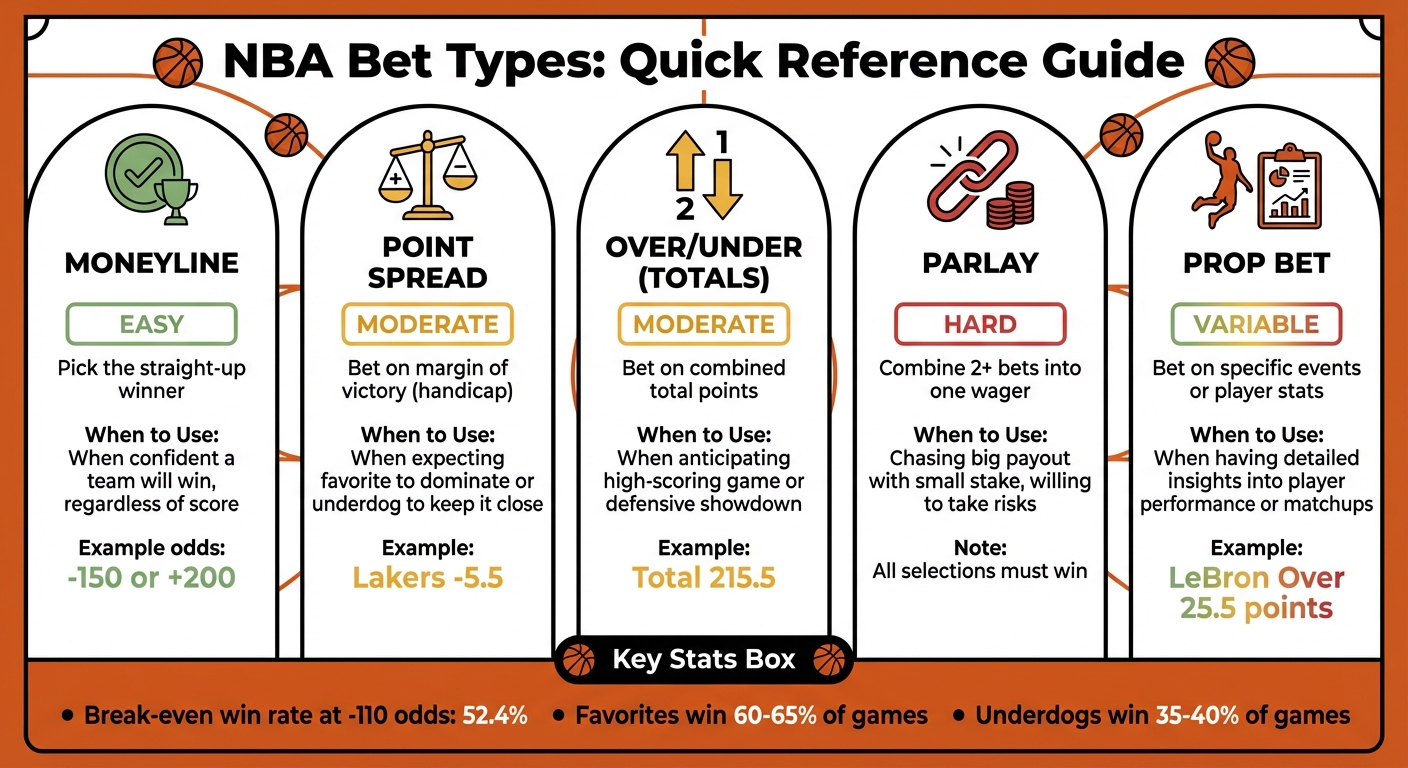
NBA Bet Types Comparison Guide: Difficulty Levels and Best Use Cases
How NBA Odds Work
NBA odds in the American format revolve around a $100 benchmark. For favorites, like -150, you’d need to bet $150 to make a $100 profit. On the other hand, for underdogs, such as +200, a $100 bet would yield $200 in profit, giving you a total return of $300.
Most point spreads and totals include a "vig" or "juice", which is essentially the sportsbook's fee. Typically, this is set at -110, meaning you’d risk $110 to win $100.
Now, let’s dive into the main types of NBA bets.
Main NBA Bet Types
Moneyline bets are straightforward: you’re simply picking which team will win the game. This type of bet works well if you’re backing an underdog or when the matchup feels evenly balanced.
Point spread bets aim to even the odds by giving the underdog a head start. For the favorite to win your bet, they need to exceed the spread; for the underdog, they must lose by less than the spread or win outright. Sportsbooks often use half-points (e.g., -5.5) to eliminate the possibility of a push, where the score matches the spread, resulting in a refund. This option is great when you’re looking for better odds on a favorite or predicting a one-sided game.
Totals (Over/Under) bets focus on the combined score of both teams. You’re betting on whether the total points will be higher or lower than the number set by the sportsbook. This is a good choice when you’re confident about the game’s pace but unsure about the winner.
Parlays allow you to combine multiple bets into one. To win, all your selections must hit. While the risk is high, the potential payout for a small wager can be very appealing.
Prop bets zero in on specific events, such as a player’s total points, rebounds, or assists. These bets require a deeper understanding of player stats and matchups, making them popular among fans who follow individual players closely.
Getting familiar with these bet types will help you apply the strategies covered later in this guide.
Bet Type Comparison Table
Here’s a quick overview of the main bet types:
| Bet Type | Definition | Difficulty | When to Use |
|---|---|---|---|
| Moneyline | Picking the straight-up winner of the game | Easy | When you’re confident a team will win, regardless of the score |
| Point Spread | Betting on the margin of victory (handicap) | Moderate | When you expect a favorite to dominate or an underdog to keep it close |
| Over/Under | Betting on the combined total points | Moderate | When you anticipate either a high-scoring game or a defensive showdown |
| Parlay | Combining 2+ bets into one wager | Hard | When you’re chasing a big payout with a small stake and willing to take risks |
| Prop Bet | Betting on specific events or player stats | Variable | When you have detailed insights into player performance or matchups |
How to Choose a Sportsbook and Place Your First Bet
Choosing a Licensed Sportsbook
Picking the right sportsbook is your first step toward diving into the NBA betting markets. Start by ensuring the sportsbook is licensed in your state. Licensed operators not only provide legal protection but also keep your funds secure. Look for your state’s gambling authority logo - like the New Jersey Division of Gaming Enforcement or Pennsylvania Gaming Control Board - in the website footer to confirm legitimacy.
Once you've verified licensing, evaluate the sportsbook's NBA betting options. A strong platform will offer more than just the basics like spreads and totals. Look for additional markets, including player props (e.g., points, rebounds, assists), futures, and live in-game betting. As Brett Smiley, Co-founder of SportsHandle, explains:
NBA player prop bets are a softer market for expert handicappers and can be a very soft market if you catch the news at the right time.
Don’t forget to compare the vig (or juice) between platforms. Most sportsbooks charge -110 on standard bets, meaning you’d risk $110 to win $100. However, some offer promotions like "reduced juice" at -105 or even +100 on select games, which can save you money over time.
Also, check for flexible banking options. E-wallets like PayPal and Venmo tend to process deposits and withdrawals faster than other methods. Lastly, test the mobile app or website experience - especially if you plan to place live bets during games. Once you've found a sportsbook that checks all these boxes, you're ready to place your first wager.
Step-by-Step: Placing Your First Bet
After choosing a sportsbook, follow these steps to get started with your first NBA bet. First, create an account by entering your personal details - such as your full name, address, date of birth, and the last four digits of your Social Security Number. This verification process ensures compliance with state regulations. Then, fund your account using a trusted payment method like a credit card, e-wallet, or cash via services like PayNearMe.
Make sure you're in a legal betting state, as sportsbooks use geofencing technology to block wagers from restricted areas. For faster transactions, e-wallets are often the best option for both deposits and withdrawals.
Once funded, head to the NBA section in the sportsbook's main lobby. Here, you’ll see upcoming games with key markets such as point spreads, totals, and moneylines. Click on your desired bet to add it to your bet slip, which is typically displayed on the right side of the screen (or at the bottom if you’re on mobile). Enter your stake amount, and the system will calculate your potential payout automatically. After placing your bet, don’t forget to explore any available sign-up bonuses to maximize your bankroll.
How to Use Sign-Up Bonuses
Sportsbooks often lure new users with welcome bonuses that can give you a boost when starting out. These bonuses might include deposit matches, where your initial deposit is matched up to a certain amount. Bonus bets are another common offer, giving you credits for signing up or meeting deposit requirements. Keep in mind, though, that only the profits from winning bonus bets are yours to withdraw.
Some sportsbooks also offer secured first bets. If your initial wager loses, they’ll refund it as bonus funds, giving you a second chance to win.
Read the fine print carefully, as most bonuses come with rollover requirements. These rules specify how many times you need to wager the bonus amount before you can withdraw any winnings. Understanding these terms ensures you can make the most of these offers without any surprises.
Basic NBA Betting Strategies
Strategies for Beginners
If you're new to NBA betting, it's best to start with the basics: moneylines, point spreads, and totals. These are simpler to understand and can help you build confidence as you learn the ropes.
Pay attention to line movement from the time odds are posted to game time. Early shifts often reflect the influence of sharp bettors. For example, when the line moves in the opposite direction of public betting, it could indicate a phenomenon known as reverse line movement.
Another critical factor is injury reports. Even the absence of a backup player can shift the line by a point or two. Always check injury updates up until tip-off - last-minute scratches can create opportunities for better bets.
Schedule context also plays a big role. Teams on back-to-back games, particularly on the road, often underperform. Fatigue becomes even more of a factor during grueling stretches like "4 games in 5 nights." Statistics show that teams playing the second night of a back-to-back lose against the spread 57% of the time when facing a well-rested opponent with at least two days off.
Once you're comfortable with these basics, you can start using NBA statistics to sharpen your betting strategy.
Using NBA Stats to Make Better Bets
Understanding team efficiency metrics is essential for smarter bets. Instead of relying on raw points per game, focus on offensive and defensive ratings, which measure points scored or allowed per 100 possessions. These stats provide a pace-neutral perspective, giving you a clearer picture of team performance.
Speaking of pace, this metric - possessions per game - is key for predicting totals (over/under bets). When fast-paced teams face slow-paced ones, the tempo often gravitates toward the slower team's average. A difference of 10 possessions between teams can translate to over 20 points in expected scoring, directly impacting your totals wager.
Don't overlook home court advantage, which typically adds about 2–3 points to the spread. And remember, professional bettors aim for a win rate of 53–55% over a season. While this may seem modest, it can yield a steady 3–5% return on investment when paired with disciplined betting.
By leveraging these stats, you'll make more informed decisions and avoid common pitfalls.
How to Avoid Emotional Betting
One of the biggest mistakes bettors make is letting emotions dictate their wagers. Betting on favorites out of loyalty or gut instinct can quickly drain your bankroll.
Instead, stick to a structured approach. Before placing a bet, review key factors like rest advantages, efficiency ratings, injury reports, and line movement. This methodical process keeps emotions out of the equation.
Be cautious about betting on popular teams based solely on their reputation. Sharp bettors often find value in fading these teams, especially in tough spots - like when they're playing their third road game in four nights. Keep in mind that underdogs win about 35–40% of NBA games, so don't automatically assume the favorite is the safer choice.
Lastly, practice bankroll management. Set a budget, track your bets, and focus on finding mismatches where the market odds don't align with the actual probabilities. The goal isn't to predict every winner - it's to identify value and make smarter bets. With discipline and these strategies, you'll build a stronger foundation for NBA betting.
Managing Your NBA Betting Bankroll
How to Set a Bankroll
Your bankroll should be money you can afford to lose - extra funds that won’t interfere with your rent, bills, or daily needs.
Start by deciding on a unit size, typically 1% to 5% of your bankroll per bet. For instance, if you’ve set aside $1,000 for NBA betting, a 2% unit means you’re wagering $20 per bet.
"Every sports bettor should always be conscious of their bankroll, no matter how often or how much they intend to bet." - Patrick Cwiklinski, Sportsbook Expert
For beginners, sticking to 1% to 2% per bet is a safer choice. More experienced bettors might go up to 3% to 5% on bets they feel strongly about. Even professional bettors rarely risk more than 1% of their total bankroll on a single event. This cautious strategy ensures you’d need to lose 30 straight bets to wipe out your funds.
Your betting frequency also matters. If you plan to bet daily during the NBA season, you’ll need a larger bankroll compared to someone who only bets on major games. For a full 82-game season, having a bankroll of 50 to 100 units helps you manage the natural ups and downs.
Bankroll and Unit Examples:
| Bankroll Total | Unit Size (1% - Conservative) | Unit Size (2% - Recommended) |
|---|---|---|
| $500 | $5 | $10 |
| $1,000 | $10 | $20 |
| $2,500 | $25 | $50 |
| $5,000 | $50 | $100 |
To break even at standard -110 odds, you need to win at least 52.4% of your bets. Winning exactly 50% of your bets will still lead to losses over time due to the sportsbook’s commission (vig), which is usually around 10%.
Once your bankroll and unit size are set, the next step is keeping detailed records of your bets.
How to Track Your Bets
Good bankroll management isn’t just about setting limits - it’s also about tracking every wager. Keeping records helps you see your true performance and avoid the trap of only remembering big wins while ignoring losses. Log important details like wager amount, bet type, odds, outcome, and net profit or loss. This process can help you identify which bets are working and which are costing you money.
"Bookkeeping tells you what you're good at, what you're not good at, and everything in between. Most people who first jump into sports betting tend to believe they can easily beat the market, but tracking the data can take the emotion and irrational thinking out of it." - Brian DeFranco, The Hammer
Beyond win-loss stats, pay attention to Closing Line Value (CLV), which compares the odds you bet at to the closing odds just before the game starts. For example, if you bet Lakers -5 and the line moves to -7, you’re beating the market. Many professional NBA bettors aim for a win rate of 53% to 55%, which typically yields a 3% to 5% return on investment over the season. Regularly reviewing your betting data - monthly or quarterly - can help you spot underperforming strategies and improve your approach. Whether you use Google Sheets, Excel, or tracking apps like Action Network or Betstamp, consistent recordkeeping is key.
Betting Responsibly
Always bet with money you can afford to lose. Your betting funds should be entirely separate from your living expenses or essential bills.
"Proper bankroll management means not spending what you don't have, setting rules for how much you will wager on a day or a bet and being disciplined to stick with those rules and not to chase losses." - SI Betting Staff
Discipline and tracking go hand in hand to protect your bankroll. If you hit a losing streak, reduce your unit size to preserve your funds instead of increasing it. Even seasoned bettors face losing streaks - accepting that variance is part of betting can help you avoid rash decisions.
Never chase losses by increasing your bets to try and recover. Stick to the same disciplined approach whether you’re winning or losing. Setting daily limits, such as keeping your exposure between 2% and 10% of your bankroll, can also help.
Avoid betting when under the influence of alcohol or when emotions are running high after a loss. Remember, NBA betting is meant to be fun, not a way to solve financial problems. If you’re betting more than you can afford or feeling stressed about your bets, it might be time to step back and reevaluate your strategy.
Advanced NBA Betting Methods
Betting on Quarters and Halves
Focusing on individual quarters and halves allows you to pinpoint moments when team dynamics shift. For example, lines for the second half and third quarter are typically released at halftime, giving you the chance to adjust based on the first half's developments - such as foul trouble, injuries, or momentum changes.
Each quarter often has its own rhythm. Home teams frequently come out strong in the first quarter, energized by the crowd. The second quarter often sees shifts due to bench rotations, while the third quarter reflects adjustments made during halftime. The fourth quarter tests team depth, as late fouling can lead to unexpected results.
One key detail: overtime counts toward second-half bets but not for fourth-quarter bets at most sportsbooks. If a star player gets into early foul trouble, betting against their team in the next quarter might be worth considering, as their minutes or aggressiveness could be reduced. Additionally, some bettors theorize that teams trailing by a significant margin at halftime often perform better in the second half, as the leading team may ease up.
Take, for instance, the Oklahoma City Thunder in October 2021. Despite being 10-point underdogs against the Philadelphia 76ers and trailing by 10 after the first quarter, they won the second quarter 25–23. This highlighted a recurring trend that season: OKC struggled to cover first-quarter spreads but excelled in second-quarter covers.
Let’s move on to another angle - player prop bets - that can give you an even greater edge.
Finding Value in Prop Bets
Player prop bets often provide opportunities that traditional game spreads might miss. Sportsbooks generally spend less time fine-tuning lines for individual players, which can create exploitable gaps. Instead of relying solely on season averages, dig deeper into how injuries or lineup changes might impact a player's role.
Metrics like Usage Rate (USG%) are especially helpful for spotting undervalued players. For example, if a star player is out and a backup’s USG% increases by 6%, their prop lines might not fully reflect their expanded role. Similarly, stats like Assist Percentage (AST%) and Total Rebound Percentage (TRB%) can help you gauge a player's overall contribution.
High-tempo teams also offer intriguing opportunities. Faster-paced games mean more possessions, which can boost counting stats and make "Over" bets more appealing. On the flip side, if a defensive specialist is unavailable, the opposing team's key scorers or rebounders might exceed their prop lines. To maximize your returns, compare prop lines across multiple sportsbooks to find the best odds.
Using Team Trends and Referee Data
Beyond individual bets, analyzing team trends and referee tendencies can sharpen your strategy. For instance, teams playing on the second night of a back-to-back lose against the spread about 57% of the time when their opponent has two or more days of rest. Fatigue also plays a big role - guards who average over 5 miles per game often see their scoring and assist numbers dip in back-to-back scenarios.
Season-long trends offer even more insights. During the 2023–24 season, the Indiana Pacers struggled with a 3–10 record in games with no rest, compared to an impressive 44–25 record in other situations. Fatigue is particularly impactful for road teams playing their fourth game in five nights, as NBA players generally need 48–72 hours for full recovery.
Referee assignments can also influence outcomes. While officials may not directly affect player props, they can impact the pace of play, free-throw volumes, and overall scoring totals. For example, between October 2023 and December 2025, Kevin Cutler officiated 138 games with a +1.54 bias favoring home teams, while Matt Boland showed a –1.03 bias favoring away teams. Meanwhile, Karl Lane's games hit the "Over" 55.3% of the time, compared to Curtis Blair, whose games leaned "Under" at 46.4%.
Before placing your bets, check the officiating crew for the game. Referees with high foul rates can create opportunities for "Over" bets, while those with low foul rates might favor the "Under." Additionally, comparing public betting percentages (Ticket %) to handle percentages (Money %) can sometimes expose sharp betting activity when there’s a noticeable gap.
Conclusion: What You Need to Know About NBA Betting
NBA Betting Basics Recap
To succeed in NBA betting, you need to focus on three main things: understanding odds, picking the right bet types, and managing your bankroll wisely. American odds help you figure out both the potential payout and the implied probability. For example, odds of –150 mean you'd need to bet $150 to win $100, while +130 means a $100 bet could win you $130. Standard –110 odds carry an implied probability of about 52.4%, so you'll need to win more than that percentage just to break even, thanks to the typical 10% vig.
When starting out, stick to the main markets: Moneyline, Point Spread, and Totals. Each offers a unique angle - moneylines are great for underdog picks, point spreads allow you to avoid heavy juice on big favorites, and totals let you bet on the combined score when you're unsure about the winner. Keep in mind that underdogs win about 35–40% of games, which can offer opportunities if you spot the right matchups.
Bankroll management is non-negotiable. A good rule of thumb is to bet using a "unit" system, where one unit equals 1% of your total bankroll. Never risk more than 2–5% on a single wager. Tracking all your bets - type, amount, odds, and results - will help you identify what works and what doesn’t.
"NBA betting is entertainment first. Before placing any bet, set a budget you can afford to lose, and treat any winnings as a bonus rather than expected income." – OddsIndex
By sticking to these basics, you'll have a solid foundation to start your NBA betting journey.
Getting Started with NBA Betting
As you begin, keep your wagers small - around 1–5% of your bankroll - while you learn how factors like back-to-back games and travel schedules can influence game outcomes. Always shop around for the best lines across multiple licensed sportsbooks, as even a small difference (like half a point) can make a big impact over an 82-game season.
Stay updated on injury reports right up until game time, as last-minute lineup changes can shift the odds dramatically. Following beat reporters on social media is a great way to get real-time updates. For beginners, it’s best to avoid complicated parlays since they carry a higher house edge and are much harder to win. Above all, keep your emotions in check. As Ryan Gutzler from RotoGrinders puts it, "Bet with who you think will win, not who you want to win".
The strategies outlined here - like analyzing pace of play and tracking trends - offer a roadmap for making smarter bets. The key is consistency, keeping detailed records, and adjusting your approach based on what the data reveals. With patience and discipline, you can make informed decisions that improve your chances of success in NBA betting.
FAQs
What should I look for when choosing a sportsbook for NBA betting?
When picking a sportsbook for NBA betting, it's important to focus on a few essentials to ensure a smooth and secure experience. Start by checking if the sportsbook provides competitive odds and a variety of betting options, such as point spreads, moneylines, and over/under totals. Also, confirm that the platform is licensed and regulated in your state to ensure it meets legal requirements and offers necessary protections for bettors.
A user-friendly experience is key, so look for features like an intuitive design, dependable payouts, and robust security to safeguard your personal information. Bonuses and promotions, such as welcome offers or risk-free bets, can add extra value to your bets. Don’t overlook the sportsbook’s reputation, the quality of its customer support, and whether it includes helpful tools like live betting or analytics to guide your decisions. Evaluating these factors can help you choose a sportsbook that aligns with your preferences and enhances your NBA betting journey.
What are the best strategies for beginners to succeed in NBA betting?
For those new to NBA betting, the key to getting started lies in thorough research and preparation. Dive into team performance, analyze recent games, check for injury updates, and review head-to-head matchups. These steps can help you spot smarter betting opportunities. Additionally, familiarize yourself with the primary types of NBA bets - moneylines, point spreads, and over/under totals - and learn when each is most effective.
Equally important is managing your bankroll wisely. Set clear betting limits, stick to them, and avoid chasing losses. Emotional or impulsive decisions can derail even the most prepared bettor. Staying informed about team updates, player stats, and public betting trends can also give you a competitive edge as the season progresses.
By blending research, a good grasp of betting options, and disciplined bankroll management, beginners can lay the groundwork for a successful NBA betting experience.
What are NBA odds and point spreads, and how do they work?
When it comes to betting on basketball, NBA odds and point spreads are crucial tools that shape how wagers are placed and how teams are assessed. Let’s break them down:
Odds: The Basics of Payouts and Probability
Odds reflect both the probability of a team winning and the potential payout for your bet. Here’s how they work:
- A favorite might have a moneyline of -150, which means you’d need to bet $150 to win $100. The negative sign indicates they’re expected to win.
- On the other hand, an underdog could have a moneyline of +130, meaning a $100 bet would return $130 if they pull off the upset.
Point Spreads: Balancing the Competition
Point spreads are designed to make games more equal for betting purposes by adding a margin of victory. Here’s an example:
- If the Lakers are listed at -5.5 against the Celtics, they need to win by at least 6 points for your bet on them to pay off.
- Conversely, betting on the Celtics at +5.5 means they can lose by up to 5 points or win outright, and your bet would still be successful.
By understanding how odds and point spreads work, you can make smarter bets and better manage your risk when wagering on NBA games.


