 LearnSportsBetting
Bankroll Management: Complete Guide
Protect and grow your sports betting bankroll with unit sizing, stop-loss limits, Kelly options, diversification, and performance tracking.

Bankroll Management: Complete Guide
Bankroll management is the key to long-term success in sports betting. Without it, even skilled bettors risk losing everything. Here’s the core idea: treat your bankroll like a business budget, not disposable income. Stick to disciplined strategies to protect your funds, minimize losses, and grow profits over time.
Key Takeaways:
- Start Small: Use only disposable income, with beginners starting at $100–$500.
- Unit Size Matters: Bet 1–5% of your bankroll per wager to manage risk.
- Adjust as You Go: Recalculate unit size when your bankroll changes by 25–50%.
- Track Everything: Monitor ROI, win rate, and bet performance to refine your approach.
- Stop-Loss Limits: Set caps on daily/weekly losses to avoid emotional decisions.
Strategies to Choose From:
- Flat Betting: Consistent bet sizes (1–2% of bankroll) for beginners.
- Percentage Betting: Bet a fixed percentage of your current bankroll for flexibility.
- Kelly Criterion: Advanced formula to maximize growth based on your edge.
How to Set Up Your Betting Bankroll
What to Consider When Choosing Your Bankroll Size
Your bankroll should always come from disposable income - money you can afford to lose without affecting your essential expenses. As Chris Wassel, Betting Expert at VegasBetting, explains:
"Once your betting budget begins to interfere with everyday expenses, you've crossed into risky territory."
Start by reviewing your monthly disposable income and considering how often you plan to bet. Occasional wagers, like a Super Bowl bet, require less capital than daily betting. Your personal risk tolerance also plays a key role. Conservative bettors typically risk 1–2% of their bankroll per bet, while more aggressive bettors might risk as much as 6%.
To keep things organized, treat your bankroll like a separate business account. Setting up a dedicated bank account or e-wallet for betting funds can help you avoid emotional decisions, like topping up after a loss, and offers a clear view of your betting performance.
Next, decide whether you want a "growing bankroll" or an "established bankroll." A growing bankroll starts small, reinvesting profits over time, which is ideal for beginners who want to ease into betting. An established bankroll, on the other hand, involves starting with a larger lump sum. Once you've chosen your approach, set a starting amount that matches your level of risk tolerance.
Starting Amounts for New Bettors
For beginners, a starting bankroll of $100 to $500 is a good range. This amount allows you to place meaningful bets - typically $1 to $5 per game, following the 1% rule - while protecting you from the natural ups and downs of betting. At this level, you'd have to lose 100 consecutive bets to wipe out your bankroll, which provides a solid safety net as you learn the ropes.
| Bettor Type | Recommended Starting Bankroll | Recommended Unit Size | Primary Goal |
|---|---|---|---|
| Beginner | $100 – $500 | 1% ($1 – $5) | Learning & Safety |
| Recreational | $500 – $2,000 | 1% – 2% ($5 – $40) | Entertainment |
| Serious Hobbyist | $2,000 – $10,000 | 2% – 3% ($40 – $300) | Long-term Growth |
| Professional | $50,000+ | 1% or less ($500+) | Primary Income |
If you have a specific wager size in mind, you can calculate the bankroll you’ll need. For example, to safely bet $20 per game, you’d need a bankroll between $400 and $2,000, depending on whether you’re conservative (1% risk) or more aggressive (5% risk). As your bankroll grows, adjust your unit size strategically. Instead of making changes after every single bet, increase your unit size when your bankroll grows by 25% or 50%.
sbb-itb-3ff9055
How to Calculate Betting Units and Stake Sizes
The 1-5% Unit Rule Explained
A betting unit represents a consistent percentage of your total bankroll, serving as your standard wager size. This approach keeps your betting disciplined and helps you navigate losing streaks. For example, if your bankroll is $2,000 and you decide on a 2% risk level, your unit size would be $40. Generally, conservative bettors stick to 1–2% per bet - at 1%, you’d need to lose 100 bets in a row to exhaust your bankroll. Moderate bettors might go with 2–3%, while aggressive bettors could push it to 3–5%.
You can also tweak your unit sizes based on your confidence in specific bets. A standard bet might be 1 unit, but for higher-confidence plays, you might wager 3–5 units. On the flip side, riskier bets like long-shot parlays should stay at 0.5 units or less. Keep in mind, you should adjust your unit size whenever your bankroll changes significantly - typically by around 25%. If your bankroll decreases by this amount, lower your unit size immediately to safeguard your funds. Only consider increasing it after a substantial boost, such as a 50% gain.
Once you’ve nailed down your unit size, the next step is figuring out how to spread your bankroll across different time periods.
How to Allocate Your Bankroll by Season or Time Period
After determining your unit size, it’s important to plan how to allocate your bankroll over time. Your betting frequency plays a key role in this. For instance, someone who only bets on the Super Bowl can afford higher stakes per game compared to someone betting daily during the NFL season.
For season-long bettors - like those following a full NBA schedule or a 38-game Premier League season - sticking to smaller unit sizes is critical. This ensures you don’t overextend yourself early, leaving enough funds for valuable opportunities later in the season.
If you’re an event-focused bettor targeting tournaments like March Madness or the World Series, you can approach things differently. With a shorter betting window, you might allocate a larger portion of your bankroll during these high-stakes periods, provided you maintain disciplined staking habits.
For year-round bettors active across multiple sports, dividing your bankroll into seasonal chunks can help. By allocating funds based on each sport’s schedule, you can avoid burning through your entire bankroll in one season and ensure you’re prepared for betting opportunities throughout the year.
Bankroll Management in Sports Betting | The Complete Beginners Guide
Bankroll Management Strategies
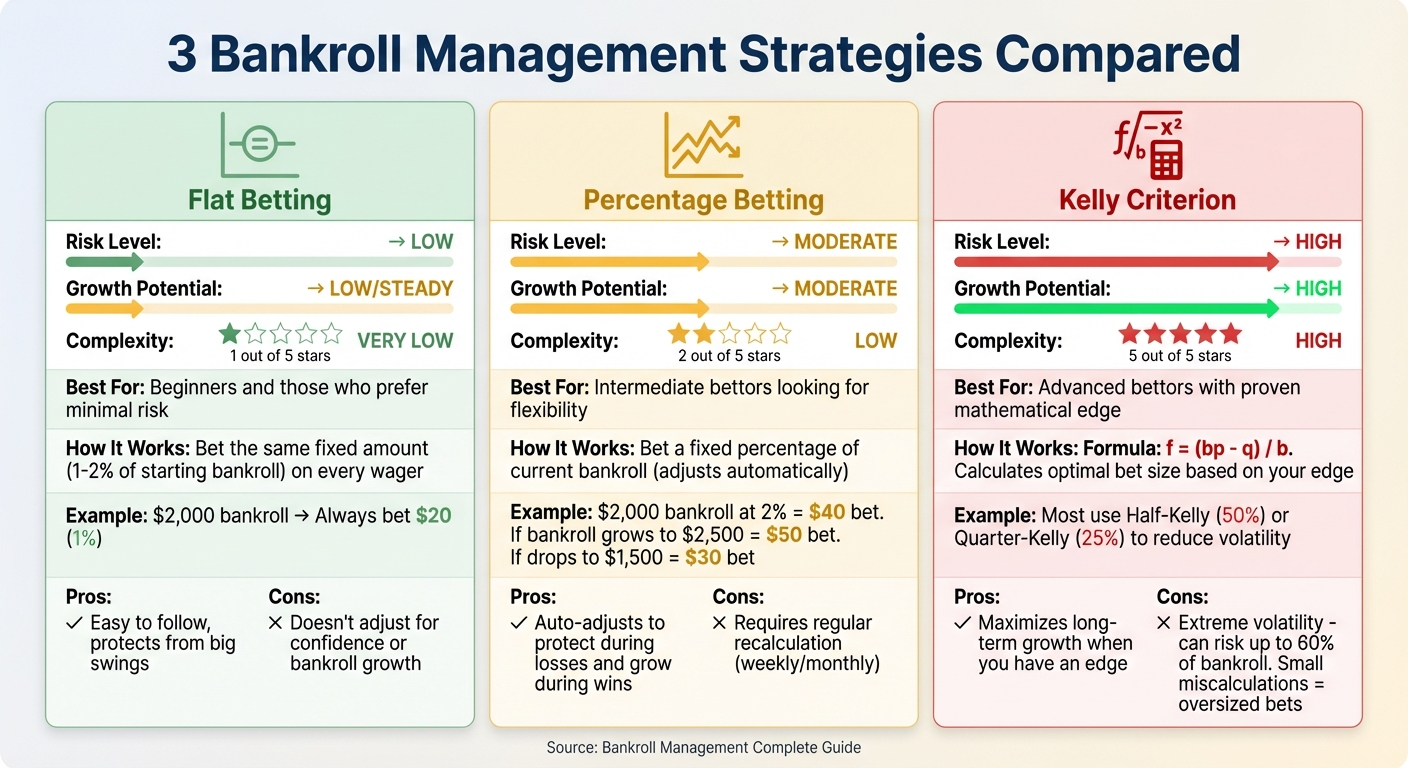
Bankroll Management Strategies Comparison: Flat Betting vs Percentage Betting vs Kelly Criterion
Once you've decided on your unit size and how to allocate your funds, the next step is to pick a strategy that fits your experience level and appetite for risk. The three primary approaches - flat betting, percentage betting, and the Kelly Criterion - each offer a unique balance between safety and the potential for growth. Here's a closer look at each to help you figure out which one aligns with your betting style.
Flat Betting Strategy
Flat betting is the most straightforward method and a great starting point. Here, you wager the same fixed amount on every bet, regardless of how confident you feel or what the odds are. Typically, you’d choose a small percentage of your starting bankroll - around 1–2% - and stick to that dollar amount until you decide to reassess.
For example, if you begin with a $2,000 bankroll and set your unit at 1%, you’d bet $20 on every game, whether it’s a heavy favorite or a long shot.
This strategy is easy to follow and helps protect your bankroll from big swings, making it ideal for beginners. However, the downside is that it doesn’t let you adjust for higher-confidence bets or take advantage of bankroll growth over time.
Percentage Betting Strategy
Percentage betting takes a more flexible approach by tying your bet size to a fixed percentage of your current bankroll, rather than sticking to a static amount. For instance, if you’re betting 2% and your bankroll grows from $2,000 to $2,500, your unit size increases from $40 to $50. Conversely, if your bankroll drops to $1,500, your unit size decreases to $30.
This method automatically adjusts to protect your bankroll during losing streaks while allowing you to ride the wave during winning streaks. To keep things accurate, you’ll need to recalculate your unit size regularly - weekly or monthly works well. Percentage betting strikes a nice middle ground, offering more growth potential than flat betting while keeping risk relatively controlled.
The Kelly Criterion Formula
The Kelly Criterion is a more advanced method that uses a mathematical formula to calculate the ideal bet size based on your perceived edge. The formula is: f = (bp - q) / b, where b is the decimal odds minus 1, p is your estimated win probability, and q is your loss probability (1 - p).
This strategy is designed to maximize long-term growth, but it comes with a lot of volatility. According to the Trademate Team, "the Kelly formula leads to extreme volatility, the probability of being badly down for an unacceptable long stretch may occur". Simulations show that betting the full Kelly amount can risk up to 60% of your bankroll, which is why many bettors use a scaled-down version, such as Half-Kelly (50%) or Quarter-Kelly (25%). These smaller fractions help reduce the wild swings while still allowing for growth.
The Kelly Criterion is best suited for experienced bettors who have a proven edge and can accurately estimate probabilities. Even a small miscalculation in your win rate can lead to bets that are too large, putting your bankroll at serious risk.
| Strategy | Risk Level | Growth Potential | Complexity | Best For |
|---|---|---|---|---|
| Flat Betting | Low | Low/Steady | Very Low | Beginners and those who prefer minimal risk |
| Percentage Betting | Moderate | Moderate | Low | Intermediate bettors looking for flexibility |
| Kelly Criterion | High | High | High | Advanced bettors with a proven mathematical edge |
Advanced Risk Management Techniques
Once you've settled on a bankroll strategy, the next step is safeguarding your funds when the inevitable ups and downs of betting occur. Even the most skilled bettors, boasting a 55% win rate, might encounter an 18.4% chance of losing five bets in a row and a 1.7% chance of losing ten consecutive bets. To navigate these challenges, you can use strategies designed to protect your bankroll from sudden, significant losses.
How to Set Stop-Loss Limits
A stop-loss limit acts like a safety net, keeping you from chasing losses or making impulsive decisions when things go south. The idea is straightforward: set a limit on how much you're willing to lose over a specific period, and stop betting once you reach that limit.
For instance, many bettors use a daily loss cap of 5% of their total bankroll and a weekly cap of 10%. If your bankroll is $2,000, you’d stop betting for the day after losing $100, or for the week after losing $200. Once you hit that threshold, take a step back and assess whether your losses are due to bad luck or flaws in your strategy.
After reaching your stop-loss limit, it’s wise to wait at least 24 hours before placing another bet. This pause gives you time to clear your head and avoid making frustration-fueled wagers. If your bankroll takes a significant hit - say, a 25% drop - experts recommend resizing your bets immediately. For example, reduce your base wager by 25% to stretch your remaining funds and leave room to recover during future winning streaks. This adjustment helps you stay in the game without depleting your bankroll during a losing streak.
Spreading Bets Across Sports and Bet Types
Diversification is another key to managing risk effectively. By spreading your bets across different sports, leagues, and bet types, you reduce the chance of a single bad streak wiping out your bankroll. If you focus only on one sport, unexpected events - like a star player’s injury - could derail your strategy. Instead, betting on multiple sports (e.g., NFL, NBA, MLB, UFC) ensures you have consistent opportunities throughout the year while minimizing the impact of unpredictable outcomes.
A common approach is to allocate 50-60% of your bankroll to major sports, 25-30% to secondary markets, and 10-15% to niche opportunities. Within these categories, mix safer bets, such as moneylines, with higher-risk options like props or underdog moneylines. To maintain long-term growth, limit individual bets to 1-3% of your total bankroll.
"By spreading your bets across different markets, you create multiple paths to profitability while protecting your bankroll from significant downswings." - BettorEdge
If you’re venturing into unfamiliar sports or bet types, start small - using just 0.5-1% of your bankroll per wager - until you gain confidence. Track your Return on Investment (ROI) separately for each sport and bet type to identify where you’re excelling. This data-driven strategy allows you to focus more resources on your strongest areas while limiting exposure to weaker ones.
How to Track and Evaluate Your Bankroll Performance
Tracking your betting activity is essential if you want to understand why you're winning or losing. It helps you make smarter, data-driven decisions. Without proper tracking, you're essentially betting blind, unable to pinpoint which strategies are boosting your bankroll and which are draining it.
Key Metrics to Track (ROI, Win Rate)
One of the most important metrics to monitor is Return on Investment (ROI). This measures your profit as a percentage of the total amount you've wagered - not just your bankroll. The formula is simple: (Net Profit / Total Amount Wagered) x 100. For example, if you've bet $5,000 in total and made $300 in profit, your ROI is 6%. Professional bettors aim for an ROI between 5% and 7%.
"The best indicator of successful betting is your return on investment - or ROI."
- Josh Inglis, Betting Analyst, Covers
Another useful metric is your Win Rate, which shows the percentage of bets you've won. While it's not as important as ROI, it still provides valuable context. For instance, a high win rate on low-odds favorites doesn't guarantee profitability. On the other hand, a win rate of around 55% on standard -110 point spreads is considered excellent. Always prioritize ROI over win rate when analyzing your performance.
Tracking your unit profit or loss is also helpful. This metric standardizes your results across different bet sizes. For example, if you're betting $50 per unit and you're up 15 units, you've made $750 in profit. It’s a simple way to measure performance relative to your risk. Additionally, keep an eye on your Closing Line Value (CLV) - compare the odds you bet on with the final odds before the game starts. Beating the closing line consistently indicates you're finding value that the market eventually acknowledges.
Break down your performance into categories like sport, league, bet type (e.g., moneylines versus parlays), or even specific teams. This helps you identify what works and what doesn’t. Also, track your deposit and withdrawal history separately. This ensures your bankroll growth comes from betting skill, not just additional deposits.
| Metric | Formula / Definition | What it Measures |
|---|---|---|
| ROI | (Net Profit / Total Amount Wagered) x 100 | Overall efficiency and profitability |
| Win Rate | (Bets Won / Total Bets Placed) x 100 | Frequency of winning, but less critical than ROI |
| Unit Profit/Loss | Total units won or lost | Standardizes performance across bet sizes |
| Closing Line Value | Your odds vs. final market odds | Shows if you're consistently beating the market |
Use these metrics to guide regular reviews and make informed strategic adjustments.
Regular Review and Strategy Adjustments
Set a consistent schedule to review your performance based on how often you bet. If you're an active bettor, daily or weekly reviews might work best. For more casual bettors, monthly assessments are usually enough. Aim to evaluate your results every 50 to 100 bets to have enough data for meaningful analysis.
When reviewing, recalculate your unit size based on your current bankroll, not your starting amount. This ensures your risk management reflects your financial position. However, only increase your base unit size permanently after your bankroll grows by 50%.
Analyze your results by sport, league, and bet type to spot trends. Identify which areas are consistently profitable and which ones lead to losses, then adjust your strategy accordingly.
"One emotional bet can wipe out weeks of winning and cut into that hopefully positive ROI. Stay robotic in your betting."
- Josh Inglis, Betting Analyst, Covers
In addition to crunching numbers, perform an emotional audit. Ask yourself if recent losses stemmed from chasing bets or impulsive decisions rather than solid research. Poor money management - not bad handicapping - is why 90% of sports bettors lose money long-term. Even with a strong 55% win rate, there's still an 18.4% chance of losing five bets in a row and a 1.7% chance of losing ten straight bets. Use your reviews to separate natural variance from flawed strategies, and only make changes when the data backs them up.
Tools for Bankroll Management
Once you've nailed down your betting strategy and started tracking your performance, integrating specialized tools can take your risk management to the next level. Managing your bankroll manually can lead to mistakes, especially when emotions run high. These tools automate calculations, helping you stay disciplined and ensuring your bet sizes adjust automatically as your bankroll changes.
Unit Calculators and Kelly Calculator
Unit calculators are a straightforward way to break down your bankroll into manageable "units", usually between 1% and 5% of your total funds. This approach keeps your bets proportional to your available capital, reducing the temptation to overbet. For instance, if you have a $2,000 bankroll and decide on 2% units, each unit equals $40. As your bankroll grows or shrinks, you simply recalculate to adjust your unit size accordingly.
On the other hand, Kelly Criterion calculators use a more mathematical approach. The formula f = (bp - q) / b determines the fraction of your bankroll to bet, where:
- f is the fraction to bet
- b is the net odds (decimal odds minus 1)
- p is your estimated win probability
- q is the probability of losing
This method identifies bets with Positive Expected Value (+EV). If no edge exists, the calculator suggests betting nothing.
Most professional bettors use a fractional Kelly approach, staking only 25% to 50% of the recommended amount to manage volatility and account for potential estimation errors. For example:
- Half Kelly offers about 75% of the growth potential of Full Kelly but reduces the maximum drawdown from around 95% to 50%.
- Quarter Kelly provides about 50% of the growth potential with only a 25% potential drawdown.
"The Kelly Criterion doesn't just say 'bet more if the edge is higher'; it also scales down your bets when value is thin, protecting your bankroll from wild swings."
- Betstamp
There are also advanced tools like bet trackers and value betting software that automatically log your wagers and calculate key metrics such as ROI and Closing Line Value. These tools are particularly effective if you have a bankroll of at least $500.
LearnSportsBetting's Kelly Calculator Features
LearnSportsBetting offers an integrated Kelly Calculator designed to simplify bankroll management. It only requires three inputs:
- Your total bankroll
- The decimal odds from your sportsbook
- Your estimated win probability
The tool determines whether a bet has a positive edge. If your estimated win probability is lower than the sportsbook's implied odds, it suggests a $0 bet, signaling you should skip that wager.
Additional features include:
- Fractional Kelly options: Choose from 1/2, 1/4, or even 1/8 stakes for a more conservative approach that minimizes volatility.
- Odds format conversion: Switch between American, Decimal, and Fractional odds, depending on your sportsbook.
- Dynamic scaling: As your bankroll changes, the tool adjusts your bet sizes accordingly, ensuring your wagers remain proportional to your current funds.
"The Kelly Criterion is a formula used in sports betting to decide how much of your bankroll to bet on a single wager... it's about managing your money properly when you do find an edge."
- Alonzo Solano, Editor-in-Chief & Sports Analyst, Boss of Betting
To get the most out of this tool, update your bankroll regularly - whether after significant wins or losses, or on a set schedule like weekly or monthly. Only apply Kelly staking to bets where you can quantify an edge using statistical models or data. Avoid relying on gut instincts. If you're placing multiple bets at once, consider reducing the Kelly percentage to avoid overexposure, as the formula assumes each bet is an independent event.
Conclusion
Disciplined bankroll management is the glue that holds all betting strategies together. It’s what helps you weather the inevitable losses and stay on track for long-term success. Without a structured approach, even a small losing streak can wipe out your account.
The main principles are simple but powerful: keep your betting money separate from your personal finances, use a unit system to standardize wagers (usually 1% to 5% of your bankroll), and track every single bet. As veteran handicapper Jerald puts it:
"I feel that it is almost as important to implement good money management tactics as it is to pick winners."
The reality is that most sports bettors - around 90% - lose money over time, and poor bankroll management is often to blame. On the flip side, sticking to a disciplined plan can make profitability achievable, even with a modest win rate of 54%. The key difference lies in mindset: are you treating betting as a marathon or a sprint? Those chasing quick wins often fall short, while patient, disciplined bettors steadily grow their wealth.
If you’re just starting out, stick with smaller unit sizes as explained in the bankroll setup and risk management sections. Following the 1% rule, for example, means you’d have to lose 100 bets in a row to go broke. This gives you a safe cushion to learn, adapt, and refine your approach. As your bankroll increases, adjust your unit size so your profits can grow over time. Resist the urge to bet big on so-called “sure things” or to chase losses after a rough day.
FAQs
How can I figure out the right bankroll size for my sports betting?
To figure out the right bankroll size, start by taking a close look at your finances. Decide how much money you can set aside specifically for betting - money that won’t interfere with your daily expenses or savings. This set amount becomes your bankroll, a fund dedicated solely to your bets.
A useful rule of thumb is to keep individual bets between 1% and 5% of your total bankroll. If you’re new to betting, it’s wise to stick to the lower end of this range. This approach helps protect your funds during losing streaks and encourages a steady, long-term strategy.
Make sure to track your bets and reassess your wager sizes as your results or financial situation change. By staying disciplined and managing your bankroll effectively, you’ll set yourself up for more consistent success over time.
What is the Kelly Criterion, and how does it work compared to other betting strategies?
The Kelly Criterion is a mathematical method that helps you figure out the ideal portion of your bankroll to bet. Its goal? To maximize long-term growth while keeping the risk of going broke as low as possible. It takes into account two key factors: your perceived edge (how likely you think it is you'll win) and the odds being offered. For instance, if you believe you have a 60% chance of winning on a bet with even odds, the Kelly Criterion would recommend betting roughly 20% of your bankroll. To further manage risk, many bettors opt for a fractional approach, like betting half or a quarter of the Kelly-recommended amount.
When compared to other strategies, such as flat betting (where you wager the same amount each time) or fixed fractional betting (where you bet a consistent percentage of your bankroll), the Kelly Criterion stands out for its adaptability. It adjusts your bet size based on how confident you are and the value you perceive in a wager. Flat betting, while straightforward and less volatile, might not yield the same potential for profit. On the other hand, the Kelly Criterion, though effective, demands precise calculations and can lead to greater swings in your bankroll if applied too aggressively. For disciplined bettors focused on long-term success, it’s often seen as one of the best tools for managing a bankroll wisely.
When should I adjust my unit size as my bankroll changes?
You should only change your unit size when your bankroll experiences a significant shift, and those adjustments should always be grounded in logic and data - not emotions. A commonly recommended range is to keep your bets between 0.5% and 5% of your total bankroll.
For instance, if your bankroll increases or decreases by 25% or more, it might be time to reassess your unit size. This method ensures you manage risk responsibly while maintaining discipline over the long haul.


